A moving deposit receipt documents money paid to reserve a mover. This guide explains when a deposit is normal and when it is a scam warning sign, the FMCSA 110 percent rule, and what to check before you pay anything.
Moving Deposit Receipt
Add custom logo
Edit line items
Choose payment method
Add/remove elements
Customize business information
Choose font
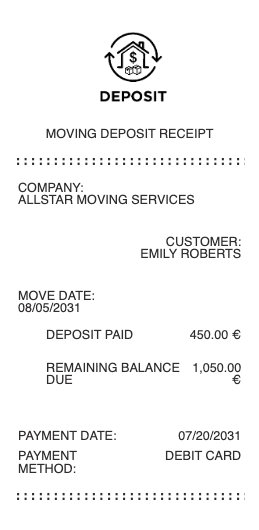
A moving deposit is where the scams start
Most people paying a moving deposit are handing a significant sum to a company they have never met, for a service weeks away, on the strength of a phone quote. Rogue movers know this — and demanding a large deposit up front is one of the classic patterns. Fraudulent operators request deposits or prepayments and then simply disappear.
That does not make every deposit suspicious. Reputable movers do sometimes take a modest booking deposit to hold a date. But the deposit is the moment your leverage is highest and your information is lowest, which makes the receipt — and what you verified before paying it — genuinely protective rather than administrative.
Check the mover is real before you pay anything
Every interstate mover must be registered with the U.S. Department of Transportation and hold an MC number. Rogue movers often cannot or will not produce them, which makes this a fast and decisive filter.
Other warning signs worth taking seriously:
No written estimate. FMCSA requires interstate movers to provide one before the move begins. Refusal is a red flag and a potential violation of federal regulation.
No verifiable address. Legitimate movers maintain offices and storage with published addresses and phone numbers; rogue operators offer only an email or a web form.
A quote given without any survey of what is actually being moved.
Pressure to pay a large deposit in cash, quickly.
Binding vs non-binding — and the 110 percent rule
The estimate type on your paperwork determines what you can be asked to pay on delivery day, and it is the single most valuable thing to understand before you sign:
A binding estimate locks in the written price unless the services actually change.
A non-binding estimate can move with the real weight of the shipment — but not without limit.
Under a non-binding estimate, the mover cannot require you to pay more than 110 percent of the estimate at the time of delivery. If the final bill exceeds that, the mover must still release your shipment on payment of 110 percent of the estimated amount, and defer billing the remainder for at least 30 days.
This is the protection that defeats the classic scam: a deliberately low quote, followed by a demand for far more once your possessions are on the truck. Know the rule before you need it, because the moment to invoke it is at the delivery door.
What the deposit receipt must show
If you pay a deposit, the document you get back should leave nothing ambiguous:
The company's legal name, address, and USDOT/MC numbers — not just a trading name.
The amount paid and the date, and that it is a deposit rather than a payment in full.
The move dates and origin and destination addresses it is holding.
Whether the deposit is refundable, and under exactly what conditions and by when.
How it is applied — credited against the final bill, or an additional charge.
The estimate it relates to, and whether that estimate is binding or non-binding.
Pay by a method that can be disputed. A card payment gives you a chargeback route; cash and wire transfers give you none, which is precisely why fraudulent movers prefer them.
Keeping the paper trail through the move
A move generates a chain of documents — the estimate, the deposit receipt, the order for service, the bill of lading, the final invoice — and each references the last. Keep them together, because a dispute is almost always about the gap between what was estimated and what was charged, and that gap can only be shown by holding both ends of the chain.
Photograph the receipt and the estimate the day you get them. If a record is missing while the payment genuinely happened, your card statement establishes the date, amount, and company, and a clear reconstructed record documents that real payment for your files — matching the underlying charge exactly. Where a dispute is heading anywhere formal, the mover's own documents and the bill of lading remain the authoritative record, so ask them to reissue before reconstructing anything.
Frequently asked questions
Everything you need to know about the product and billing.
Do moving companies require a deposit?
Some reputable movers take a modest booking deposit to hold a date, so a deposit is not automatically suspicious. But demanding a large deposit up front — especially in cash — is a classic pattern among rogue movers who take the funds and disappear.
What is the 110 percent rule?
Under a non-binding estimate, a mover cannot require you to pay more than 110 percent of the estimate at delivery. If the bill exceeds that, they must still release your shipment on payment of 110 percent and defer billing the remainder for at least 30 days.
What is the difference between a binding and non-binding estimate?
A binding estimate locks in the written price unless the services change. A non-binding estimate can vary with the actual weight of the shipment — subject to the 110 percent limit at delivery.
How do I check a moving company is legitimate?
Every interstate mover must be registered with the U.S. DOT and hold an MC number — ask for both. Also expect a written estimate before the move, a verifiable business address, and a survey of what is being moved.
What should a moving deposit receipt show?
The company's legal name, address, and USDOT/MC numbers; the amount and date; that it is a deposit; the move dates and addresses; whether it is refundable and under what conditions; how it applies to the final bill; and which estimate it relates to.
How should I pay a moving deposit?
By a method you can dispute — a card gives you a chargeback route. Cash and wire transfers give you none, which is exactly why fraudulent movers prefer them.