A multi-currency receipt records a transaction where invoicing, payment, and reporting currencies differ. This guide explains functional currency, how FX gains and losses arise, and what the receipt must capture.
Multi-Currency Receipt
Add custom logo
Edit line items
Choose payment method
Add/remove elements
Customize business information
Choose font
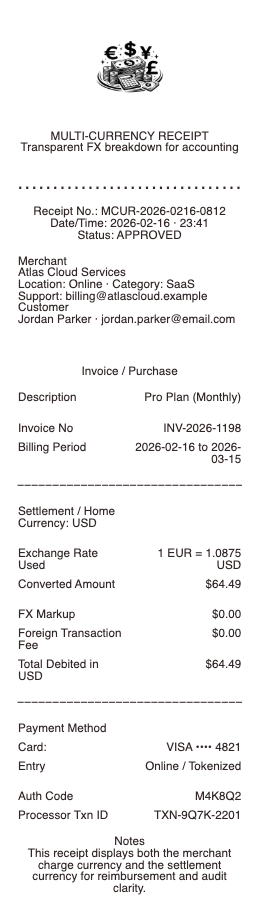
Three currencies can be involved in one sale
Businesses trading internationally routinely deal with a transaction touching several currencies at once, and confusing them is where the accounting goes wrong:
The transaction currency — what the invoice is denominated in.
The settlement currency — what the customer actually paid in.
The functional (reporting) currency — the currency the business keeps its books in.
A US company invoicing a German client in euros, paid in euros, reporting in dollars, has all three in play. The receipt needs to record enough that all three views can be reconstructed — because at some point an accountant, an auditor, or a tax authority will want to.
Where the exchange gain or loss comes from
Here is the mechanism people find counterintuitive. A foreign-currency transaction is recorded at the exchange rate on the transaction date. But payment usually arrives later, at a different rate. The difference between the two is a foreign exchange gain or loss — real money, appearing in your accounts without anything about the sale having changed.
Invoice €10,000 when the rate makes it $11,000, get paid when it is worth $10,700, and you have booked an FX loss of $300. You sold what you meant to sell, at the price you agreed, and you are $300 worse off. Nothing went wrong — that is simply how currency movement lands in the books.
This is why the receipt must record the date, the original currency amount, and the rate applied. Those three fields are the inputs to that calculation, and without them it cannot be done correctly.
What a multi-currency receipt must show
The amount in the transaction currency — the invoiced sum.
The amount in the settlement currency, if different.
The exchange rate applied, and its date.
Any conversion fee or margin, stated separately from the rate.
The tax treatment — VAT or sales tax is generally calculated in a specific currency, and cross-border rules may make the sale zero-rated or reverse-charged.
A receipt that shows only a converted total, with no rate and no original amount, cannot be reconciled to the underlying transaction — which makes it nearly useless for anything beyond proving that money changed hands.
Fees hide in the rate, not the fee line
The most expensive part of a cross-border payment is frequently not the labelled fee. Banks and payment providers commonly apply a margin to the exchange rate itself, which never appears as a charge — the transfer looks free or cheap, and the cost is embedded in a rate a few percent from the mid-market.
To see the real cost, compare the rate applied against the mid-market rate on the same day. A receipt that discloses both the rate and the margin lets you do that; one that quotes only an amount does not. This is the entire reason the better providers publish the margin explicitly — and the reason to ask for a receipt that shows it.
Keeping multi-currency records straight
Keep the original-currency document, not merely your converted figure. The invoice or receipt in the transaction currency is the primary record; your conversion is a derived number, and derived numbers need a source.
Also record which rate source you used and be consistent about it — a daily central-bank reference rate, a payment provider's rate, or the rate actually applied. Mixing sources across a year is what produces accounts that will not reconcile.
If a record is lost while the payment genuinely occurred, your bank statement establishes the settled amount, date, and counterparty, and a clear reconstructed record documents that real payment for your files — matching the settlement exactly. It cannot recreate the original-currency invoice or the rate applied, which is why the source document is the one to protect.
Frequently asked questions
Everything you need to know about the product and billing.
What is a functional currency?
The currency a business keeps its books and reports in. It can differ from both the currency an invoice is denominated in and the currency the customer actually pays in — and all three can appear in a single transaction.
Where does a foreign exchange gain or loss come from?
From the gap between the rate on the transaction date and the rate when payment settles. Invoice €10,000 worth $11,000 and get paid when it is worth $10,700, and you book a $300 FX loss — without anything about the sale having changed.
What must a multi-currency receipt show?
The amount in the transaction currency, the amount in the settlement currency if different, the exchange rate applied and its date, any conversion fee or margin stated separately, and the tax treatment.
Why is a converted total not enough?
Because without the original amount, the rate, and the date, the receipt cannot be reconciled to the underlying transaction — and the FX gain or loss cannot be calculated correctly.
Where do currency conversion fees actually hide?
Usually in the exchange rate itself rather than in a labelled fee. A transfer can look free while carrying a margin of several percent over the mid-market rate — which is why a receipt disclosing the rate and margin matters.
Which document should I keep for a foreign transaction?
The original-currency invoice or receipt. Your converted figure is a derived number, and a derived number needs its source — keep the primary document and note the rate source you used.