A museum ticket receipt may cover general admission, a timed exhibition slot, or a membership. This guide explains donation add-ons and Gift Aid, why timed entry is not a queue pass, and what the receipt should show.
Museum Ticket Receipt
Add custom logo
Edit line items
Choose payment method
Add/remove elements
Customize business information
Choose font
The donation line you agreed to without noticing
Museum checkouts routinely add a voluntary donation to the ticket price — often preselected, often described as making the ticket "support" the institution. It is genuinely voluntary, and it is genuinely easy to pay without having decided to.
In the UK the mechanism goes further: many museums offer admission at a slightly higher price so that the payment can be treated as a donation eligible for Gift Aid, letting the charity reclaim tax on it. That is a legitimate and valuable scheme for the museum — but it means the amount on your receipt may exceed the headline admission price, by design and with your agreement.
None of this is a scam. It is simply worth knowing that the number you pay is often a choice you made quickly, and the receipt is where you can see what you actually agreed to.
Timed entry is not a queue pass
Most major museums and blockbuster exhibitions now use timed entry, and it is widely misunderstood. A timed slot guarantees admission within a window — typically 15 or 30 minutes. It does not guarantee immediate entry, it does not skip the security queue, and arriving outside your window may mean not being admitted at all.
Two practical consequences:
Arriving late can void the ticket. Some institutions will accommodate you at a later slot if there is capacity; some will not.
The slot is on the receipt. That is what you show, and it is what a dispute at the door turns on.
Membership changes the arithmetic
Museum membership typically pays for itself in two or three visits, and it usually adds free or priority access to paid exhibitions — which is where the real cost of a museum year accumulates.
What matters for your records:
Membership is generally annual and auto-renewing, so the renewal receipt is where a price rise appears.
Membership fees are frequently partly a donation, and the portion above the value of benefits received may be treated as charitable — the receipt or annual statement is what evidences it.
Member exhibition tickets are still usually ticketed — free, but requiring a booked slot, which many members discover too late for a popular show.
What the receipt should show
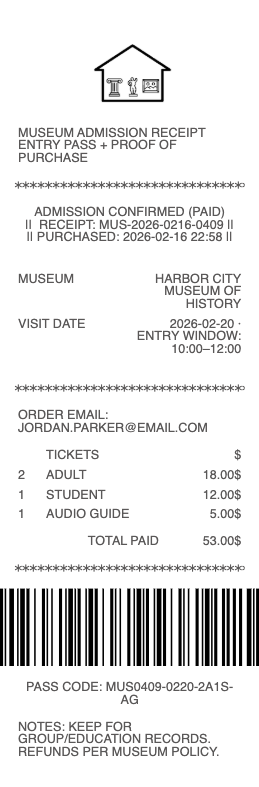
The institution, the date, and — for timed entry — the slot.
What was bought: general admission, a specific exhibition, or both.
The admission price and any donation, itemised separately. A single blended figure obscures what you actually gave.
Concessions applied — student, senior, child.
Membership number, where the booking used one.
Any Gift Aid or charitable declaration made.
Keeping the record
Keep the receipt until the visit, and keep it afterwards if a donation was made and you may claim it, or if the visit is a business expense — a museum visit is deductible only in narrow circumstances, and the itemisation is what any claim would rest on.
Museums retain booking history and can usually resend a confirmation, which is the first place to look for a lost ticket. If a record is missing while the purchase genuinely happened, your card statement establishes the date, amount, and institution, and a clear reconstructed record documents that real payment for your files, matching the charge exactly — but it does not evidence a Gift Aid declaration or a charitable donation, which only the museum's own receipt can do.
Frequently asked questions
Everything you need to know about the product and billing.
Why is the museum ticket more than the advertised price?
Often because a voluntary donation was added at checkout — sometimes preselected. In the UK, museums also offer a slightly higher 'donation' admission price so the payment qualifies for Gift Aid, letting them reclaim tax. It is legitimate, but it is a choice you made.
What does a timed entry ticket actually guarantee?
Admission within a window, usually 15 or 30 minutes. It does not mean immediate entry, does not skip security, and arriving outside your slot can mean not being admitted at all.
Is museum membership worth it?
It typically pays for itself in two or three visits and usually adds free or priority access to paid exhibitions — which is where a museum year's cost really accumulates. Note that member exhibition tickets are usually still ticketed and need booking.
Is a museum donation tax deductible?
The portion of a payment above the value of benefits received may be treated as charitable, and the receipt or annual statement is what evidences it. This is why the donation should be itemised separately rather than blended into the admission price.
What should a museum receipt show?
The institution, date and timed slot; what was bought (general admission, a specific exhibition, or both); the admission price and any donation itemised separately; concessions applied; the membership number if used; and any Gift Aid declaration.
What happens if I arrive late for a timed slot?
It depends on the institution. Some will fit you into a later slot if capacity allows; others will not admit you at all. The slot is printed on your receipt, and that is what any discussion at the door turns on.