A receipt with no tax line can be perfectly correct. This guide explains when no tax legitimately applies — no-sales-tax states, untaxed services, private sales, exempt buyers — and why the receipt should still say so.
No Tax Receipt
Add custom logo
Edit line items
Choose payment method
Add/remove elements
Customize business information
Choose font
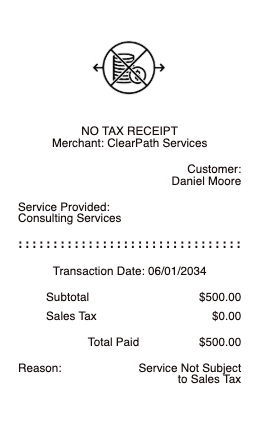
No tax on the receipt is not automatically an error
People are trained to expect a tax line, so a receipt without one looks wrong. Frequently it is exactly right. The legitimate reasons a receipt carries no tax:
The state has no sales tax. Five US states levy none: New Hampshire, Oregon, Montana, Delaware, and Alaska (which allows local option taxes but no state-level one).
The item is not taxable there. Many states exempt groceries, prescription drugs, or clothing below a threshold.
The service is not taxable. Plenty of states tax goods broadly but many services narrowly or not at all.
The buyer is exempt — a resale certificate, a qualifying nonprofit, a government purchaser.
The seller is below registration thresholds or the sale is a private, casual one between individuals.
The receipt should still account for the absence
A correct no-tax receipt is one where the absence is explicable, not silent. Good practice — and in exempt-buyer cases, requirement — is that the document shows why: the exemption certificate number, the "tax: $0.00" line with the item's exempt category, or simply a seller and location from which the treatment is obvious.
The distinction that matters: no tax charged correctly versus tax owed but not collected. The second does not make the tax disappear — it usually shifts the obligation to the buyer, which is the next section — and a receipt that is silent about tax leaves open which of the two happened.
Use tax: the part consumers never learned
Most US states with a sales tax also levy a use tax — owed by the buyer when taxable goods were bought without tax being collected and then used in the taxing state. The classic cases: buying in a no-tax state and bringing goods home, or an out-of-state seller who did not collect.
Enforcement against individuals is famously light, but for businesses it is real: use tax is a standard line item in state audits, and untaxed purchase receipts are exactly what auditors sample. A business buying equipment tax-free from Oregon and using it in a sales-tax state owes its state the use tax — and the no-tax receipt, far from hiding the liability, is the document that quantifies it.
Private sales and person-to-person receipts
A large share of genuinely untaxed transactions are casual sales between individuals — the used sofa, the second-hand bicycle, the private car sale (though vehicles are the big exception: most states collect tax at registration regardless of who sold it).
For these, the receipt matters for non-tax reasons: proof of ownership, the agreed price, sold-as-seen condition, and the date. A simple written receipt with both parties' names, the item, the amount, the date, and signatures is entirely valid — and for anything with a serial number, recording it protects the buyer against the item later proving stolen.
Records on both sides of the border between taxed and not
For consumers, keep no-tax receipts exactly as you would any other — for warranties, returns, and resale. For businesses, keep them more carefully: they are the use-tax exposure file, and the audit defence is being able to show which untaxed purchases were legitimately exempt and which had use tax self-assessed.
If a record is missing while the purchase genuinely happened, your card statement establishes the date, amount, and seller, and a clear reconstructed record documents that real payment for your files, matching the charge exactly — including its absence of tax, which should never be silently converted into a tax line that was not on the original.
Frequently asked questions
Everything you need to know about the product and billing.
Which US states have no sales tax?
New Hampshire, Oregon, Montana, Delaware, and Alaska — with Alaska allowing local-option taxes despite having no state-level sales tax. A no-tax receipt from these states is simply correct.
Why does my receipt show no tax on groceries?
Many states exempt or reduce tax on specific categories — commonly groceries, prescription drugs, and sometimes clothing under a threshold. The item's category, not an error, explains the missing line.
What is use tax?
The buyer-side counterpart of sales tax: owed when taxable goods are bought without tax collected (out of state, or from a non-collecting seller) and used in a taxing state. For businesses it is a standard audit item, and untaxed purchase receipts are what auditors sample.
Is a receipt without tax valid for a private sale?
Yes. A written receipt with both parties' names, the item, the price, the date, and signatures is entirely valid — and casual sales between individuals are generally not taxed, with vehicles the notable exception (tax is usually collected at registration).
What should a no-tax receipt show?
Enough to explain the absence: an exemption certificate number for exempt buyers, a tax line at $0.00 with the category, or a seller and location from which the treatment is obvious. Silence about tax leaves open whether the treatment was correct.
Do businesses need to keep no-tax receipts?
More carefully than taxed ones. They are the use-tax exposure file — the audit defence is showing which untaxed purchases were legitimately exempt and which had use tax self-assessed.