An office rent receipt often covers base rent plus CAM, taxes, and insurance. This guide explains triple net versus gross leases, the annual CAM reconciliation, and Florida's 2025 repeal of sales tax on commercial rent.
Office Rent Receipt
Add custom logo
Edit line items
Choose payment method
Add/remove elements
Customize business information
Choose font
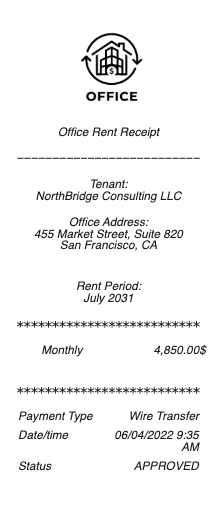
Commercial rent is rarely one number
Residential rent is simple: one figure, one month. Commercial rent is a structure, and the receipt reflects it. What a business actually pays is usually base rent plus a share of the building's running costs — and understanding which lease you signed determines what lands on your invoice.
Gross lease — one all-inclusive rent. The landlord absorbs taxes, insurance, and maintenance.
Triple net (NNN) — base rent plus three cost categories passed through to the tenant: property taxes, building insurance, and common area maintenance (CAM).
Modified gross — a negotiated middle, where some costs pass through and others do not.
The arithmetic is unforgiving: base rent of $20 per square foot with $8 of NNN expenses is not a $20 lease, it is a $28 one. A tenant comparing two quoted rents without asking which structure they use is not comparing anything.
The CAM reconciliation — and the bill you didn't budget for
CAM charges cannot be known in advance, because nobody knows next year's snow removal or insurance premium. So NNN leases run on an estimate-and-reconcile model:
The landlord budgets the building's operating expenses for the year.
Each tenant's estimated pro rata share is collected in equal monthly instalments alongside base rent.
After year-end — typically within 90 to 180 days, per the lease — the landlord reconciles the estimates against what was actually spent.
Then comes the part tenants feel. If actual costs exceeded the estimates, you owe a true-up payment. If they came in under, you get a credit or refund. That true-up arrives months after the year it relates to, and it is the single most common source of unbudgeted commercial rent expense.
Your monthly receipts are what you audit it against. A tenant who has kept every receipt and the reconciliation statement can check the maths; one who has not simply pays.
Florida's commercial rent tax is gone
A significant change worth knowing if you lease in Florida. The state was the only one in the country to levy a sales tax on commercial rent — and that tax has been repealed as of 1 October 2025, along with the local discretionary surtaxes on commercial rent.
No state sales tax or surtax applies to rent for occupancy periods beginning on or after that date. If your Florida lease invoices still carry a sales tax line on rent in 2026, that is worth querying — the charge should no longer be there.
What an office rent receipt should show
The premises — building and suite, not just an address.
The period covered, which for commercial is often quarterly rather than monthly.
Base rent, stated separately.
Each pass-through, separately named — CAM, property taxes, insurance — not merged into a single 'additional rent' line.
Whether the charge is an estimate or a reconciliation true-up.
Any tax, where the jurisdiction levies one.
The separation matters because these lines are negotiated differently, capped differently, and audited differently. A receipt that merges them is a receipt you cannot check.
Keeping commercial rent records
Commercial rent is usually a business's largest fixed cost and is fully deductible as a business expense — which makes these receipts both a tax record and a control document. Keep them alongside the lease itself, the annual CAM reconciliation statements, and any audit correspondence.
Most leases grant the tenant a right to audit the landlord's operating expenses within a defined window. Exercising it is impossible without your own records of what was estimated and what was paid — the reconciliation statement alone tells you what the landlord thinks, not whether they are right.
If a receipt is missing while the payment genuinely occurred, the landlord or managing agent can reissue from their ledger, and your bank record establishes date, amount, and payee. A clear reconstructed record from those details documents the real payment for your files, matching it exactly — but for a CAM dispute, the landlord's statements and your bank records are what actually settle it.
Frequently asked questions
Everything you need to know about the product and billing.
What is a triple net (NNN) lease?
A lease where the tenant pays base rent plus three property-level costs: real estate taxes, building insurance, and common area maintenance. A gross lease instead bundles everything into one all-inclusive rent paid to the landlord.
What are CAM charges?
Common area maintenance — the tenant's pro rata share of running the building. They are estimated at the start of the year, collected monthly, and reconciled against actual spend after year-end.
What is a CAM true-up?
The reconciliation payment owed when actual operating costs exceed the estimates you were billed. It typically arrives 90 to 180 days after year-end and is the most common source of unbudgeted commercial rent expense. If estimates exceeded actuals, you receive a credit instead.
Does Florida still tax commercial rent?
No. Florida was the only state to levy a sales tax on commercial rent, and it was repealed effective 1 October 2025, along with local discretionary surtaxes. Rent for occupancy periods beginning on or after that date carries no state sales tax or surtax.
What should an office rent receipt show?
The premises, the period covered, base rent stated separately, each pass-through (CAM, taxes, insurance) named individually rather than merged, whether the charge is an estimate or a true-up, and any applicable tax.
Can I audit my landlord's CAM charges?
Most commercial leases grant a right to audit operating expenses within a defined window. Exercising it requires your own records of what was estimated and paid — the landlord's reconciliation statement alone only tells you what they claim.