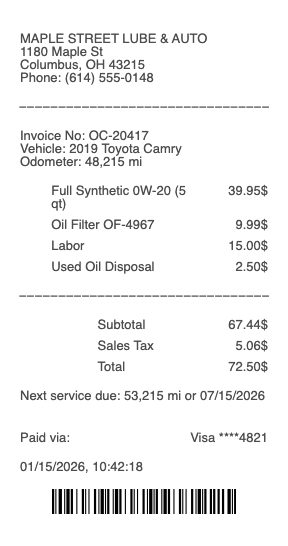
An oil change receipt is the small record that proves a car was maintained on time. Shops hand it over after every service, and drivers keep it for warranty files, fleet logs and resale. This example shows what a complete one includes, from the oil grade and quart count to the mileage and the next service due, so you can issue one for your shop or keep your own records in order.
Oil Change Receipt
Add custom logo
Edit line items
Choose payment method
Add/remove elements
Customize business information
Choose font
What's on an Oil Change Receipt
Shop name, address, phone and invoice number
Service date and the odometer reading at the time of service
Vehicle details — year, make, model, and often the VIN or license plate
The oil — brand, viscosity grade such as 5W-30, conventional, blend or full synthetic, and the number of quarts
The filter — brand and part number
Labor and shop fees, such as disposal of the used oil
Tax, total and payment method
Next service due — the mileage or date for the following change
The oil line is the one people check later. A receipt that only says "oil change" cannot show that the engine got the grade the owner's manual calls for.
Why Oil Change Receipts Matter for a Car Warranty
Under a new-car warranty, you do not have to use the dealer for routine service. The Federal Trade Commission says it is illegal for a dealer to deny warranty coverage because routine maintenance or repairs were done by someone else. The catch is proof. The FTC advises keeping records of oil changes, tire rotations, belt replacements, brake pads and inspections, because the warranty company could ask for your maintenance records.
That is why the mileage and the oil grade matter. If an engine claim comes up at 60,000 miles, a run of dated receipts with odometer readings, each showing the correct oil, answers the question before it becomes a dispute.
Oil Change Receipts for Shops and Mobile Mechanics
For an independent shop or a mobile mechanic, the receipt is also the job record. Number every receipt in order so a customer can ask for a copy by number later. Write the oil and filter exactly as installed, not as a generic line, and note the quantity in quarts. If the customer brought their own oil, say so on the receipt, so it is clear what the shop supplied and what it only installed.
A short "next service due" line at the bottom saves a phone call and brings the customer back. Many shops print the same number on the windshield sticker.
Keeping a Maintenance Record That Holds Up
Paper oil change receipts are often printed on thermal paper, and they fade in a glove box. Photograph each one the day you get it, or keep the shop's emailed copy, and store them in one folder by date. For a vehicle you plan to sell, a complete set of oil change receipts with steady mileage gaps is one of the simplest ways to show a buyer that the car was looked after.
If you change the oil yourself, keep the store receipt for the oil and the filter and write the date and mileage on it. It is not a shop invoice, but it shows what was bought and when.
Create an Oil Change Receipt
Our generator builds an oil change receipt with every line a shop normally prints: shop details, vehicle and mileage, oil grade and quarts, filter, labor, fees, tax, total and the next service due. Download it as a PDF, PNG or JPG and print it or email it to the customer.
Use it responsibly: issue receipts only for services that were actually performed, with the real amounts and mileage. A made-up maintenance record submitted for a warranty claim, a sale or a reimbursement is fraud.
Frequently asked questions
Everything you need to know about the product and billing.
What should an oil change receipt include?
The shop's details, the date, the odometer reading, the vehicle, the oil brand, grade and quarts, the filter, labor and fees, tax, the total and the next service due.
Do I need to keep my oil change receipts?
It is a good idea. The FTC advises keeping maintenance records such as oil changes, because the warranty company could ask for them if you make a claim.
Can I get my oil changed somewhere other than the dealer without losing my warranty?
Yes. The FTC says a dealer cannot deny warranty coverage just because routine maintenance was done by someone else. Keep the receipts to show the work was done on time.
What if I change my own oil?
Keep the store receipt for the oil and the filter and write the date and the mileage on it. Store it with your other maintenance records.
Why does the oil grade on the receipt matter?
The owner's manual names the oil grade the engine needs. A receipt that lists the exact grade shows the right oil was used.
How do I get a copy of a lost oil change receipt?
Ask the shop that did the work. Give the date, the vehicle and the phone number or plate used at the visit. Many shops can look up the service record and send a copy.