An online course receipt comes from a platform or the creator directly — and the difference decides refunds, taxes, and support. This guide explains marketplace billing, what lifetime access really means, and certificate paywalls.
Online Course Receipt
Add custom logo
Edit line items
Choose payment method
Add/remove elements
Customize business information
Choose font
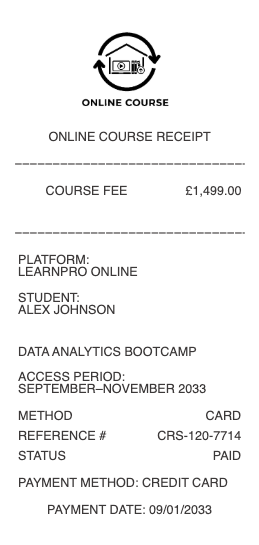
Who actually sold you the course?
The first question about any online course receipt is the merchant. Two models dominate:
Marketplace platforms — the platform is the merchant: it bills you, issues the receipt, applies your local digital-services tax, and owns the refund policy. The instructor is paid by the platform.
Creator-hosted courses — the instructor's own site (via a commerce layer) is the merchant, and policy is whatever they published.
Everything downstream follows: refund route, receipt reissue, tax documentation, even whether a discount was legitimate. The receipt names the merchant of record — read it, because "the course I bought on X" and "the course billed by X" are not always the same sentence.
Subscriptions blur the merchant question further: all-you-can-learn platforms sell access to a catalogue, not a course, so the receipt names a billing period rather than a title. For expense claims that need a named course, the certificate of completion — not the subscription receipt — is the document that says what was actually studied.
What 'lifetime access' actually promises
The flagship claim of online courses — lifetime access — has a quiet definition problem: whose lifetime? In practice it means the lifetime of the course on the platform: platforms close, creators retire courses, hosting agreements end. The purchase survives as long as the product does.
The receipt cannot fix that, but it defines your position when it happens: platforms that retire content typically owe notice, migration, or refunds per their terms, and your purchase record is the claim. The practical hedge is unglamorous — download what the licence allows (workbooks, resources) while access is live, because a receipt for a vanished course is an argument, not a course.
Refund windows and the consumption clause
Online course refunds run on two dials: a time window (commonly 14–30 days) and a consumption limit — refund eligibility often ends once a stated share of content is accessed, whatever the calendar says. The pairing exists because a course can be binge-consumed in a weekend and then refunded, which platforms reasonably refuse to fund.
Check both dials before starting a course you might return. And keep the refund confirmation if you take one — accounting between platforms and creators means refunds occasionally resurrect as access-revoked-but-charge-remains errors, which the confirmation resolves in one email.
Cohort-based courses move the goalposts once more: with a fixed cohort start date, refund terms commonly key to the start of the cohort rather than the date of purchase — buy early and the window may still be open months later; buy late and it can close before the course begins. The receipt's purchase date and the cohort date together decide which clock you are on.
Certificates, and the paywall behind completion
Online course certificates sit in every configuration: included, paid add-on, or — on audit-model platforms — the course is free to take while the certificate is what you actually buy. The receipt shows which product you purchased, and it matters when a certificate is the point:
Employer reimbursement for a course frequently requires the completion certificate plus the receipt.
Professional development claims want the certificate's issuer and course title to match the receipt.
Audit-track learners hold no receipt at all — and discover the certificate costs money exactly when they need it.
Keeping online course records
Keep the receipt, the completion certificate, and — for anything career-relevant — a syllabus snapshot: courses get revised, and the version you completed is part of what the certificate attests. Platform purchase histories hold receipts and can reissue them, which is the recovery route while the account exists.
If a record is missing while the purchase genuinely happened, your card statement establishes the date, amount, and merchant — noting that for marketplace purchases the merchant shown is the platform — and a clear reconstructed record documents that real payment for your files, matching the charge exactly. The certificate and the course access live in the platform account, which is why the account email you enrolled under is worth keeping alive.
Frequently asked questions
Everything you need to know about the product and billing.
Who issues the receipt for an online course?
The merchant of record — the marketplace platform for marketplace purchases (it also applies your local tax and owns the refund policy), or the creator's own site for self-hosted courses. The receipt names which, and everything downstream follows from it.
What does lifetime access really mean?
The lifetime of the course on the platform — not yours. Platforms close and creators retire courses; terms then govern notice or refunds, with your receipt as the claim. Download what the licence allows while access is live.
Why was my course refund refused inside the time window?
Probably the consumption clause — eligibility commonly ends once a stated share of content has been accessed, regardless of the calendar. Both dials, time and consumption, are in the refund terms. Cohort courses add a second clock — refund windows often key to the cohort start date rather than purchase, so early buyers keep the exit open longer.
Are certificates included with online courses?
Every configuration exists: included, paid add-on, or free-to-audit courses where the certificate is the actual product. The receipt shows what you bought — which matters when reimbursement requires certificate plus receipt.
Can I expense an online course?
Work-relevant courses are commonly reimbursable or deductible, evidenced by the receipt and the completion certificate with matching course details. Check the policy before enrolling, not after. On subscription platforms, pair the billing receipt with the completion certificate — the receipt names a period, and only the certificate names the course.
Where do I find an old course receipt?
In the purchase history of the account that bought it — platform or creator site. That account email is also where the certificate and access live, which is why it is worth keeping active.