A painter's receipt sits inside a contractor paper trail: estimate, deposit, progress payments, and lien waivers. This guide explains payment schedules, why lien waivers matter on bigger jobs, and what the final invoice should show.
Painter Receipt
Add custom logo
Edit line items
Choose payment method
Add/remove elements
Customize business information
Choose font
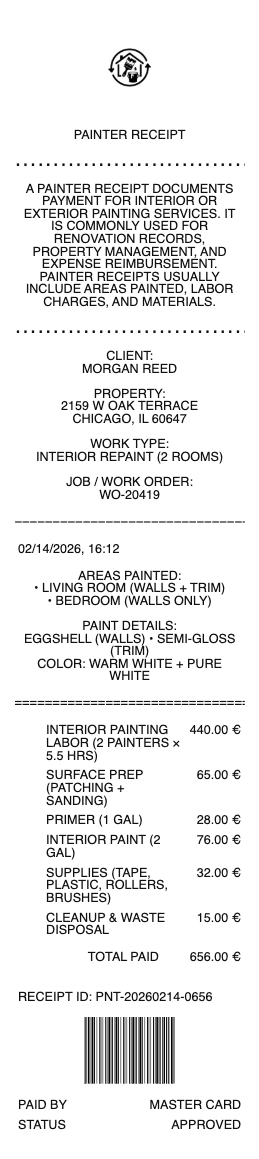
The painting job's paper trail starts before the paint
A professional painting job produces documents in a fixed order, and each protects a different moment:
The estimate or quote — scope (rooms, surfaces, prep, coats), materials, and price. Whether it is a fixed quote or an estimate that can move matters enormously and should be explicit.
The deposit receipt — commonly a modest share of the job to secure the slot and cover materials.
Progress payments on longer jobs — tied to stages, not dates.
The final invoice and receipt — settled after the walkthrough, not before.
The sequencing rule that protects homeowners: the final payment follows the final inspection. A painter paid in full before the walkthrough has no financial reason to return for the missed patch behind the door.
Lien waivers: the document homeowners learn about too late
In much of the US, contractors and their suppliers can file a mechanic's lien against a property over unpaid work — including, painfully, when the homeowner paid the general contractor but the contractor failed to pay a subcontractor or the paint supplier. The protection is the lien waiver: a document signed by the contractor (and, on larger jobs, subs and suppliers) waiving lien rights for work covered by a payment.
The practice scales with the job: a one-day interior repaint rarely warrants the ceremony; a whole-house job with a crew and supplied materials does. The mechanics: exchange a conditional waiver with each payment (effective when the payment clears) and a final unconditional waiver with the last one. Payment receipt plus matching waiver is the pairing that keeps a paid-for job from becoming a lien on the title.
What the final invoice should itemise
Labour and materials separately — and whether materials were contractor-supplied or homeowner-purchased.
The scope as performed — surfaces, coats, prep work (sanding, priming, repairs), matching the quote or documenting agreed changes.
The paint itself — brand, line, colour codes, and finishes. This is the receipt detail with the longest afterlife: touch-ups years later depend on the exact colour formula, and the invoice is where it survives.
Warranty terms — reputable painters warrant their workmanship for a stated period; the invoice is where it is written.
Deposit and progress payments credited, arriving at the balance actually due.
Estimates, changes, and the price that moved
Painting prices move for legitimate reasons — wall repairs discovered after furniture moves, an extra coat over a stubborn colour, scope added mid-job. The discipline is the same as any contract work: changes agreed in writing before the work, priced, and referenced on the final invoice.
A final bill that exceeds the quote without documented changes is contestable, and the quote plus your payment receipts is the evidence. Symmetrically, a painter holding signed change approvals collects the difference without a fight. Text messages count — informal, but written and dated beats remembered.
Keeping the job file
Keep the quote, contract, payment receipts, waivers, and final invoice together for the warranty period at minimum — and keep the paint specification permanently, because colour-matching a five-year-old wall without the codes is guesswork. Photographs of finished work dated alongside the final payment close the file.
Contractors keep job records and can reissue invoices, which is the recovery route. If a record is missing while the payment genuinely happened, your bank or card statement establishes the amounts and dates, and a clear reconstructed record documents those real payments for your files, matching them exactly — while the lien waivers, which only the contractor's side can sign, are originals to chase rather than reconstruct.
Frequently asked questions
Everything you need to know about the product and billing.
How should payments be scheduled on a painting job?
A modest deposit, progress payments tied to stages on longer jobs, and the final payment only after the walkthrough. A painter paid in full before inspection has no financial reason to return for the missed patch.
What is a lien waiver and do I need one?
A signed waiver of mechanic's lien rights covering paid work — protection against a lien filed by an unpaid sub or supplier even when you paid the contractor. Ceremony scales with the job: skip it for a one-day repaint, insist on it for a whole-house job.
What should the final painting invoice show?
Labour and materials separately, the scope as performed against the quote, the paint brand, colours and finishes (the detail you will need for touch-ups years later), warranty terms, and all prior payments credited.
Can the final bill exceed the quote?
Only through documented changes agreed before the work — discovered repairs, extra coats, added scope. Without written changes, the quote plus your receipts is the evidence against an inflated final bill.
What is the difference between a quote and an estimate?
A fixed quote holds unless scope changes; an estimate can move with actual time and materials. Which one you have should be explicit on the document — it decides who bears the risk of surprises.
How long should I keep the painting paperwork?
The full file for the workmanship warranty period; the paint specification permanently. Colour-matching an old wall without the codes is guesswork.