A per diem meal allowance pays a fixed daily rate instead of reimbursing actual costs. This guide explains the FY2026 CONUS rate, when receipts are required, and how per diem differs from actual-expense reimbursement.
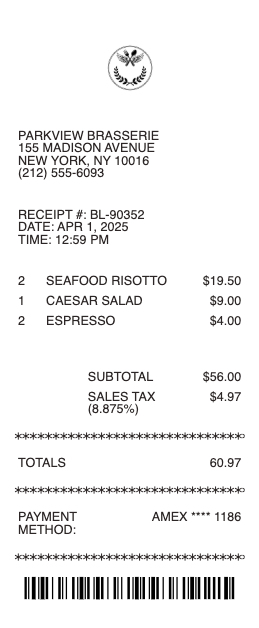
Per Diem Meal Receipt
Add custom logo
Edit line items
Choose payment method
Add/remove elements
Customize business information
Choose font
Per diem replaces receipts with a rate
Per diem is a fundamentally different reimbursement model from the one most people assume. Under actual expense, you spend, you keep the receipt, you get repaid what you spent. Under per diem, you receive a fixed daily allowance regardless of what you actually spent — and individual meal receipts are generally not required at all.
The consequence is that per diem carries real upside and real risk for the traveller. Spend less than the rate and you keep the difference. Spend more, and you absorb it. The organisation's motive is administrative: it is vastly cheaper to pay a rate than to process a thousand small receipts.
The FY2026 numbers
For fiscal year 2026, the standard CONUS per diem is $178 per day, split into $110 for lodging and $68 for meals and incidental expenses (M&IE).
That $68 is not a single sum but an allocation, and knowing the split is what lets you reason about partial days and provided meals:
Breakfast — $16
Lunch — $19
Dinner — $28
Incidentals — $5
The incidentals allowance has held at $5 regardless of location, and dinner takes roughly 41% of M&IE at every rate tier. High-cost cities use higher tiers, where the components scale proportionally.
Provided meals and partial days
Two adjustments do most of the work in a real claim:
Provided meals are deducted. If a meal is furnished to you — a conference lunch, a hotel rate including breakfast, a meal on a flight — the corresponding component is normally removed from your M&IE for that day. Eating the free conference lunch and claiming the $19 as well is an over-claim.
Travel days are reduced. The first and last days of a trip are commonly paid at 75% of the M&IE rate, because you are not away for all three meals.
These two rules explain most of the discrepancies between what a traveller expects and what an expense system pays.
If receipts are not required, why keep anything?
Because the per diem system still rests on evidence of the trip, even where it does not require evidence of each meal. What you generally do need:
Proof of travel — dates, destination, and business purpose.
Lodging receipts, which are usually required even under per diem, because lodging is frequently reimbursed at actual cost up to the cap rather than as a flat rate.
Records of provided meals, since those reduce the claim.
And one practical warning: confirm which system your employer uses before you travel. Travellers who assume per diem, discard every meal receipt, and then discover they are on actual-expense reimbursement cannot reconstruct a week of meals — and that mistake is expensive and entirely avoidable.
Per diem and tax
Where an employer reimburses at or below the federal per diem rate under an accountable plan, the payment is generally not treated as taxable income to the employee, and does not appear as wages. Pay above the federal rate and the excess is typically treated as taxable compensation — which is why organisations rarely exceed the published rates without a reason.
The self-employed can use the M&IE per diem rates for meals while travelling rather than tracking actual costs, though lodging must generally be actual. Keep the trip records regardless: the rate substitutes for the meal receipts, not for the evidence that the travel happened at all. Where a record is missing for a trip that genuinely occurred, a clear reconstructed record built from your itinerary and card statement documents the real travel for your files — matching the actual trip exactly, never inventing days or destinations.
Frequently asked questions
Everything you need to know about the product and billing.
What is the per diem rate for 2026?
The FY2026 standard CONUS rate is $178 per day — $110 for lodging and $68 for meals and incidental expenses. The $68 M&IE splits into breakfast $16, lunch $19, dinner $28, and $5 incidentals.
Do I need receipts if I am on per diem?
Generally not for individual meals — the fixed rate is the reimbursement regardless of what you spent. You do typically need proof of travel and lodging receipts, and records of any meals that were provided to you.
What happens if a meal is provided?
The corresponding component is normally deducted from your M&IE for that day. Eating a free conference lunch and also claiming the $19 lunch allowance is an over-claim in most systems.
Are travel days paid at the full rate?
Usually not. The first and last days of a trip are commonly reimbursed at 75% of the M&IE rate, because you are not away for all three meals.
Is per diem taxable income?
Where an employer reimburses at or below the federal rate under an accountable plan, it is generally not taxable and does not appear as wages. Amounts paid above the federal rate are typically treated as taxable compensation.
What is the difference between per diem and actual expense?
Per diem pays a fixed daily rate regardless of spending, and individual meal receipts are generally not needed. Actual expense reimburses what you really spent, up to a cap — and there, every receipt is the claim. Confirm which applies before you travel.