A permit fee receipt proves a permit was paid for — not that work was approved. This guide explains permits versus inspections, why unpermitted work surfaces at home sale, and which documents to keep with the property.
Permit Fee Receipt
Add custom logo
Edit line items
Choose payment method
Add/remove elements
Customize business information
Choose font
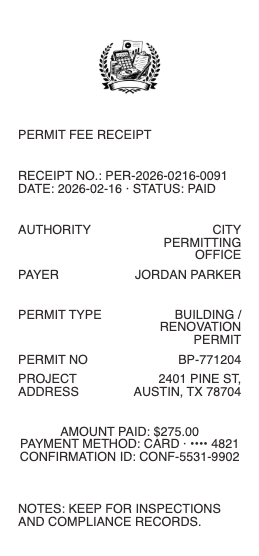
Paying for the permit is step one of three
A building permit has a lifecycle, and the fee receipt only evidences its beginning:
The permit is issued — the fee is paid, the application approved, and work may begin. This is what the fee receipt proves.
The work is inspected — at stages fixed by the permit type: foundation, rough-in, final.
The permit is closed — the final inspection passes and the work becomes, officially, part of the property.
The failure mode is stopping after step one. A permit that was paid for but never inspected and closed is an open permit — and open permits surface, years later, in exactly one place: the title search when the property is sold.
Unpermitted work: the discount that collects itself later
Skipping the permit saves the fee and the inspections. The cost arrives later, with interest:
At sale — buyers' inspectors and title searches flag unpermitted additions; lenders and insurers care; deals renegotiate or die on it.
At claim time — insurers can contest damage involving unpermitted electrical or structural work.
At enforcement — retroactive permits typically cost more than original ones, can require opening finished walls for inspection, and occasionally require redoing the work to current code.
The permit fee receipt, the permit card, and the inspection sign-offs are therefore property documents: they travel with the house, and their absence is a defect a future buyer will price.
How permit fees are set
Permit fees are commonly calculated from the declared value of the work — a percentage or a stepped schedule — plus fixed components for plan review and per-inspection charges. Two consequences:
Undervaluing the job to shrink the fee is tempting and self-defeating: the declared value is on record, and a suspiciously low one invites scrutiny while creating an inconsistent paper trail for insurance and resale.
Revisions cost money — plan changes mid-project can trigger new review fees, each with its own receipt.
The receipt should show the permit number, the property address, the declared work value the fee was computed from, and each component of the fee.
Contractors, homeowners, and who pulls the permit
Either the contractor or the homeowner can usually pull a permit, and the choice matters: the permit holder is responsible for the work meeting code. A contractor who asks the homeowner to pull the permit as an owner-builder is shifting that responsibility — sometimes legitimately, often as a flag that they cannot or will not pull it themselves (unlicensed contractors cannot).
Whoever pulls it, the homeowner should hold copies: the permit, the fee receipts, and every inspection record. If the contractor pulled the permit, get the closure documentation before final payment — an open permit discovered after the contractor is paid and gone becomes the homeowner's problem alone.
Keeping permit records with the property
Keep permit fee receipts, the permit itself, plans, and inspection sign-offs for as long as you own the property, and hand them to the buyer at sale — a complete permit file is a selling point, and its absence is a discount.
Building departments keep permit histories by address and can usually produce copies, which is the recovery route for missing documents — and worth doing proactively before listing a property, to surface any open permits while there is still time to close them. If a fee record is lost while the payment genuinely happened, your bank record establishes the amount, date, and payee, and a clear reconstructed record documents that real payment for your files — while the permit and inspection records themselves, which only the building department holds, are what actually evidence the work's status.
Frequently asked questions
Everything you need to know about the product and billing.
Does a permit fee receipt mean the work was approved?
No — it proves the permit was paid for and issued, which is step one. The work must then pass its inspections and the permit must be closed. A paid-for but never-closed permit is an open permit, and it surfaces in the title search at sale.
What happens if work was done without a permit?
It tends to surface at sale — through buyers' inspections and title searches — and at insurance claims involving the unpermitted work. Retroactive permits typically cost more, can require opening finished walls, and occasionally require redoing work to current code.
How are permit fees calculated?
Commonly from the declared value of the work, via a percentage or stepped schedule, plus plan-review and per-inspection components. Undervaluing the job to shrink the fee creates a paper trail that undermines insurance and resale later.
Who should pull the permit — me or the contractor?
The permit holder is responsible for code compliance. A contractor asking the homeowner to pull the permit is shifting that responsibility — sometimes legitimately, often because they are unlicensed and cannot pull it themselves.
What permit documents should I keep?
The permit, the fee receipts, the plans, and every inspection sign-off — for as long as you own the property. A complete permit file is a selling point; a missing one is a discount.
How do I find old permit records for my house?
Building departments keep permit histories by address and can produce copies. Doing this before listing a property is worth it — it surfaces open permits while there is still time to close them.