A pet clinic receipt covers routine care — often under a wellness plan, which is a prepaid discount, not insurance. This guide explains plans versus insurance, the records that travel with the pet, and add-on services.
Pet Clinic Receipt
Add custom logo
Edit line items
Choose payment method
Add/remove elements
Customize business information
Choose font
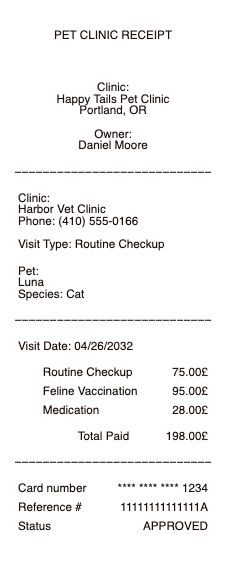
A wellness plan is not pet insurance — and the receipt shows why
Veterinary chains and clinics sell wellness plans: a monthly fee covering a defined bundle of routine care — exams, vaccinations, screenings, dental cleanings. The confusion they cause is categorical: a wellness plan is prepayment for scheduled care at a discount, while pet insurance reimburses unexpected costs — accidents, illness, emergency surgery.
The receipts make the difference visible. Wellness-plan paperwork shows services consumed against a plan (often at $0 point-of-sale with the plan referenced); insurance paperwork shows you paying in full and claiming back. The categories complement rather than substitute: a plan does nothing for the swallowed sock, insurance does nothing for the annual booster — and knowing which document set you hold prevents both kinds of surprise.
The plan's arithmetic and its cancellation clause
Wellness plans price on the assumption of full use: consume the whole bundle and you save against à-la-carte prices; skip visits and the clinic wins. Two contract points matter more than the brochure:
The plan is usually an annual commitment billed monthly — not a cancel-anytime subscription. Cancelling mid-term commonly requires paying the difference between plan pricing and full price for services already used, which can exceed the remaining instalments.
Auto-renewal is standard; the renewal notice and the receipt trail are where a price change appears.
The receipts to keep: the plan agreement, each monthly billing, and the per-visit records showing plan services consumed — the set that answers any cancellation arithmetic.
The records that travel with the pet
Clinic receipts do double duty as the pet's documented history, and several downstream users will ask for them:
Vaccination records — boarding kennels, groomers, daycare, travel, and licensing all require proof, and the clinic receipt with the vaccine, date, and batch is the underlying evidence.
Microchip registration — the implant receipt carries the chip number; registration (and keeping the registry updated) is a separate step the receipt reminds you of.
New-owner handover — a sold or rehomed pet should travel with its clinical paperwork; for breeders, the health-check receipts are part of the sale documentation.
Add-ons, and where clinic bills grow
Routine visits accrete services — nail trims, anal glands, ear cleaning at the groom-adjacent end; bloodwork panels, urinalysis, dental radiographs at the medical end. Each belongs itemised on the receipt, and the itemisation is what lets you distinguish plan-covered from billable, and medical from cosmetic.
For the growing number of employers offering pet benefits, and for insurance claims on the medical lines, that itemisation is the qualifying detail — a lump-sum "vet visit" line supports nothing.
For anything beyond the routine, ask for the estimate before treatment — most clinics produce a written low-to-high range for a procedure, and signing it is what authorises the spend. The estimate then becomes part of the receipt file: a final bill that lands far above its signed estimate is a conversation the paperwork lets you have precisely, line by line, instead of by impression.
Keeping pet care records
Keep the vaccination and medical receipts for the pet's lifetime — the history has clinical value, not just financial — and the wellness-plan paperwork for the plan term plus its cancellation window. Clinics maintain patient records (the pet's chart) and reprint histories on request, which is the recovery route, and the standard request when changing clinics.
If a receipt is missing while the care genuinely happened, the clinic can reissue an itemised history, and your card statement establishes the payment; a clear reconstructed record documents that real payment for your files, matching the charge exactly — while the clinical record, which only the clinic maintains, is what kennels, insurers, and the next vet actually rely on.
If the pet is insured, the clinic receipt is the claim: insurers reimburse against the itemised invoice, usually after you have paid the clinic directly — so the receipt's itemisation quality decides how smoothly the claim runs. Keep the claim correspondence with the receipt it reimbursed.
Frequently asked questions
Everything you need to know about the product and billing.
What is the difference between a wellness plan and pet insurance?
A wellness plan prepays scheduled routine care at a discount — exams, vaccines, cleanings. Insurance reimburses the unexpected — accidents, illness, surgery. They complement each other, and their paperwork looks completely different. Insurance also runs on different paper: claims reimburse against the clinic's itemised receipt after you pay, while a wellness plan simply discounts the bundled routine care.
Can I cancel a pet wellness plan mid-year?
Usually only by settling the arithmetic: plans are annual commitments billed monthly, and cancelling commonly means paying the gap between plan pricing and full price for services already used — sometimes more than the remaining instalments.
Which pet receipts do boarding and travel require?
Vaccination proof — the clinic receipt or certificate with the vaccine, date, and batch. Kennels, groomers, daycare, and travel authorities all ask for it.
What should a pet clinic receipt itemise?
Each service separately — exam, vaccines, tests, extras — with plan-covered versus billable distinguished. Lump-sum 'vet visit' lines support neither insurance claims nor benefit reimbursements. For procedures, the signed estimate belongs with it — the low-to-high range you authorised is the yardstick for the final bill.
What records should follow a rehomed pet?
Its clinical paperwork: vaccination history, medical records, microchip details. For breeders, health-check receipts form part of the sale documentation.
How do I get records from a previous vet?
Clinics maintain the pet's chart and reprint histories on request — the standard step when changing clinics, and the recovery route for any missing receipt.