A private lesson receipt covers one-to-one instruction — often sold in prepaid packages with cancellation windows. This guide explains package accounting, no-show policies, and receipts from sole-trader teachers.
Private Lesson Receipt
Add custom logo
Edit line items
Choose payment method
Add/remove elements
Customize business information
Choose font
Lessons are sold by the hour but bought in packages
Private instruction — music, languages, sport, academics — prices by the hour but sells in packages: ten lessons at a discount, paid upfront. The economics are simple (the teacher buys commitment, the student buys a rate), but the accounting is where disputes live.
A package purchase is a prepayment, and its receipt should behave like one: the number of lessons bought, the rate, the expiry (packages commonly lapse after a period), and — as lessons are consumed — some running record of the balance. A teacher who marks each lesson against the package, and a student who keeps that tally, never argue about lesson seven. Everyone else eventually does.
The cancellation window is the contract's heart
One-to-one time is perishable: an hour cancelled at short notice cannot be resold. That is why every established teacher runs a cancellation window — commonly 24 hours — inside which the lesson is charged whether or not it happens.
The fair-and-functional version cuts both ways: the student loses the fee for late cancellation and no-shows, and the teacher reschedules or credits when they cancel. Whichever policy applies, it should be stated at booking and referenced on the receipts — because "charged for a lesson that didn't happen" is the single most common private-tuition dispute, and it is resolved entirely by what the policy said and when the cancellation landed.
The gentler cousin of the cancellation fee is the makeup lesson — the missed hour rescheduled instead of charged. Where a teacher offers makeups, the paperwork question is expiry and count: how many makeups a package allows and how long they stay claimable. An untracked makeup is the lesson-package equivalent of an unspent voucher — real value that quietly lapses.
Receipts from a sole trader are still receipts
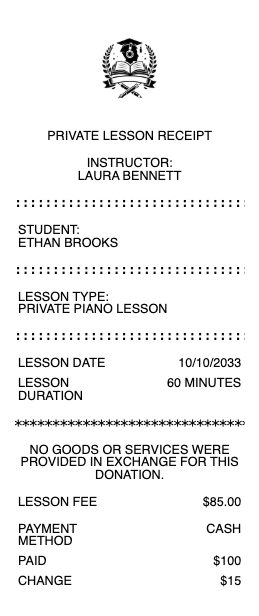
Most private teachers are sole traders, and their paperwork is correspondingly simple — sometimes a numbered receipt book, sometimes an emailed note, sometimes a payment-app record. All of it is valid documentation, provided it carries the essentials: the teacher's name, the date, the lessons covered, the amount, and ideally a signature or account reference.
For parents paying for children's lessons, the receipt should name the student as well as the payer. And for teachers: the duplicate book or payment-app history is your income record — the same documents your students keep as proof of payment are what your tax return stands on.
Online lessons changed the paper slightly, not the substance: the receipt should say what platform delivered the hour and, where the teacher sells across borders, the currency and any platform fee. A lesson bought through a marketplace adds the marketplace's own receipt on top of the teacher's — keep both, because refunds route through the platform, not the teacher.
When lessons touch tax and benefits
Private tuition is mostly a personal cost, but the edges matter:
Professional skill development — a working musician's lessons with a master teacher, a professional's language coaching for an overseas posting — can qualify as business expense, receipt-supported, where it maintains or improves existing professional skills.
Tutoring for a diagnosed learning need can, in some circumstances and jurisdictions, carry medical-expense treatment when prescribed — a narrow category with specific documentation requirements.
Ordinary enrichment lessons — piano for pleasure, tennis for fitness — are personal, however valuable.
Keeping lesson records
Keep package receipts and the lesson tally until the package is fully consumed plus any dispute window; keep professional-development lesson receipts with your tax records for the standard retention period.
Teachers can reissue receipts from their own records — the duplicate book or app history — which is the recovery route. If a record is missing while the payment genuinely happened, your bank or payment-app statement establishes the date, amount, and teacher, and a clear reconstructed record documents that real payment for your files, matching it exactly, with the lessons-covered detail confirmed against the teacher's tally rather than memory.
Frequently asked questions
Everything you need to know about the product and billing.
What should a lesson package receipt show?
The number of lessons, the rate, the total paid, the expiry period, and the student's name — plus, as lessons happen, a running tally of the balance. Package disputes are always about lesson seven, and the tally is what settles them.
Can I be charged for a lesson I cancelled?
Inside the teacher's cancellation window — commonly 24 hours — yes, because one-to-one time cannot be resold at short notice. The policy stated at booking, and when your cancellation landed, decide it.
Is a handwritten receipt from a private teacher valid?
Yes. Sole-trader paperwork — a numbered receipt book, an emailed note, a payment-app record — is valid documentation when it shows the teacher, date, lessons covered, and amount. Marketplace-booked lessons add the platform's receipt on top — keep both, since refunds route through the platform rather than the teacher.
Are private lessons tax deductible?
Mostly personal. The exceptions: instruction maintaining or improving existing professional skills can be a business expense, and tutoring prescribed for a diagnosed learning need can carry medical treatment in narrow circumstances.
Do lesson packages expire?
Commonly yes — packages lapse after a stated period, which should be on the receipt. An expiring package is a prepayment you lose by not scheduling, which is worth knowing before buying twenty lessons. Makeup lessons deserve the same tracking — where offered, note how many a package allows and when they expire, because an unclaimed makeup lapses like an unspent voucher.
What records should teachers keep?
The mirror of the student's: the duplicate receipt book or payment-app history, per student, with lessons marked against packages. It is simultaneously the students' proof of payment and the teacher's income record.