A property management receipt documents fees charged to a landlord or rent collected on their behalf. This guide explains management and leasing fees, why client money sits in a trust account, and how to read an owner statement.
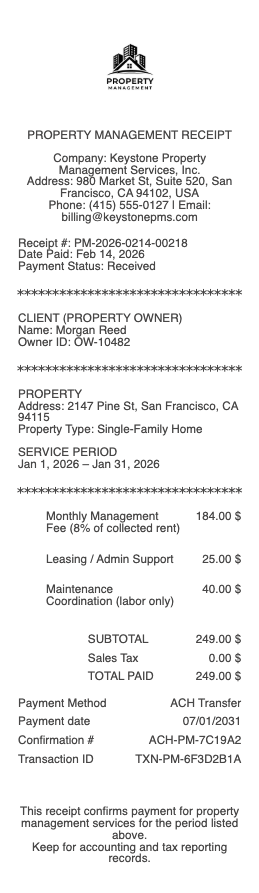
Property Management Receipt
Add custom logo
Edit line items
Choose payment method
Add/remove elements
Customize business information
Choose font
Two different money flows, one relationship
Property management paperwork confuses owners because two things move in opposite directions at once. The manager collects rent from the tenant on the owner's behalf, and separately charges the owner fees for doing so. Both appear on the same statement, and untangling them is the whole skill of reading it.
What actually reaches the owner is the rent collected, minus the management fee, minus any maintenance paid out, minus any other agreed deductions. The receipt or statement is what shows the arithmetic — and an owner who does not check it is trusting a company with their largest asset on faith.
The fees, and what each is for
Management fee — the recurring charge for running the tenancy, typically a percentage of the rent collected. If it is charged on rent collected rather than rent due, the manager only earns when you do, which aligns the incentives correctly.
Leasing or tenant-placement fee — a separate, one-off charge for finding and vetting a tenant, often expressed as a portion of one month's rent.
Renewal fee — charged when an existing tenant re-signs.
Maintenance coordination — sometimes a markup on contractor invoices, which should be disclosed rather than buried.
Vacancy or setup fees, where they apply.
The fees themselves are ordinary. What matters is that each appears on the statement as a named line rather than as an unexplained deduction.
One more balance hides in the arrangement: the reserve float — a small owner-funded balance the manager holds for repairs and surprises, replenished from rent as it is spent. The statements should show it like a bank account: opening balance, draws with their invoices, closing balance. A reserve that only ever depletes without documentation is the first place an owner audit looks.
Trust accounts: whose money is it?
Rent collected on your behalf is your money, not the manager's. Client funds are held in a designated trust or client account, kept separate from the management company's own operating money, precisely so that a firm's financial trouble cannot consume the rent it holds for its clients.
This separation is the reason receipts and statements matter so much in this relationship. They are the evidence of what was collected in your name and what was disbursed from it. An owner statement that does not reconcile — rent collected that does not match deductions plus payout — is the single most important thing to query, and to query immediately.
Reading an owner statement
A monthly owner statement should let you rebuild the month without asking a question:
Rent collected, by property and by tenant, with the date received.
Management fee, shown as a rate and an amount.
Maintenance and repairs, itemised, with contractor invoices attached or available.
Other disbursements made on your behalf.
Net paid to owner, and the date it was transferred.
Arrears — rent due but not collected, which is the number that quietly matters most.
Year-end assembles the monthly statements into two documents: the annual owner statement totalling the year's income and expenses by category, and — in the US, where the manager collected rents — the 1099 reporting those rents to the IRS. The monthly statements are what let you check both against reality before filing season locks them in.
Why owners keep every statement
These documents are the backbone of a rental business's tax position. Rental income is declared gross, and management fees, maintenance, and other costs are deducted against it — which means every fee receipt is a deduction and every statement is evidence supporting the return.
Keep them for the retention period your jurisdiction requires for property records, which is typically longer than for ordinary receipts. Managers keep their own records and can reissue statements; that is the first route to a missing document. If a record is genuinely gone while the payment happened, a clear reconstructed record from your bank statement documents the real transaction for your files — matching it exactly, and never replacing the manager's own trust-account records, which are the authoritative account of money held in your name.
Frequently asked questions
Everything you need to know about the product and billing.
What is a property management fee?
The recurring charge for running a tenancy, usually a percentage of rent. Where it is charged on rent collected rather than rent due, the manager only earns when the owner does — which aligns the incentives.
What is a leasing or tenant-placement fee?
A separate one-off charge for finding and vetting a tenant, often expressed as a portion of one month's rent. It is distinct from the ongoing management fee.
What is a trust account?
A designated client account where rent collected on an owner's behalf is held, kept separate from the management company's own operating funds. The rent is the owner's money, and the separation protects it from the firm's own financial trouble.
What should an owner statement show?
Rent collected by property and date, the management fee as a rate and amount, itemised maintenance, other disbursements, the net paid to the owner, and arrears — rent due but not collected. Including the reserve float where one exists — opening balance, documented draws, closing balance, like a small bank account inside the statement.
Are property management fees tax deductible?
For a rental business, management fees and maintenance are ordinarily deductible against rental income, which is declared gross. This is why every fee receipt and statement is worth keeping — each supports a deduction.
What if my owner statement does not reconcile?
Query it immediately. Rent collected should equal deductions plus the payout. A statement that does not balance is the most important thing to raise, and the trust-account records are what settle it. Reconcile before year-end especially — the annual statement and any 1099 are built from these monthlies, and filing season locks their numbers in.