A public transport receipt supports commuter benefits, expense claims, and pass-versus-fare decisions. This guide covers the 2026 pre-tax transit limit of $340 a month and how to document travel across mixed systems.
Public Transport Receipt
Add custom logo
Edit line items
Choose payment method
Add/remove elements
Customize business information
Choose font
The pre-tax benefit is the biggest number in commuting
For US commuters, the most valuable fact about public transport paperwork is a tax rule: transit passes and vanpool costs qualify as a pre-tax transportation fringe benefit, up to $340 per month in 2026 — up from $325 in 2025. Qualified parking carries its own separate $340 monthly limit, and a commuter with both kinds of expense can use both.
Routed through an employer's commuter program, that is up to $4,080 of transit spending a year paid from pre-tax salary — a saving worth several hundred dollars at typical marginal rates, for filling in a form. Both employee salary deferrals and any employer-paid portion count toward the same cap, and amounts above it are taxable wages.
The documentation lives mostly in the program itself: enrollment, monthly elections, and the transit card or pass it loads. Your role is keeping the election matched to what you actually spend — the receipts and journey histories are how you check.
Pass or pay-per-ride: the arithmetic worth doing twice a year
Every transit system prices the same choice: a period pass (weekly, monthly) against pay-per-ride, increasingly with fare capping blurring the line. The breakeven is simple — pass price divided by single fare equals the trips per period that justify it — but the answer changes when your travel pattern does.
Hybrid working broke a lot of monthly-pass habits: three office days a week often makes capping or pay-per-ride cheaper than the monthly pass bought from muscle memory. Your journey history or receipts are the data; the twice-a-year check is the discipline. Buying the pass you no longer need is the quietest recurring overspend in commuting.
Documenting travel across mixed systems
Real journeys cross operators — bus to train to metro — and the documentation fragments accordingly: a tap on one system, a paper ticket on another, an app purchase on a third. For expense claims, the assembly rules:
Registered smartcards and contactless accounts export journey histories — the cleanest evidence.
App purchases keep receipts in the app account.
Paper singles are the weak link: photograph them at purchase, because they fade and vanish.
The claim should reconstruct the journey, not just the spend — date, route, and purpose alongside the amounts.
Concessionary travel adds a document of its own: student, senior, and disability fares ride on a photocard or eligibility pass, and the receipt for a concession-priced product only makes sense next to the entitlement that priced it. Reimbursers and auditors asking why a pass cost less than list price are really asking to see that card.
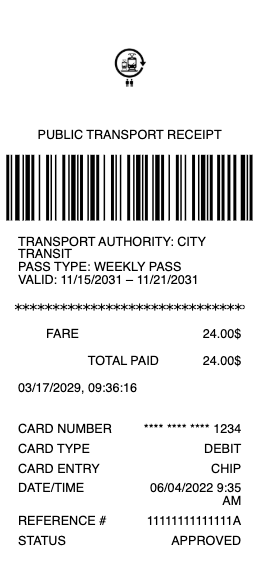
What a transit receipt or statement should show
The operator and system.
The product — single, return, day pass, period pass — and its validity window.
Journey details where the system records them: date, time, origin, destination.
The amount and payment method.
The card or account identifier the product is loaded on — passes are replaceable only when tied to a registered identity.
Refund paperwork on transit runs backwards from most retail: the unused portion of a period pass is typically refunded pro-rata from the surrender date, minus an administration fee — so the refund document, not the original purchase receipt, states what the pass really cost you. File the two together; the pair is the true price record.
Keeping transit records
For commuter-benefit users, keep the program statements and elections with a sample of actual spending — the match between them is what an audit of the benefit checks. For expense claimants, export journey histories monthly; for pass holders, keep the purchase receipt for the life of the pass plus any refund window, since unused-period refunds are calculated from it.
If a record is missing while the travel genuinely happened, your card statement establishes the spend with the operator, and a clear reconstructed record documents that real payment for your files, matching the charge exactly — while per-journey detail lives in the operator's registered-account history, which is the argument for registering every card you tap.
Frequently asked questions
Everything you need to know about the product and billing.
How much transit can I pay for pre-tax in 2026?
Up to $340 per month for transit passes and vanpooling — up from $325 in 2025 — through an employer's commuter benefit program. Qualified parking has its own separate $340 monthly limit, and both can be used together.
Is a monthly pass still worth it with hybrid working?
Often not. The breakeven is pass price divided by single fare; three office days a week frequently makes fare capping or pay-per-ride cheaper. Check your journey history against the pass price twice a year.
How do I document a journey across several operators?
Assemble it: registered-card journey exports, app receipts, and photographed paper tickets, tied together with date, route, and purpose. The claim should reconstruct the journey, not just list amounts.
What should a transit receipt show?
The operator, the product and its validity window, journey details where recorded, the amount and payment method, and the card or account the product is loaded on — which is what makes a lost pass replaceable. Concession products need one more thing alongside — the photocard or eligibility pass that justified the reduced fare.
What happens to amounts over the pre-tax limit?
They are included in taxable wages. Both your salary deferrals and any employer contribution count toward the same monthly cap.
Can I get a refund on an unused period pass?
Often pro-rata, minus fees, calculated from the purchase record — which is why the pass receipt is worth keeping for the pass's whole life plus the refund window. The refund statement then becomes part of the record — pro-rata value minus the fee, from the surrender date — and together with the purchase receipt it shows what the pass truly cost.