A rail ticket receipt records a fare class as much as a journey — advance, off-peak, or flexible. This guide explains why the same seat has many prices, delay compensation, and what business travellers should keep.
Rail Ticket Receipt
Add custom logo
Edit line items
Choose payment method
Add/remove elements
Customize business information
Choose font
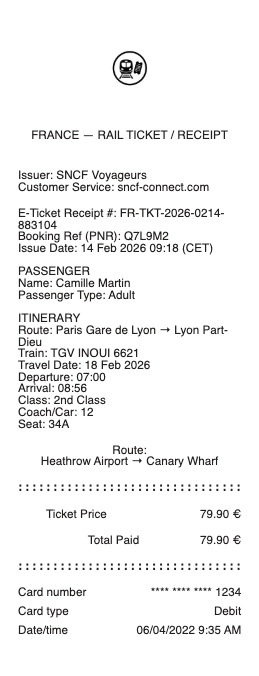
The same seat, sold at five prices
Rail pricing confounds people because the product looks identical while the price varies wildly. The difference is the fare class — the conditions attached, not the seat:
Advance fares — cheapest, sold for a specific train. Miss it, and the ticket is generally worthless; flexibility was what you traded for the price.
Off-peak fares — valid on any train outside restricted hours, at a middle price.
Anytime or flexible fares — valid on any train, refundable or changeable, at the top price.
The receipt records which class you bought, and that field decides everything downstream: whether you can take the earlier train, whether a refund exists, what a missed connection costs. Two colleagues on the same train can hold tickets at triple-price difference — one is buying certainty, the other flexibility.
The pricing maze has one legal exploit worth naming: split ticketing — buying the same journey as two or more consecutive tickets that together cost less than the through fare. It is permitted where the train calls at the split points, and it multiplies the paperwork: each segment is its own ticket, its own receipt, and its own delay-compensation claim if things go wrong.
Delay compensation: the refund most passengers never claim
Rail operators in many systems run delay compensation schemes — money back when your train arrives late, scaling with the delay, on some operators from delays as short as fifteen minutes. The consistent facts across schemes:
It must be claimed — compensation is rarely automatic (though some operators auto-compensate advance tickets bought direct).
It runs on the ticket — the claim requires the ticket or booking reference, the journey, and the delay.
Claim windows are short — typically weeks, not months.
The economics are quietly significant for commuters and frequent travellers: a year of unclaimed 30-minute delays is real money, and the only barrier is keeping the tickets and knowing the scheme exists. That is a receipt-retention argument measured in cash.
Season tickets and the commuting arithmetic
Rail season tickets — weekly, monthly, annual — price commuting at a discount to daily fares, and the receipt matters for three reasons:
Refunds on unused portions — season tickets are typically refundable pro-rata (minus fees) when circumstances change, calculated from the purchase record.
Employer schemes — season-ticket loans and salary-sacrifice arrangements run on the purchase documentation.
Duplicate issue — a lost season ticket is usually replaceable precisely because the purchase record exists, unlike an anonymous single.
Post-pandemic flexible-commuting products (carnet-style bundles, flexi-seasons) complicate the arithmetic — the receipt history is how you check whether your actual travel pattern still justifies the product you are buying.
Flexible-working season products — carnet tickets, flexi passes priced for two or three office days a week — sit between singles and traditional seasons, and their receipts carry a use-by rhythm the old products never had: a bundle of day passes expiring on a schedule. The expiry dates on the receipt are part of the price; unused expired days are the discount quietly handed back.
What a rail receipt should show
The journey — origin, destination, and route restrictions if any.
The fare class and its conditions — the field that determines flexibility and refunds.
The specific train, for advance fares — date and departure time.
Seat reservations, where applicable.
The booking reference — what changes, refunds, and delay claims run on.
Railcard or discount applied — inspectors can require the railcard that earned the discount.
Keeping rail records
Keep tickets and booking confirmations until the journey is complete and any delay-compensation window has passed — the claim you have not made yet is the reason. For business travel, the e-ticket PDF with its fare class and amount is the expense document; app-purchased tickets live in the operator's account history and can be re-downloaded.
If a record is missing while the journey genuinely happened, your card statement establishes the date, amount, and operator, and a clear reconstructed record documents that real payment for your files, matching the charge exactly — while the booking reference, which only the operator's system holds, remains what any refund or delay claim actually requires.
Frequently asked questions
Everything you need to know about the product and billing.
Why did my colleague pay a third of my rail fare?
Different fare class, same seat. Advance fares are train-specific and cheap; off-peak fares are time-restricted and mid-priced; flexible fares are refundable and expensive. The receipt records which conditions you bought. Split ticketing may be the answer — consecutive tickets over the same route can legally undercut the through fare where the train calls at the split points.
What happens if I miss the train on an advance ticket?
Generally the ticket is worthless — it was valid only for that specific service. The low price was payment for giving up flexibility. Some operators allow changes for a fee before departure, which the booking reference enables.
How does rail delay compensation work?
Money back scaling with the delay — on some operators from just fifteen minutes late. It must usually be claimed, within a short window, using the ticket or booking reference. For frequent travellers, unclaimed delays add up to real money.
Are season tickets refundable?
Typically pro-rata on the unused portion, minus fees, calculated from the purchase record — one of several reasons the season-ticket receipt matters. Lost season tickets are usually replaceable because the purchase record exists. Flexi and carnet products add expiry arithmetic — unused days that lapse on schedule are part of the real price, so the expiry dates on the receipt matter as much as the discount.
What should a rail receipt show?
The journey and any route restrictions, the fare class and conditions, the specific train for advance fares, seat reservations, the booking reference, and any railcard discount applied.
How long should I keep rail tickets?
Until the journey is done and the delay-compensation window has closed — the unclaimed compensation is the reason. Business travellers should keep the e-ticket PDF as the expense document.