A Rebag receipt can document a purchase, an instant sell offer, or a Clair Trade credit. This guide explains Clair valuations, how selling pays out, and why the offer document matters as much as the receipt.
Rebag Receipt
Add custom logo
Edit line items
Choose payment method
Add/remove elements
Customize business information
Choose font
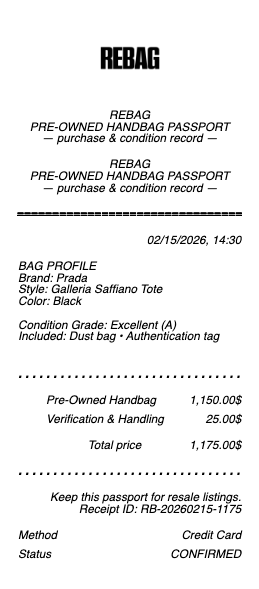
Rebag receipts come in three kinds
Rebag — the luxury resale retailer for handbags and accessories — generates paperwork in three distinct directions, and each is a different document:
Buying — Rebag owns its inventory and sells as the retailer, so the purchase receipt is a straightforward retail document from a single identifiable merchant.
Selling — you receive an offer, and acceptance produces a payout: sellers are paid within about 2–3 business days after the item is received and verified, or instantly at Rebag's stores.
Trading — Clair Trade converts your item's offer value directly into credit against a purchase, and you pay only the difference.
Knowing which transaction you made determines which document matters — and the trade, being both a sale and a purchase, produces paperwork for each side at once.
Clair: the valuation that became a document
Clair — the Comprehensive Luxury Appraisal Index for Resale — is Rebag's pricing engine: photograph a bag and its AI image recognition identifies the make and model and states a market value, across dozens of top luxury brands. The valuation is the number an instant offer is built from.
Treat the Clair valuation as a document in its own right. For sellers, it is the quote — the basis to compare against other channels (consignment elsewhere, private sale) before committing. For owners not selling at all, it is a free, dated market valuation of an item you hold: useful context for insurance conversations and a record of what the resale market thought your piece was worth on a given day.
Selling: the offer, the shipment, and the verification gap
The sell flow is offer → free shipping label → item received → verification → payout. That verification stage is the one to understand: the offer is conditional on the item matching what was described, and condition discrepancies found at verification adjust or void the offer.
The paperwork discipline mirrors every remote-sale situation: photograph the item thoroughly before shipping, keep the offer document and the shipping receipt, and reconcile the payout against the offer. A payout that differs from the offer comes with a revised assessment — which you can accept or decline with the item returned — and the before-shipping photographs are your side of that conversation.
Buying resale from a retailer, not a peer
Because Rebag owns and sells its inventory, buying carries retailer mechanics rather than marketplace ones: condition-graded listings, the company's own authentication behind every piece, returns per its stated policy, and a receipt from one merchant of record. That differs structurally from peer-to-peer platforms (you buy from an individual) and consignment houses (the platform sells on an owner's behalf).
For the buyer's records, the receipt plus the condition grade at purchase is the provenance entry: a resale item's history continues through you, and the graded listing snapshot documents the state in which it entered your ownership.
Keeping resale paperwork
Buyers: keep the receipt and the listing's condition grade with photographs from arrival — the provenance file for a future sale. Sellers: keep the Clair offer, the shipping proof, and the payout confirmation until the money lands and any adjustment window closes; the set documents what was offered, what was sent, and what was paid.
The account holds order and offer history, which is the recovery route. If a record is missing while the transaction genuinely happened, your bank statement establishes the payment or payout, and a clear reconstructed record documents that real transaction for your files, matching it exactly — with valuations and condition grades taken from the platform's records rather than memory.
Frequently asked questions
Everything you need to know about the product and billing.
What is Clair?
Rebag's Comprehensive Luxury Appraisal Index for Resale — an AI pricing engine that identifies a bag from photographs and states its market value. Instant offers are built from it, and the valuation itself is a useful dated document even if you never sell.
How fast does Rebag pay sellers?
Within about 2–3 business days after the item is received and verified — or instantly when selling in person at Rebag's stores.
What is Clair Trade?
Trade-in for luxury resale: your item's offer value becomes credit against a purchase, and you pay only the difference. It is a sale and a purchase at once, producing paperwork for both sides.
Can my payout differ from my offer?
Yes — offers are conditional on verification. Condition discrepancies found on receipt adjust or void the offer, which you can accept or decline with the item returned. Photograph everything before shipping.
Is buying from Rebag like buying on a marketplace?
No — Rebag owns its inventory and sells as the retailer, with its own authentication, condition grading, and return policy, and one merchant of record on your receipt. Peer-to-peer and consignment platforms work differently.
What paperwork should sellers keep?
The Clair offer, the shipping proof, and the payout confirmation — together they document what was offered, sent, and paid, which is exactly the file an adjustment dispute needs.