A recreated receipt documents a real transaction whose original record is lost. This guide explains the reconstruction workflow, the Cohan rule and its limits, missing-receipt affidavits, and what each third party will accept.
Recreated Receipt
Add custom logo
Edit line items
Choose payment method
Add/remove elements
Customize business information
Choose font
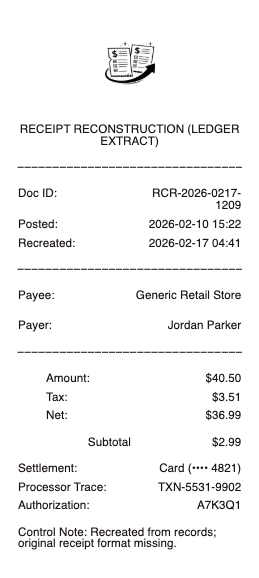
Reconstruction is a workflow, not a memory exercise
A recreated receipt is only as good as the evidence it is rebuilt from — so the workflow starts with evidence, not recollection:
Anchor the transaction — the bank or card statement line: date, amount, merchant. This is the skeleton, and every field of the reconstruction must match it exactly.
Recover the detail — order confirmations, emails, loyalty histories, calendar entries, the merchant's own records. Each source pins another field.
Rebuild the document — the real merchant, the real date, the real amount, the items as evidenced; where a detail cannot be recovered, it stays general rather than guessed.
Label it honestly — a reconstruction presented as an original is a forgery; presented as what it is, it is documentation.
The discipline in one sentence: a recreated receipt records what the evidence shows — never what would be convenient.
The Cohan rule — and where it stops
US tax law contains a famous mercy: under the Cohan rule (from a 1930 case involving the Broadway showman George M. Cohan), courts may allow reasonable estimates of deductible expenses where records are missing but the spending clearly occurred — the taxpayer bears the uncertainty, but imperfect records are not automatic disallowance.
Two hard limits keep it honest:
There must be a credible basis — some evidence the expense category and scale are real. Cohan tolerates lost paper, not invented spending.
Strict-substantiation categories are excluded — travel, meals, gifts, and listed property demand actual records by statute; no estimate substitutes. Precisely the categories people most often lose receipts for are the ones estimation cannot rescue.
The practical reading: reconstruction beats estimation, estimation beats nothing, and for travel and meals only reconstruction counts.
The missing-receipt affidavit: the corporate version
Inside companies, the lost receipt has an established instrument: the missing-receipt affidavit (or lost-receipt declaration) — a signed statement of the expense's date, vendor, amount, business purpose, and the reason the original is unavailable, usually capped at modest amounts and monitored for frequency.
It coexists with reconstruction rather than replacing it: the affidavit asserts, the reconstructed record (built on the statement line) corroborates, and together they make a claim an approver can pass. The frequency monitoring is the part to respect — the affidavit is a safety valve, and a pattern of them reads as a process problem or worse.
What each third party will accept
Employers — per policy: affidavit plus supporting evidence for occasional losses; card-statement matching for the rest.
Tax authorities — reconstructed records with corroboration; Cohan estimates outside the strict categories; the merchant's reissued document above all.
Insurers — proof-of-loss processes accept reconstructed ownership evidence (statements, photos, registrations) weighted by corroboration.
Merchants (returns/warranty) — usually their own records: the card lookup or loyalty history, which outranks anything you rebuild.
The common thread: a reconstruction is supporting evidence. Wherever the counterparty can reissue or look up the original — merchant, processor, platform — that retrieval is worth more than the best rebuild, and should be attempted first.
Prevention, and the honest limits
The reconstruction workflow also describes its own limits: cash purchases at unrecorded tills leave no anchor line, and details no evidence supports cannot be restored — only generalised. Which is the argument for capture-at-source habits: same-day photographs, emailed receipts, loyalty accounts, card payments over cash for anything that might matter later.
A recreated receipt documents a real payment you genuinely made, matching the underlying transaction exactly, labelled as what it is. It never invents a transaction, inflates an amount, backfills an attendee, or converts one category of spending into another — the line between reconstruction and fabrication is the line between record-keeping and fraud, and every legitimate use of a recreated receipt lives entirely on the first side of it.
Frequently asked questions
Everything you need to know about the product and billing.
How do I properly recreate a lost receipt?
Anchor it to the bank or card statement line, recover details from confirmations, emails, and merchant records, rebuild with every field matching the evidence, and label it as a reconstruction. What the evidence cannot support stays general — never guessed.
What is the Cohan rule?
A US tax doctrine allowing courts to accept reasonable estimates of deductible expenses when records are lost but the spending clearly occurred. It requires a credible basis — and it excludes travel, meals, gifts, and listed property, which demand actual records by statute.
What is a missing-receipt affidavit?
The corporate instrument for lost receipts: a signed declaration of date, vendor, amount, and business purpose, typically capped in amount and monitored for frequency. It asserts; a reconstruction built on the statement line corroborates.
Will the IRS accept a recreated receipt?
Reconstructed records with corroboration carry real weight, and estimates may be allowed under Cohan outside the strict categories — but a merchant's reissued document outranks both, and travel-and-meal deductions need actual records.
Is a recreated receipt valid for returns?
Merchants generally rely on their own systems — card lookups and loyalty histories — which outrank anything you rebuild. Attempt the retrieval first; the reconstruction is supporting evidence, not a store document.
Where is the line between reconstruction and fraud?
A reconstruction documents a real payment, matching the actual transaction exactly, labelled honestly. Inventing transactions, inflating amounts, or recategorising spending crosses from record-keeping into fabrication — no legitimate use lives there.