A credit note is a document a seller issues to cancel or reduce a previously issued invoice. This guide explains what a credit note must contain, how it differs from a refund receipt and a debit note, and how VAT is adjusted on both sides.
Refund Receipt Credit Note
Add custom logo
Edit line items
Choose payment method
Add/remove elements
Customize business information
Choose font
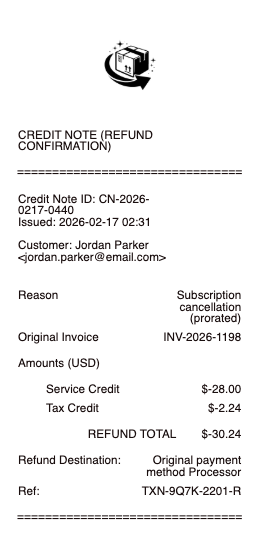
What a credit note actually is
A credit note (also called a credit memo) is a document a seller issues to a customer to cancel or reduce the amount owed on a previously issued invoice. If an invoice increases what the buyer owes, a credit note decreases it — they are mirror images of each other, which is why a credit note is sometimes described as a negative invoice.
It exists because you cannot simply delete or rewrite an issued invoice. Once a document has gone to a customer and entered both parties' books, accounting integrity requires that any correction leaves a trace. The credit note is that trace: the original invoice stands, and a second document formally reduces it.
Credit note vs refund receipt vs debit note
These three get used interchangeably and they are not the same thing:
Credit note — issued by the seller. It reduces what the customer owes. No money necessarily moves: an unpaid invoice can simply be reduced, or the credit can be held against future purchases.
Refund receipt — proof that money actually went back to the customer. This is a payment record, not an adjustment to a bill.
Debit note — the opposite direction. It increases the amount owed, typically when the taxable value of a supply rises (a quantity, rate, or price correction), or is raised by a buyer returning goods.
The practical distinction: a credit note changes the bill; a refund receipt records the money. A returned item might generate both — a credit note cancelling the invoice line, and a refund receipt when the cash goes back.
What a credit note must contain
A credit note is only useful if it can be tied unambiguously to the thing it is correcting:
A clear label — the words "credit note" — so it is never mistaken for an invoice.
Its own unique credit note number.
The original invoice number and date it relates to. This is the single most important field; a credit note that does not reference its invoice is very hard to reconcile.
The reason for the credit — a return, a pricing error, a discount, damaged goods, or a cancelled service.
The seller and customer details, and where VAT applies, the seller's VAT registration number.
The amount being credited, with the VAT rate and VAT amount shown separately.
How VAT is adjusted on both sides
A credit note is not just a courtesy — where VAT is involved, it is the mechanism that corrects the tax. Issuing one adjusts the VAT figures for both parties: the seller reduces the output VAT they previously declared, and the customer reduces the input VAT they reclaimed on the original invoice.
That symmetry is why the reference to the original invoice matters so much, and why a credit note cannot simply be issued informally by email. Both sets of books, and both VAT returns, have to move in step. If a credit note is raised in a different accounting period from the original invoice, it is normally reflected in the period in which it is issued — which is precisely the sort of timing detail your accountant will want the documents to make obvious.
Common situations that call for a credit note
Most credit notes come from a small set of everyday circumstances:
Goods returned by the customer, in whole or in part.
An overcharge or pricing error on the original invoice.
Damaged or short-delivered goods, where a partial credit is agreed rather than a full return.
A cancelled order that was already invoiced.
A retrospective discount — a volume rebate, or a settlement discount actually taken.
In accounting software, a credit note is typically raised against the customer and then allocated against a specific outstanding invoice — or left on account as an available credit. Leaving credits unallocated is one of the most common causes of a receivables ledger that will not reconcile, so allocate them as you go.
Frequently asked questions
Everything you need to know about the product and billing.
What is a credit note?
A document a seller issues to cancel or reduce the amount a customer owes on a previously issued invoice. Where an invoice increases what the buyer owes, a credit note reduces it — which is why it is sometimes called a negative invoice.
What is the difference between a credit note and a refund?
A credit note reduces the bill; a refund moves the money. An unpaid invoice can be reduced by a credit note without any cash changing hands, and the credit can be held against future purchases instead.
What is the difference between a credit note and a debit note?
A credit note decreases the amount owed and is issued by the seller. A debit note increases it — typically when the taxable value of a supply rises, or when a buyer raises one on returning goods.
What must a credit note include?
The words 'credit note', its own unique number, the original invoice number and date it relates to, the reason for the credit, seller and customer details, the VAT number where applicable, and the amount credited with the VAT shown separately.
Does a credit note change my VAT?
Yes. It adjusts VAT for both parties — the seller reduces the output VAT previously declared, and the customer reduces the input VAT reclaimed on the original invoice. This is why the reference to the original invoice is essential.
Why must a credit note reference the original invoice?
Because both parties' books and VAT returns must move in step. Without the invoice reference, the credit cannot be reconciled against what it is correcting, and the ledger will not balance.