Paying rent by bank transfer creates its own proof, but only if the reference is right. This guide explains what to put in the payment reference, why a transfer is not automatically a receipt, and when a landlord must still issue one.
Rent Bank Transfer Receipt
Add custom logo
Edit line items
Choose payment method
Add/remove elements
Customize business information
Choose font
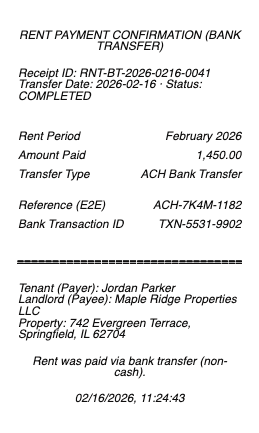
A bank transfer is evidence — but of what?
Paying rent by transfer feels self-documenting: the money left your account, the bank recorded it, and the record cannot be lost in a drawer. That is genuinely stronger than handing over cash. But it proves something narrower than tenants assume.
A bank record proves that you sent an amount to an account on a date. It does not, by itself, prove what the payment was for. It does not say which month's rent it covers, whether it was rent at all rather than a deposit or a repair contribution, or how the landlord chose to apply it.
That gap is where disputes live — and it is closed by one field almost nobody uses properly.
The reference field is the whole point
The payment reference (or memo) is the only place you can attach meaning to a transfer, and it travels with the payment into the landlord's bank statement. Use it deliberately:
Name the period. "Rent July 2026" is worth vastly more than "rent" or your surname alone.
Identify the property where the landlord holds several — a flat number or a short address code.
Keep it consistent month to month, so a run of payments reads as a clean series.
Never leave it blank. A blank reference is an amount arriving from a name, which a landlord can apply to arrears, to a deposit, or to whatever they choose.
The allocation point is the sharp one. Where a tenant is behind, a payment with no reference can be applied to the oldest debt rather than the current month — leaving you still recorded as late on this month's rent despite having paid it.
Standing orders, direct debits, and who controls the payment
These are not the same instrument, and the difference is about control:
Standing order — you instruct your bank to send a fixed sum on a fixed date. Only you can change or cancel it.
Direct debit — the recipient pulls the payment, and can vary the amount under the mandate.
For rent, a standing order is generally the safer instrument: the amount is fixed, the tenant retains control, and a rent increase requires a deliberate act rather than an automatic uplift. Whichever you use, the bank record shows the payment — and the reference still has to carry the meaning.
Does a transfer remove the need for a receipt?
Not necessarily. Several states require landlords to issue rent receipts, and while the requirement most often attaches to cash and money orders — precisely because those leave no trail — some jurisdictions require a receipt on request regardless of payment method.
More practically: a receipt records the landlord's own acknowledgment of what the payment was for. A bank statement records what you did; a receipt records what they accepted. When the two disagree, the receipt is the document that resolves it, which is why asking for one is worthwhile even when you have paid electronically.
Our rent receipt guide answers this question too, and covers what the receipt should include.
Building a payment history that holds up
Keep your bank statements, and where you have them, the landlord's receipts alongside. A consistent run of transfers with clear references is powerful evidence: it demonstrates not only that you paid but that you paid on time, for the right period, every month — which is exactly what a court, a new landlord, or a mortgage underwriter wants to see.
If a landlord's receipt is missing for a transfer that genuinely happened, your bank record already establishes date, amount, and payee, and a clear reconstructed record documents that real payment for your files — matching the bank record exactly. Where a state requires the landlord to issue a receipt, your reconstruction is your record and not a substitute for the document they owe you: ask for it in writing, because the request itself becomes evidence.
Related: the landlord rent receipt for the receipt your landlord should issue, and the bank transfer receipt for transfers that are not rent.
Frequently asked questions
Everything you need to know about the product and billing.
Is a bank transfer proof of rent payment?
It proves you sent an amount to an account on a date — but not what the payment was for, which month it covers, or how the landlord applied it. The payment reference is what closes that gap.
What should I put in the rent payment reference?
The period and the property: 'Rent July 2026, Flat 3' is far stronger than your surname alone. Keep it consistent month to month, and never leave it blank.
What happens if I leave the reference blank?
The landlord receives an amount from a name with no stated purpose, and can apply it as they choose — including to older arrears rather than the current month, leaving you recorded as late despite having paid.
Should I use a standing order or a direct debit for rent?
A standing order is generally safer: you instruct your bank to send a fixed amount, and only you can change or cancel it. A direct debit lets the recipient pull the payment and vary the amount under the mandate.
Do I still need a rent receipt if I pay by transfer?
Often it is still worth asking. A bank statement records what you did; a receipt records what the landlord accepted it as. Some states require a receipt on request regardless of payment method.
How do I prove a good payment history?
A consistent run of transfers with clear, period-specific references, kept alongside any landlord receipts. It shows not just that you paid but that you paid on time, for the right period, every month.