A SaaS receipt documents business software billed per seat or by usage. This guide explains seat-based billing and proration, why the invoice matters more than the receipt for B2B, and what finance teams need from it.
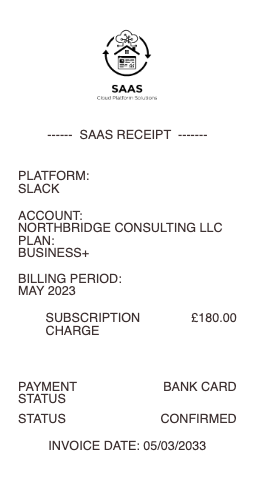
SaaS Receipt
Add custom logo
Edit line items
Choose payment method
Add/remove elements
Customize business information
Choose font
SaaS billing is priced in seats, and seats move
Most business SaaS is billed per seat per month, and unlike a fixed subscription, the number being multiplied changes constantly: people join, leave, get deactivated, get re-added. Every one of those events touches the bill.
That is why SaaS receipts are full of proration lines — partial-month charges for a seat added on the 17th, credits for one removed on the 9th. A receipt with four proration adjustments is not a billing error; it is the ledger of your team's churn that month. But it does need checking, because deactivated-but-still-billed seats are the single most common source of SaaS overspend — the subscription equivalent of paying rent on an empty desk.
Invoice versus receipt: B2B runs on the first
Consumer subscriptions send receipts; business SaaS properly issues invoices, and the difference matters to a finance team:
The invoice is the demand for payment — numbered, dated, addressed to the legal entity, showing tax correctly for the buyer's jurisdiction.
The receipt confirms the invoice was paid.
Accounts payable, VAT reclaims, and audits all key off the invoice. If your SaaS vendor only emails a card receipt to whoever signed up, finance is missing the document it actually needs — most vendors will add a billing contact, the company's legal name, address, and tax number to invoices on request, and doing it once at setup saves a year of forwarding emails.
The annual-versus-monthly decision at company scale
SaaS vendors discount annual commitments heavily — and at company scale the trade-off is sharper than for a personal subscription. Annual billing means the year's cash leaves on day one and the seat count is often committed: you can usually add seats mid-term (prorated), but rarely reduce below the committed number until renewal.
So the receipt trail to keep is: the order form or plan agreement (the committed seats and rate), the invoices (what was actually billed), and the proration lines (what moved). Renewal negotiation runs on exactly these documents — a buyer who can show actual seat utilisation against commitment negotiates from evidence; one who cannot, negotiates from the vendor's numbers.
What a SaaS invoice or receipt must show
The plan and billing period.
Seat count and per-seat rate — the multiplication, visible.
Proration adjustments, each dated and attributed.
Usage-based components where they exist (API calls, storage), stated separately.
The legal entity billed and its tax details.
Tax treatment — SaaS is taxed very unevenly across jurisdictions, and cross-border B2B sales frequently arrive under reverse charge with no tax charged.
Keeping SaaS records as a business
SaaS spend is fully deductible business expense, and it is also the category most prone to silent sprawl — tools bought by one team on one card, invisible to finance until the annual renewal. Central billing contacts and a monthly reconciliation of invoices against the card statement are the unglamorous fix.
Vendors keep complete billing histories in the account portal, which is the first place to recover a missing invoice — and the reissued document carries the tax details a reconstruction cannot. If a record is missing while the charge genuinely happened, your card statement establishes date, amount, and vendor, and a clear reconstructed record documents that real payment for your files, matching the statement exactly; for VAT or audit purposes, the vendor's own invoice remains the document that counts.
Frequently asked questions
Everything you need to know about the product and billing.
Why does my SaaS receipt have proration lines?
Because seats moved mid-cycle — a partial charge for a seat added on the 17th, a credit for one removed on the 9th. It is normal, but check it: deactivated-but-still-billed seats are the most common source of SaaS overspend.
What is the difference between a SaaS invoice and a receipt?
The invoice is the numbered demand for payment, addressed to the legal entity with correct tax treatment; the receipt confirms payment happened. Finance, VAT reclaims, and audits run on the invoice — set up proper billing details once at signup.
Can I reduce seats mid-term on an annual plan?
Usually not below the committed count — annual commitments typically allow prorated additions mid-term but hold the floor until renewal. That committed number, against actual utilisation, is exactly what renewal negotiations turn on.
What should a SaaS invoice show?
The plan and period, seat count and per-seat rate, dated proration adjustments, any usage-based components separately, the legal entity billed with its tax details, and the tax treatment — often reverse charge on cross-border B2B.
Why is there no tax on my SaaS invoice?
If you are a business buying cross-border and supplied your tax number, the sale likely falls under the reverse charge — you account for the tax yourself. Domestically, SaaS taxability varies widely by jurisdiction.
How do we stop SaaS sprawl?
Central billing contacts, one card or PO route for software, and a monthly reconciliation of invoices against the statement. Sprawl is invisible until renewals land — the invoice trail is what makes it visible earlier.