A sample receipt is a filled-in example you can study before writing or generating your own — every field completed the way a real receipt would be. This guide walks through an annotated sample line by line, shows how samples differ by receipt type (payment, cash, rent, hotel), and clears up the difference between a sample, a blank template, and a generator — plus one common mix-up about USCIS "receipt notices."
Sample Receipt
Add custom logo
Edit line items
Choose payment method
Add/remove elements
Customize business information
Choose font
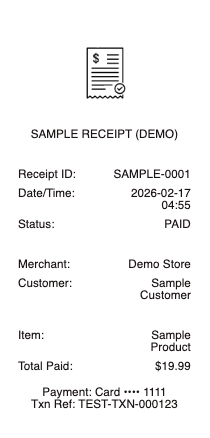
Anatomy of a sample receipt, line by line
Read any good receipt sample from top to bottom and you'll find the same skeleton:
Header — the business or issuer's name and contact details.
Receipt number & date — a sequential number and the transaction date.
Itemized lines — each product or service with quantity and price.
Subtotal, tax & total — the pre-tax amount, sales tax, and final figure.
Payment method — cash, card (last four digits), check, or transfer.
Signature or confirmation — the receiver's sign-off where applicable.
A sample exists to show what "complete" looks like — if your receipt has all six zones filled, it will hold up.
Receipt samples by type
The skeleton stays constant, but each receipt type stresses different fields. A payment receipt sample highlights the paid-in-full status and what the payment was for. A cash receipt sample writes the amount in figures and words with a signature, since cash has no bank trail. A rent receipt sample adds the property and the rental period covered. A hotel receipt sample (folio) itemizes nightly rates, taxes, and incidentals by day. Studying the sample for your specific use shows which fields carry the legal or reimbursement weight before you write your own.
Sample vs. blank template vs. generator
Three tools, three jobs. A sample is a completed example — you look at it to understand the format. A blank template is the same layout with empty fields — you print it and fill it in by hand. A generator asks for your details and produces the finished receipt for you, ready to download or print. Most people start with the sample to see the standard, then use the template or generator to produce theirs. Whichever route you take, the goal is identical: a complete, legible record of a real transaction.
What separates a useful sample from a decorative one is realistic details: a good example shows plausible tax arithmetic (the tax line actually equals the rate times the taxable subtotal), sequential-looking transaction numbers, and payment lines that match how tills really print them. Samples with lorem-ipsum item names teach the layout but not the logic — and the logic is what you are usually trying to learn.
One mix-up: the USCIS "receipt notice"
A frequent search — USCIS receipt notice sample — is about something entirely different. That's Form I-797C, the notice U.S. Citizenship and Immigration Services mails to confirm it received your immigration application, with a case receipt number for tracking. It is a government case document, not a purchase receipt, and only USCIS can issue it — no template or generator legitimately produces one. If that's what you're looking for, the reference sample lives on official USCIS resources; the receipts on this site are payment and transaction receipts only.
Related receipt template receipts: see also our Simple receipt guide and our Generic receipt guide.
Get a sample receipt (and make your own)
Our receipt samples, templates, and generator cover the common types — payment, cash, rent, sales, hotel, and more — so you can study a completed example and then produce your own clean, itemized receipt in minutes.
For genuine transactions only. Samples exist to show the format; receipts you create should document real payments that actually happened. Fabricating a receipt for a transaction that didn't occur is fraud, whatever tool produced it.
Use a sample the way an accountant would: as a checklist to grade real receipts against. Vendors hand over incomplete slips constantly — a missing date here, an absent tax breakdown there — and the fastest way to know what to ask a merchant to add is to hold their slip against a complete example of the same type.
Frequently asked questions
Everything you need to know about the product and billing.
What is a sample receipt?
A filled-in example of a receipt with every field completed — header, receipt number and date, itemized lines, subtotal, tax and total, payment method, and signature. It shows what a complete receipt looks like before you write or generate your own. The best ones carry realistic details — tax lines that actually compute, plausible transaction numbers — because the arithmetic logic is what a sample teaches.
What's the difference between a sample receipt and a blank template?
A sample is a completed example you study for the format; a blank template is the same layout with empty fields you fill in yourself. A generator goes one step further and produces the finished receipt from your details.
What should every receipt include?
The issuer's name and details, a receipt number and date, itemized products or services, the subtotal, tax and total, the payment method, and a signature or confirmation where applicable.
How do receipt samples differ by type?
The skeleton is the same, but each type stresses different fields: cash receipts write the amount in figures and words with a signature, rent receipts add the property and period, hotel folios itemize nightly charges, and payment receipts highlight the paid status.
What is a USCIS receipt notice sample?
That's Form I-797C — the notice USCIS mails confirming it received your immigration application, with a case number for tracking. It's a government case document, not a purchase receipt, and only USCIS can issue one.
Can I use a sample receipt as my actual receipt?
No — a sample is a reference showing the format. To document a real transaction, fill in a blank template or use a generator with the actual details of the payment that took place. Its real job is as a benchmark — hold a vendor's incomplete slip against a complete sample of the same type and you can name exactly what to ask them to add.