A shared scooter receipt is built from an unlock fee plus per-minute pricing — and sometimes a fine arrives later. This guide explains the fare anatomy, parking-photo rules, and the pass-through charges that follow a ride.
Scooter Rental Receipt
Add custom logo
Edit line items
Choose payment method
Add/remove elements
Customize business information
Choose font
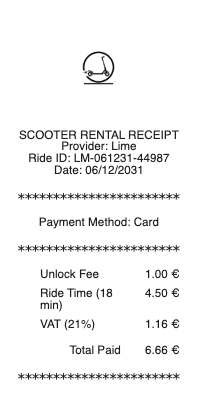
The two-part price: unlock plus minutes
Shared e-scooter pricing is nearly universal in structure: a fixed unlock fee to start the ride, plus a per-minute rate while it runs. The receipt shows both, and the structure explains the economics of short trips — on a five-minute hop, the unlock fee can be half the total, which is why day passes and subscription bundles exist for regular riders.
The meter runs on time, not distance — a scooter stuck at red lights costs the same per minute as one moving. Pausing a ride (locking mid-trip to enter a shop) usually bills at a reduced per-minute rate, which appears as its own line. The receipt's minute count against your remembered trip time is the first thing to check when a total looks wrong.
The parking photo is part of the transaction
Shared scooters end their rides with a requirement no other rental has: the end-ride photo proving the scooter was parked legally and properly. That photo is not busywork — it is your evidence in the two commonest post-ride problems:
The ride that won't end — billing continues until the app accepts the end-ride; the photo timestamps when you actually finished.
The parking fine — cities fine operators for badly parked scooters, and operators pass those fines through to the last rider. Your photo of a properly parked scooter is the appeal.
Take the photo carefully — the scooter, its position, the surroundings — because it is the one piece of evidence only you can create.
The charge that arrives days later
Scooter receipts have a second act. After the ride, further charges can land:
Fines passed through — parking violations, riding-zone breaches.
Retrieval fees — scooters ended outside the service area or in forbidden zones.
Damage charges, from operator inspection.
Each should arrive with its own notification and receipt referencing the original ride. Anything that arrives without one is disputable — in-app first, then via your card issuer with the original ride receipt and your end-ride photo as evidence. Check your statements in the weeks after using scooters in an unfamiliar city; this category of charge is easy to miss.
What the ride receipt should show
The unlock fee and per-minute charges, with pause time separately if it applied.
Ride duration and route — start and end points, times.
The scooter's ID — the specific vehicle, which matters when a fine or damage claim follows.
Credits or passes applied — day passes, subscription minutes, promo credit.
The total and payment method.
Two more lines matter when they appear. A geofence penalty — ending a ride outside the service area or inside a no-parking zone triggers a fee the app warned about in small print, and the receipt should name the zone rule it applied. And any ride pass or subscription — day passes and monthly bundles change the arithmetic of the unlock fee, so the receipt should show whether a pass absorbed it or the standard rate applied.
Keeping micromobility records
Ride history lives in the app with per-ride receipts, and the end-ride photos are stored with the rides — screenshot the ones from any ride that felt likely to generate a dispute (awkward parking, service-area edges). For expensed rides, the app history exports cleanly.
If a record is missing while the ride genuinely happened, your card statement establishes the date, amount, and operator, and a clear reconstructed record documents that real payment for your files, matching the charge exactly. Post-ride fines and fees are the operator's records — dispute them from the app history, where the original ride, its route, and your photo still live.
If a later charge looks wrong, work from the app's own records: the ride map, the timestamps, and your end-ride photo are all stored against the ride, and an appeal built on them — filed through the app promptly — is how wrongly attributed fines and damage claims get reversed.
For longer rentals booked through a shop rather than an app, the rental receipt example shows an agreement-style layout with a deposit line.
Frequently asked questions
Everything you need to know about the product and billing.
How is a shared scooter ride priced?
A fixed unlock fee plus a per-minute rate — time, not distance. On short trips the unlock fee dominates, which is why day passes exist. Paused time usually bills at a reduced rate on its own line.
Why does the end-ride photo matter?
It proves when the ride ended and that the scooter was parked properly. It is your evidence against continued billing and against parking fines passed through by the operator — the one piece of evidence only you can create.
Why did I get a charge days after my scooter ride?
Operators pass through parking fines, retrieval fees for out-of-zone endings, and damage charges after inspection. Each should reference the original ride; anything unexplained is disputable with your ride receipt and photo. Check the app's ride record first — the map, timestamps, and your end-ride photo are stored with the ride and are the evidence an appeal is built on.
What should a scooter receipt show?
Unlock fee and per-minute charges (pause time separate), duration and route, the specific scooter's ID, any passes or credits applied, and the total with payment method. Geofence penalties and ride-pass deductions should also be named when they apply — a fee without a stated rule is worth querying.
Why does the scooter's ID matter?
Because fines and damage claims attach to a specific vehicle — the ID on your receipt is what ties, or fails to tie, a later charge to your ride.
Do scooter rides work for expense claims?
Yes — the app's ride history exports per-ride receipts with dates, routes, and amounts, which substantiate short urban work trips cleanly.