A second-hand luxury receipt documents a pre-owned designer or high-value purchase. This guide explains what provenance means, which fields protect resale value, and how authentication paperwork differs from a purchase receipt.
Second Hand Luxury Receipt
Add custom logo
Edit line items
Choose payment method
Add/remove elements
Customize business information
Choose font
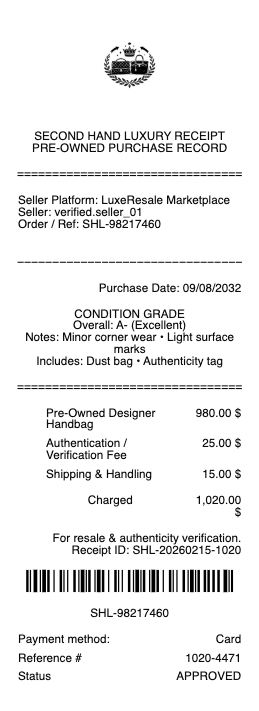
In pre-owned luxury, the paperwork is part of the asset
Buy a new handbag from a boutique and the receipt is a formality — the item's history begins with you. Buy the same bag second-hand and the receipt becomes something else entirely: the newest link in a provenance chain, the documented record of what the item is and who has owned it.
That chain is not sentimental. It is a measurable component of value. Two identical items in identical condition sell for different sums depending on what paperwork travels with them, which is why in this market the documents are treated as part of the goods rather than as an afterthought.
What a pre-owned luxury receipt must capture
A general-purpose receipt is not sufficient here. The document needs to identify the individual object, not a category of object:
Brand, model, and reference — the specific product name and code, not "handbag".
Serial, date, or authenticity code — the identifier stamped, embossed, or embedded in the item itself.
Condition grade, in the seller's own terms, and ideally what that grade means.
What is included — original box, dust bag, authenticity card, original receipt, extra links, spare buttons. Each has value; the absence of each has cost.
Any known history — service records, prior repairs, refurbishment performed by the reseller.
Price, date, and payment method.
An authentication is not a receipt — and vice versa
These two documents get conflated constantly, and they do entirely different jobs:
A receipt proves a transaction: that you paid this amount, to this seller, on this date.
An authentication or certificate asserts a fact about the object: that a qualified party examined it and considers it genuine.
You can have either without the other, and neither substitutes for the other. A receipt from a reputable reseller with an authenticity guarantee is strong precisely because it links the two: it evidences the purchase and the promise standing behind the object. Keep both documents together, because at resale a buyer will want to see both — and an insurer certainly will.
Why condition language matters more than it looks
Second-hand luxury lives or dies on condition grading, and grading is not standardised across the market. One reseller's "excellent" is another's "very good". The receipt or listing record is what pins down what you were told at the point of sale — and that matters enormously if the item arrives worse than described.
Keep the listing photographs with the receipt. A dispute over condition is a dispute about what was represented, and the representation lives in the listing, not in the invoice total. Resellers with a returns window expect you to inspect on arrival; the paperwork is what makes an inspection actionable.
Keeping the chain intact
Everything that arrived with the item is worth keeping, however trivial it seems: box, dust bag, authenticity card, care booklet, and the reseller's own receipt and authentication. Photograph the item, its serial or date code, and each document on arrival, and store the images alongside the purchase record.
For insurance, the receipt establishes value and the serial identifies the object — both are needed to schedule a valuable item on a policy. If a purchase record is lost while the purchase genuinely happened, a clear reconstructed record of your own transaction, built from the order confirmation and your card statement, documents that real payment for your files. It does not authenticate anything, it cannot replace a certificate or the reseller's own records, and it should match the underlying transaction exactly.
Frequently asked questions
Everything you need to know about the product and billing.
What is provenance in second-hand luxury?
The documented history of an item — what it is, where it came from, and who has owned it. It is a measurable part of value: two identical items in identical condition can sell for different sums depending on the paperwork that travels with them.
What should a pre-owned luxury receipt include?
The brand, model and reference, the item's serial or authenticity code, the condition grade, exactly what is included (box, dust bag, authenticity card, original receipt), any service history, and the price, date, and payment method.
Is an authenticity certificate the same as a receipt?
No. A receipt proves a transaction — what you paid, to whom, when. An authentication asserts a fact about the object — that a qualified party examined it and considers it genuine. You need both, and neither substitutes for the other.
Why does 'box and papers' affect the price?
Because they are part of the provenance chain a future buyer will assess. An item with its original box, cards, and paperwork consistently commands a premium over an identical item sold with nothing.
What if the item arrives worse than described?
The dispute is about what was represented, so keep the listing photographs and the condition grade alongside the receipt. Grading is not standardised across resellers, which is exactly why the record of what you were told matters.
Do I need the receipt to insure a luxury item?
Generally yes. Scheduling a valuable item requires documented value and an identifier for the object — the receipt provides the first and the serial or date code the second.