A seminar receipt often supports continuing education requirements — CPE, CLE, CE credits. This guide explains why the receipt and the completion certificate are both required, and how professionals should file them.
Seminar Receipt
Add custom logo
Edit line items
Choose payment method
Add/remove elements
Customize business information
Choose font
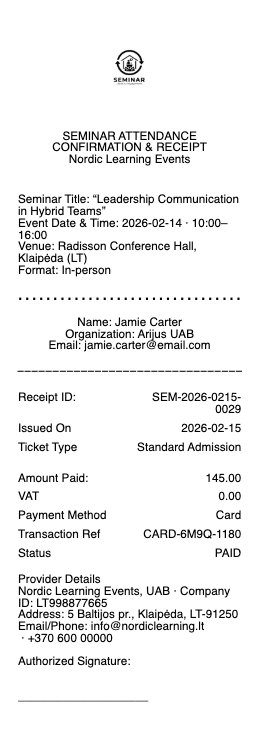
For professionals, a seminar receipt is compliance paperwork
Licensed professionals — accountants, lawyers, engineers, medical staff, financial advisers, real estate agents — carry continuing education obligations: a required number of credit hours (CPE, CLE, CE) per reporting cycle, evidenced to a licensing board.
That turns seminar paperwork into compliance documentation. The board audit does not ask whether you found the afternoon useful; it asks for evidence you attended a qualifying program. And that evidence is two documents, not one — which is the point most professionals discover only when audited.
The receipt and the certificate do different jobs
The receipt proves you paid and registered — the transaction.
The certificate of completion proves you attended and earned the credits — issued after the event, stating the credit hours, the field of study, and the provider's accreditation details.
Boards want the certificate; expense claims and deductions want the receipt; a clean file holds both, stapled together per event. The certificate's details matter: credits in the wrong field of study, or from a provider not accredited for your jurisdiction, can fail an audit even with perfect attendance — check the accreditation before registering, from the seminar's own marketing, which is obliged to state it.
Who pays, and what that changes
Three funding patterns, three paper trails:
Employer-paid — the firm registers and pays; your role is ensuring the certificate lands in your CE file, because the credits are yours even though the receipt is theirs.
Self-paid, employed — reimbursement runs on the receipt; the certificate stays with you.
Self-employed — continuing education that maintains or improves skills in your existing profession is an ordinary business expense; the receipt supports the deduction, and the certificate supports the licence.
The recurring failure: employer-paid seminars where the certificate was emailed to the booking coordinator and never reached the professional's own records. Chase the certificate the week of the event, not the week of the audit.
What the seminar receipt should show
The provider and its accreditation or sponsor ID where applicable.
The program title, date, and format — live, webinar, or self-study, which boards treat differently.
The credit hours offered and field of study.
The amount, and what it covered — registration, materials, exam fees separately where they apply.
The registrant's name — credits are personal, and a receipt in the firm's name plus a certificate in yours is the normal, correct pairing.
Where the seminar spans formats, the receipt should reflect it: a livestreamed session, an on-demand recording, and an in-person day of the same program can carry different credit values and even different accreditation — the receipt naming the format you actually bought is what keeps the certificate and the payment record telling the same story.
Filing for the audit you hope never comes
Boards audit CE compliance by sampling licensees and asking for the cycle's documentation. The professionals who pass painlessly keep one running file per cycle: certificates with receipts attached, a simple tally of credits by category, kept for the cycle plus the retention period the board specifies.
Providers keep registration and completion records and can reissue both documents, which is the recovery route — though slow ones can outlast an audit deadline, which is the argument for filing as you go. If a receipt is missing while the payment genuinely happened, your card statement establishes the date, amount, and provider, and a clear reconstructed record documents that real payment for your files, matching the charge exactly; the certificate, which only the provider can reissue, remains what the board actually requires.
Boards also differ on carryover — whether hours earned above one cycle's requirement count toward the next. Where carryover exists, the seminar receipts near a cycle boundary matter twice: the date on the receipt decides which cycle the hours belong to, and a program completed days apart from its payment can land the two documents in different reporting years.
Frequently asked questions
Everything you need to know about the product and billing.
What is the difference between a seminar receipt and a CE certificate?
The receipt proves you paid and registered; the certificate of completion proves you attended and earned the credits, stating hours, field of study, and the provider's accreditation. Boards want the certificate; claims and deductions want the receipt — keep both.
How do I know a seminar qualifies for my CE requirements?
Check the provider's accreditation and the credits' field of study against your board's rules before registering — the seminar's marketing must state them. Wrong field or unaccredited provider fails an audit regardless of attendance.
Are seminars tax deductible?
For the self-employed, continuing education that maintains or improves skills in your existing profession is ordinarily deductible, supported by the receipt. Education qualifying you for a new profession is treated differently.
My employer paid — what do I need to keep?
The certificate. The credits are personal to you even when the firm holds the receipt — make sure the completion certificate reaches your own CE file the week of the event.
What should a seminar receipt show?
Provider and accreditation ID, program title, date and format, credit hours and field of study, the amount with materials or exam fees separate, and the registrant's name. The delivery format belongs on it too — livestream, on-demand, and in-person versions of one program can carry different credit values.
How long should CE records be kept?
For the reporting cycle plus the retention period your board specifies. Audits sample licensees and ask for the full cycle's certificates — the painless pass is a running file kept as you go. Receipts near a cycle boundary deserve extra care — where a board allows carryover, the dates decide which cycle the hours count toward.