A shoe store receipt supports exchanges, returns, and manufacturer defect claims. This guide explains why unworn condition is the test, how sizing exchanges work, and what separates a defect from ordinary wear.
Shoe Store Receipt
Add custom logo
Edit line items
Choose payment method
Add/remove elements
Customize business information
Choose font
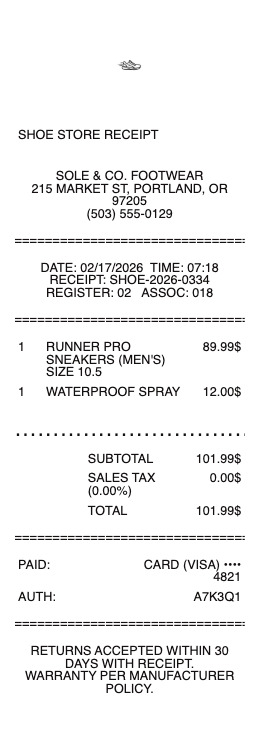
Footwear returns turn on one word: unworn
Shoes are the retail category where the condition rule bites hardest, because a shoe cannot be assessed without being tried — and trying it outdoors destroys the right to return it.
The near-universal standard is unworn: try them on indoors, on carpet, for as long as you like. Take them onto a pavement once and the soles carry the evidence, which is exactly what a returns desk inspects. This is not pedantry on the retailer's part; a shoe worn outside cannot be resold, so the cost of the return falls entirely on them.
Keep the box, too. It is part of the product for return purposes, it carries the model and size codes, and returning shoes without it is frequently refused outright.
Exchanges are the common case, and the receipt makes them painless
Most footwear returns are not complaints — they are size swaps, and retailers expect them. A receipt turns a size exchange into a two-minute counter transaction, and its absence turns it into an argument about what you paid.
The detail worth knowing: an even exchange is straightforward, but where the item has since gone on sale, a no-receipt exchange is typically valued at the current price. Exchange a $140 pair for the same shoe in another size and the receipt makes it an even swap. Without one, a store applying the current $80 sale price may ask you to make up the difference — for the identical shoe you already bought.
Manufacturing defect or ordinary wear?
This is the distinction that decides every footwear complaint, and retailers assess it carefully because customers routinely claim the second as the first:
A manufacturing defect is a failure of materials or construction: a sole separating from the upper, stitching coming apart, a failed adhesive, an eyelet tearing out of intact leather. These fail early and in ways wear does not explain.
Ordinary wear is the shoe doing its job: worn treads, creased uppers, compressed cushioning, scuffs.
Defect claims often extend beyond the return window and go to the manufacturer rather than the store — and they require the proof of purchase and its date, because the claim rests on how long the shoe survived. A sole failing at three months is a defect; the same failure at three years is a shoe that has been worn out.
Athletic footwear and the wear-tested exception
Some athletic brands and specialist running retailers deliberately break the unworn rule, offering a trial period during which shoes can be run in and returned if they do not suit. It is a genuine, valuable exception — and it is a specific programme, not a general right.
These trials carry conditions: a defined window, sometimes a requirement to return through the original channel, and always the original proof of purchase. Do not assume a running-shoe trial policy applies at a general shoe shop; check before you take them outside, because that single step is irreversible everywhere else.
Keeping the record
Keep the receipt and the box for at least the return window, and considerably longer for an expensive pair where a defect claim is plausible. Photograph the receipt on purchase — footwear receipts are thermal and fade, and a defect claim at eight months is exactly when you will need a legible one.
Many retailers attach purchases to a loyalty account or email a digital receipt, which is the easiest record to keep and the first place to look for a missing one. If an original is lost while the purchase genuinely happened, a clear reconstructed record from your card statement documents that real payment for your files, matching the charge exactly — and for a manufacturer defect claim, ask the retailer to reissue from their transaction record, which is the document the maker will want.
Frequently asked questions
Everything you need to know about the product and billing.
Can I return shoes I have worn?
Generally not. The standard is unworn — trying them on indoors is fine, but wearing them outside marks the soles and makes them unsellable, which is what a returns desk inspects for. Some running specialists offer a wear-test trial, but that is a specific programme, not a general right.
Do I need the shoe box to return them?
Usually yes. The box is treated as part of the product, carries the model and size codes, and returns without it are frequently refused.
What happens if I exchange shoes without a receipt?
The exchange is typically valued at the current price. If the shoe has since gone on sale, you may be asked to pay the difference to swap for the identical pair in another size — which a receipt would have made an even exchange.
What counts as a manufacturing defect in footwear?
A failure of materials or construction — a sole separating, stitching coming apart, failed adhesive, an eyelet tearing out of intact leather. Worn treads, creases, and compressed cushioning are ordinary wear, not defects.
How long do I have for a defect claim?
Defect claims often extend beyond the return window and go to the manufacturer rather than the store. They require a dated proof of purchase, because the claim rests on how long the shoe survived before failing.
Why should I photograph a shoe receipt?
Because it is thermal and will fade. A defect claim months later is precisely when you need a legible receipt, and by then the paper original often is not.