A sneaker store receipt does double duty: proof of purchase and provenance for resale. This guide explains raffle-release rules, why limited drops are final sale, and how the receipt supports authentication later.
Sneaker Store Receipt
Add custom logo
Edit line items
Choose payment method
Add/remove elements
Customize business information
Choose font
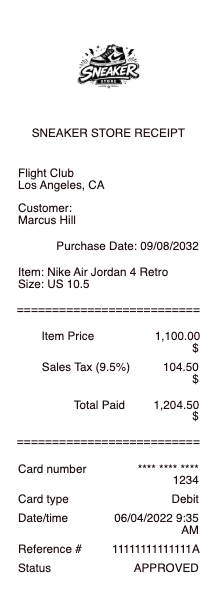
Sneaker retail runs on scarcity, and the paperwork shows it
Limited-release sneakers inverted normal retail: for hyped models, demand so exceeds supply that stores choose the buyers — through raffles, app draws, and queue systems — and the purchase comes with conditions no ordinary shoe carries.
The receipt from a limited drop is therefore a different document from a regular shoe receipt. It evidences not just a purchase but a win: this pair, this size, from this authorised retailer, on release day. In a market where a pair can resell the same afternoon for a multiple of retail, that evidence has cash value — which is why the receipt's afterlife matters more here than almost anywhere in retail.
Raffles, draws, and the one-pair rule
Release mechanics vary — in-app draws, in-store raffles, first-come queues — but converge on the same conditions:
One pair per person, enforced by ID, account, or payment card.
Winner's name matches the buyer — entries are personal and transfer is barred at purchase.
Payment windows — a won draw must be paid within hours or the pair passes to the next entrant.
The receipt (or app order confirmation) records the win being exercised. Stores enforce the rules unevenly, but the paperwork trail — entry, win notification, payment, receipt — is what a dispute about a cancelled or unfulfilled win is argued from.
The in-app order record deserves separate respect from the email receipt: draw-based releases live inside the retailer's app, and the order history there is often the only place the entry, the win, and the purchase appear as one thread. Screenshots of a winning draw entry age better than app accounts do — apps get deleted, re-registered, and migrated, and the order thread rarely survives the move.
Final sale: why limited drops rarely come back
Limited releases are commonly final sale — no returns, exchanges only for defects — for a mechanical reason: a returned pair cannot rejoin a release that already ended. Policies differ between general-release stock (normal return windows) and drop stock (final or heavily restricted), and the receipt should state which regime applied.
The practical consequences: size decisions matter before purchase (release-day pairs bought on hope of fitting are a resale market staple), and defect claims run through the manufacturer or store warranty route rather than returns — with the receipt's date and item identification carrying the claim.
The receipt as provenance in the resale market
Sneaker resale platforms authenticate by inspecting the shoes — but for private sales, high-value pairs, and disputes, the original receipt is the provenance document: it ties the pair to an authorised retailer and a release date, which is exactly what a counterfeit lacks.
Selling — a pair offered with its original receipt commands more buyer confidence, and often more money, than an identical pair without.
Style codes matter — the receipt should show the model's style/SKU code, which is how a specific colourway is identified against the box label.
Insurance — collections of consequence are insurable, and receipts establish the values.
Keeping sneaker records
For pairs with resale or collection value, keep the receipt with the box — physically or photographed together with the box label and style code. App-based purchases keep order history in the account, which is the recovery route for digital receipts.
If a record is missing while the purchase genuinely happened, your card statement establishes the date, amount, and retailer, and a clear reconstructed record documents that real payment for your files, matching the charge exactly. It is not an authentication — nothing but the shoes and their inspection is — but as provenance support, the dated record from an authorised retailer is precisely the paper the resale market values.
For customs and warranty questions the receipt does the same jobs it does everywhere else — but sneaker collections add one habit worth copying from watch collectors: a simple inventory list, one line per pair with style code, size, purchase date, and price, kept with the receipt photos. Insurers, buyers, and future-you all read a list faster than a shoebox of slips.
Frequently asked questions
Everything you need to know about the product and billing.
Why are limited sneaker releases sold by raffle?
Because demand for hyped models exceeds supply so severely that stores select buyers — via app draws, raffles, and queues — with one-pair-per-person rules enforced by ID or account. The receipt evidences the win being exercised.
Are limited-release sneakers returnable?
Commonly final sale — a returned pair cannot rejoin a release that ended. General stock keeps normal return windows; drop stock is final or heavily restricted, and the receipt should show which regime applied. Defects go the warranty route instead. Screenshot the winning draw entry too — app order histories rarely survive account migrations, and the entry-win-purchase thread is the fullest record of a release pair.
Does the original receipt increase resale value?
It adds provenance: proof the pair came from an authorised retailer on a given date — exactly what counterfeits lack. Pairs offered with receipts command more buyer confidence and often more money.
What is a style code and why does it matter?
The model/colourway SKU printed on the box label and, ideally, the receipt. Matching receipt, box, and shoe by style code is the basic provenance chain the resale market checks.
What should a sneaker receipt show?
The retailer, date, the model with its style code and size, the price, and the sale regime (general release or final-sale drop). For app purchases, the order confirmation in the account carries the same role.
Can I insure a sneaker collection?
Collections of consequence are insurable like other valuables, with receipts establishing values — one more reason receipts and box labels stay together, physically or photographed. An inventory list helps — one line per pair with style code, size, date, and price, kept alongside the receipt photos, is what an insurer or buyer actually reads.