A software subscription receipt proves an entitlement that ends when payment stops. This guide explains subscription versus perpetual licences, what happens to files and access at lapse, and enterprise true-up audits.
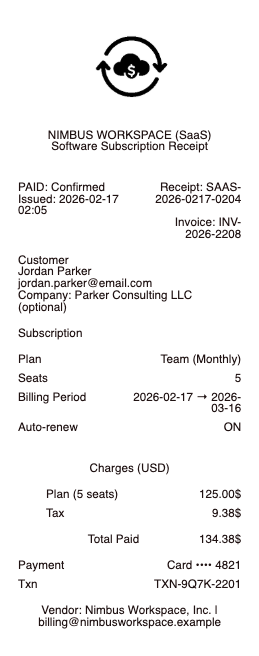
Software Subscription Receipt
Add custom logo
Edit line items
Choose payment method
Add/remove elements
Customize business information
Choose font
You are not buying software — you are renting the right to run it
The defining fact of subscription software is what happens when you stop paying: the software stops working. Not gradually — access ends, apps deactivate, and in the strictest models even opening your existing files requires an active plan.
That is the difference between a subscription and the perpetual licence it replaced. A perpetual licence bought version X forever (with updates sold separately); a subscription buys continuous access, always-current versions, and cloud services — for exactly as long as the payments continue. Neither is wrong, but they are different assets, and the receipt is the record of which one you hold. On a subscription, the receipt run is effectively your proof of entitlement: the evidence that, this month, you are licensed.
What lapse actually does — plan for it before it happens
Before letting any software subscription lapse, three questions, answered from the vendor's terms rather than optimism:
What happens to the files? Proprietary formats can become read-only or unreadable without the subscription. Export to open formats before the lapse, not after.
What happens to cloud storage? Grace periods before deletion vary from generous to brutal; the receipt's coverage end-date is the clock.
What happens to the price if you return? Winback offers exist, but so do repriced plans — the rate on your old receipts is not a promise.
The enterprise version: compliance and the true-up
At business scale, software subscription paperwork becomes a compliance matter. Volume agreements license a stated number of users or devices, and vendors audit: an true-up is the periodic reconciliation where actual deployment is counted against licensed entitlement, and the gap is billed — sometimes with back-charges.
The defence is the same boring discipline as every audit: records. The agreement, the entitlement counts, the invoices, and the deployment inventory, kept current. A business that can show its licence position from its own records negotiates a true-up; one that cannot, receives one.
What the receipt should show
The product and edition — feature tiers matter at renewal and at audit.
The licence type: subscription term or perpetual.
Seats or devices covered, and the coverage period.
The account or licence ID the payment attaches to — entitlement is looked up by this, not by your name.
Amount, tax, and the payment method.
Two more fields earn their place. The billing entity — subscription receipts routinely arrive from a parent company, a reseller, or an app-store biller whose name matches nothing on the product — and reconciling the charge to the ledger means knowing which name to expect. And the renewal date with its cancellation window: the receipt that states when the next charge lands, and by when you must cancel to avoid it, is the one that prevents the accidental year.
Keeping software records
Keep the receipt with the licence ID and, where one exists, the licence key — the receipt proves you paid, the ID proves what for, and support conversations require both. For a business, keep the full run for the life of the product plus your audit retention period.
Vendors' account portals hold billing history and can reissue documents, which is the first recovery route. If a record is missing while the payment genuinely happened, your card statement establishes date, amount, and vendor, and a clear reconstructed record documents that real payment for your files, matching the statement exactly — it cannot recreate a licence entitlement, which lives in the vendor's systems against your account ID.
Add one habit at the end of a subscription's life: keep the final invoice and the cancellation confirmation together. Proration and refund questions arrive after the account is closed — when you can no longer log in to check anything — and that pair of documents is the whole answer.
Frequently asked questions
Everything you need to know about the product and billing.
What happens when a software subscription lapses?
Access ends and apps deactivate — and in strict models, even opening existing files requires an active plan. Export proprietary-format files to open formats before letting a subscription lapse, and check the cloud-storage deletion grace period.
What is the difference between a subscription and a perpetual licence?
A perpetual licence bought a version forever, with updates sold separately. A subscription buys continuous access and current versions for as long as payments continue. They are different assets, and your receipt records which one you hold.
What is a true-up?
The periodic reconciliation in enterprise licensing where actual deployment is counted against the licensed entitlement, and the gap is billed — sometimes with back-charges. Your own records of entitlement, invoices, and deployment are the defence.
What should a software subscription receipt show?
The product and edition, the licence type, the seats or devices and coverage period, the account or licence ID the payment attaches to, and the amount with tax and payment method. Note the billing entity too — the charge often arrives under a parent company or app-store name that matches nothing on the product.
Why does the licence ID on the receipt matter?
Because entitlement is looked up by account or licence ID, not by your name. Support, reactivation, and audits all start from that identifier — keep it with the receipt.
Will I get the same price if I resubscribe later?
Not necessarily. Winback offers exist, but plans get repriced — the rate on your old receipts is history, not a promise. Promotional and legacy pricing generally dies with the subscription — a lapsed account resubscribes at the current list price, which is one of the three questions to answer before letting a licence lapse.