A streaming subscription receipt often comes from an app store rather than the service itself. This guide explains third-party billing, ad-supported tiers, household rules, and why cancelling has two different doors.
Streaming Subscription Receipt
Add custom logo
Edit line items
Choose payment method
Add/remove elements
Customize business information
Choose font
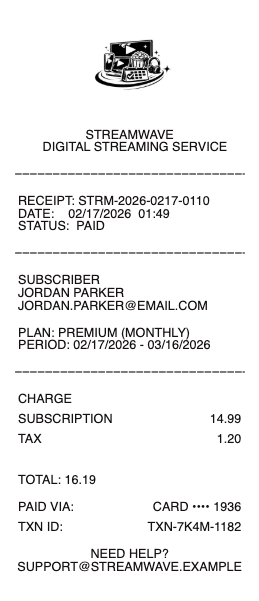
Your streaming receipt may not come from the streamer
The most confusing fact in streaming billing: if you subscribed through an app on your phone or TV, the app store may be the merchant. Apple or Google bills you, their receipt lands in their account history, and the streaming service itself may have no billing relationship with you at all.
Every downstream consequence follows from that:
The receipt lives in the app store account — not in your email from the streamer, and not on the service's website.
Cancellation must happen where the billing lives. Cancelling on the service's site does nothing if the subscription is an app-store one; it has to be cancelled in the store's subscription settings.
Prices can differ between direct and app-store signup for the same service.
The statement line tells you which door you are in: a charge from the app store is an app-store subscription, whatever the show you watch is called.
Tiers, ads, and the price ladder
Streaming pricing has stratified into tiers — ad-supported at the bottom, ad-free above it, premium (4K, more concurrent streams) on top — and providers move the rungs regularly. The receipt's job is to say which tier this month's charge bought, because the recurring pattern of the last few years is tier prices rising unevenly: the ad-free tier climbing while the ad tier holds, nudging subscribers downward or upward.
Comparing this month's receipt against last month's is how you notice you were migrated, repriced, or moved to a new plan name. Providers announce changes, but announcements are emails; receipts are facts.
Household rules and the end of casual sharing
Most major streamers now enforce household definitions — the account belongs to one residence, with extra-member slots sold separately. The billing consequence: what used to be one shared subscription is now a primary subscription plus paid add-on members, each visible as its own line on the receipt.
For the person paying, that means the receipt now documents who is on the account, and the add-on member fee is the field to check when the total creeps up. For families genuinely in one household, nothing changed except the enforcement; for everyone else, the receipt is where the new arithmetic shows.
Bundles: one charge, several services
Streaming increasingly arrives bundled — several services for one price, or included with a phone plan, an ISP, or a retail membership. Bundles complicate the paperwork in a predictable way: one charge, one receipt, several entitlements — and cancelling the bundle kills all of them, while cancelling one service may not reduce the price at all.
Know which services ride on which charge. A quarterly look at the receipt (or the carrier bill line) against what you actually watch is the entire discipline — bundles are priced on the certainty that most people never do this.
Keeping streaming records
For personal use, streaming receipts matter mainly for the audit: what tiers, which add-ons, which bundles, and whether the total has crept. For business claims they are rarely deductible outside genuine industry use — a media company's competitive research is a different thing from watching television.
App stores and streamers both keep billing history in the account, which is the recovery route for any missing record. If one is lost while the charge genuinely happened, your card statement establishes the date, amount, and merchant — noting that for app-store billing the merchant shown is the store, not the streamer — and a clear reconstructed record documents that real payment for your files, matching the statement exactly.
Frequently asked questions
Everything you need to know about the product and billing.
Why is my streaming receipt from Apple or Google?
Because you subscribed through an app, making the app store the merchant. The receipt lives in the store's account history, and the subscription must be cancelled there — cancelling on the streamer's website does nothing for an app-store subscription.
Why does the same service cost different amounts?
Direct and app-store signups can carry different prices, and tiers move: ad-supported, ad-free, and premium rungs are repriced unevenly and plans get renamed. Comparing receipts month to month is how migrations and increases surface.
What is an extra member or household fee?
Most major streamers now tie accounts to one residence and sell extra-member slots separately. Each add-on member appears as its own line, and it is the field to check when the total creeps upward.
How do bundles affect my receipt?
One charge covers several entitlements — and cancelling the bundle ends all of them, while dropping one service may not cut the price. Know which services ride on which charge before cancelling anything.
Are streaming subscriptions a business expense?
Rarely, outside genuine industry use — a media company's research is different from watching television. For most businesses they are personal costs.
Where do I find old streaming receipts?
In the account that billed you: the app store's purchase history for app-store subscriptions, or the streamer's billing page for direct ones. Your card statement tells you which — the merchant on the line is the one holding the records.