A supermarket receipt itemises a full grocery shop, with loyalty savings, unit pricing, and mixed tax lines. This guide explains how to read one, why food and non-food are taxed differently, and what to keep it for.
Supermarket Receipt
Add custom logo
Edit line items
Choose payment method
Add/remove elements
Customize business information
Choose font
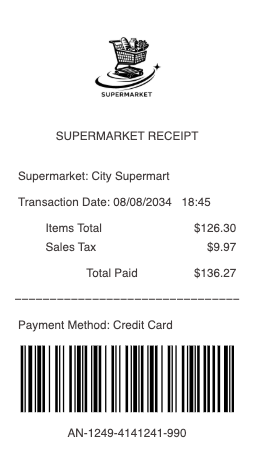
Why a supermarket receipt is longer than any other
A supermarket receipt is the most information-dense document most households handle. A single weekly shop can carry sixty or more line items, several different tax treatments, loyalty discounts applied at various levels, and a payment split across more than one method — all on one strip of paper.
That density is exactly why it is worth learning to read one properly. Most people glance at the total; the useful information is in the structure underneath it.
Unit pricing: the number that tells you the truth
Many supermarket receipts and shelf labels show a unit price — the cost per ounce, per litre, per 100g, or per item — alongside the headline price. It exists so that a 12-pack and an 18-pack, or a value size and a standard size, can be compared honestly.
It is the single most useful figure on the receipt for anyone tracking a food budget, because pack sizes are designed to make direct comparison hard. Two products with different prices and different weights are not comparable at a glance; their unit prices are. When you are checking whether prices have genuinely risen or the pack has quietly shrunk, the unit price is the number that reveals it.
Mixed tax lines: why some items are taxed and others aren't
A supermarket is one of the few shops where a single receipt commonly carries several tax treatments at once. In most tax systems, basic groceries are treated more favourably than other goods — often exempt, zero-rated, or taxed at a reduced rate — while household items, toiletries, alcohol, and prepared or hot food are taxed at the standard rate.
This is why supermarket receipts print a letter or symbol beside each line and a key at the foot of the receipt. The codes tell you which lines carried tax and which did not. If you are claiming any part of a shop as a business expense, or reclaiming VAT where it applies, that coded breakdown — not the total — is the part your bookkeeper actually needs.
Loyalty savings, coupons, and the two totals
Supermarket receipts typically show more than one total, and confusing them is a common source of error:
Gross total — the sum of the items at shelf price.
Loyalty and coupon deductions — card-linked prices, digital coupons, and manufacturer coupons, often listed separately.
Amount actually paid — the figure that hits your card, and the only one that matches your bank statement.
"You saved" line — a marketing summary, not an accounting figure.
When reconciling a receipt to a statement, the amount paid is the only number that will match. And where a shop is split across a card and a gift card, or a card and cash, each tender is listed separately at the foot of the receipt.
Keeping grocery receipts, and recovering a lost one
Grocery receipts matter more than people expect: for returns of spoiled or recalled products, for household budgeting, for per-diem and travel meal claims, and for anyone running a food business who buys supplies at retail. Loyalty accounts help here — most large chains keep a digital purchase history for card holders, and many can email or re-print a receipt from the transaction record.
Thermal supermarket receipts fade quickly, so anything you may need in months rather than days should be photographed the day you get it. If an original is gone and the purchase genuinely happened, you can reconstruct a clear record of your own transaction from your card statement, which pins the date, amount, and store — a record for your files documenting a real payment, matching the underlying charge exactly, and never a substitute for the store's own transaction record.
Frequently asked questions
Everything you need to know about the product and billing.
What is a unit price on a supermarket receipt?
The cost per ounce, litre, 100g, or item, shown alongside the headline price so that different pack sizes can be compared honestly. It is the most useful figure for tracking a food budget and for spotting shrinking pack sizes.
Why are some items on my grocery receipt taxed and others not?
Basic groceries are usually exempt, zero-rated, or reduced-rated, while household goods, toiletries, alcohol, and prepared or hot food are taxed at the standard rate. The letter codes beside each line and the key at the foot of the receipt show which is which.
Why does my supermarket receipt show two different totals?
One is the gross total at shelf prices; the other is what you actually paid after loyalty pricing and coupons. Only the amount paid will match your bank statement — the 'you saved' line is a marketing summary, not an accounting figure.
Can I get a copy of a lost supermarket receipt?
Often yes. Most large chains keep a digital purchase history for loyalty card holders and can re-print or email a receipt from the transaction record. Bring the card you paid with, or your loyalty account details.
Do I need the itemised receipt for a business expense?
Usually yes. The itemised receipt shows which lines carried tax and what was actually bought — a card slip shows only a total, which is not enough where food and non-food are treated differently.
Why do supermarket receipts fade?
They are printed on thermal paper, which darkens under heat rather than using ink and fades with time, light, and warmth. Photograph any receipt you may need beyond a few weeks.