A takeaway receipt through a delivery app carries fees the restaurant never charged. This guide explains the service, delivery, and small-order fees, the commission restaurants pay, and why the app total exceeds the menu price.
Takeaway Receipt
Add custom logo
Edit line items
Choose payment method
Add/remove elements
Customize business information
Choose font
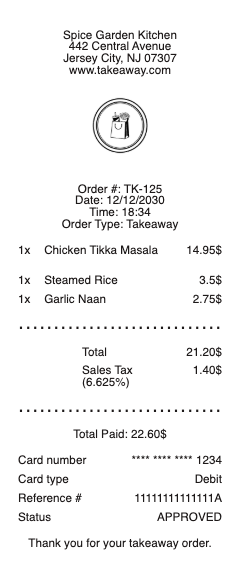
Why the app total never matches the menu
Order a $30 takeaway through a delivery app and pay $45. Nothing has gone wrong — you are seeing a stack of fees that a restaurant collecting your order at the counter would never have charged. The receipt is where the stack becomes visible, and it is worth learning to read.
A delivery-app total typically contains: the food subtotal (sometimes at a marked-up menu price), a delivery fee, a service fee (commonly around 15% of the order), a small-order fee where the basket is below a threshold, taxes, and a tip. Each is a separate line, and each goes to a different place.
The commission the restaurant pays out of your order
The part invisible on your receipt is what the platform takes from the restaurant. Commission rates typically run 15% to 30% per order, with the major platforms at the upper end, and on top of that sit payment processing fees of roughly 2.5–3% of order value, plus optional marketing and promotional costs.
So a $30 order can leave the restaurant with well under $22 before they have bought a single ingredient — which explains two things you may have noticed: menu prices on apps that are higher than in the restaurant (the markup is the restaurant recovering commission), and the small card in the bag asking you to order direct next time.
Fee, service charge, and tip are three different things
These get conflated constantly, and only one of them reaches the driver:
Delivery fee — goes to the platform, notionally to cover the cost of delivery. It is not the driver's payment.
Service fee — the platform's own charge, funding its infrastructure and operations.
Tip — the money intended for the driver.
The consequence matters: a high delivery fee does not mean the driver has been paid well. Customers who reason that a $6 delivery fee makes a tip unnecessary have in most cases paid the platform, not the person who carried the food. Subscription plans (DashPass, Uber One, Grubhub+) waive or reduce delivery fees for a monthly cost — which changes what you pay the platform and nothing about what the driver receives.
What the receipt has to show for an expense claim
Takeaway is one of the most commonly claimed and most commonly rejected expenses, because the app's summary email is often not enough:
The itemised food order, not just a total — and where the order fed several people, that itemisation is what evidences it.
Each fee, separately named. Some employers reimburse the food and tax but not the delivery and service fees, and only an itemised receipt allows the split.
The restaurant name, not merely the platform's.
The date and delivery address, which is what ties a working-late meal to a working-late claim.
Missing items, cold food, and who is responsible
When an order goes wrong, the receipt determines who owes you. A missing item is generally the restaurant's packing error; a late or cold delivery is generally the platform's. Both are usually resolved through the app rather than the restaurant, and both require the order number from the receipt.
Report it while the order is recent — refund windows on delivery apps are short, and a complaint made days later is routinely refused. Keep the receipt or the in-app order record until you are satisfied the order was correct, which for most people means until the meal is eaten.
Keeping the record
Delivery apps keep a full order history in the account, which is the easiest receipt archive you will ever have — everything is retrievable, itemised, and already digital. Download or screenshot the itemised version rather than relying on the summary confirmation email, because the summary frequently omits the fee breakdown that an expense claim needs.
If a record is lost while the order genuinely happened, your card statement establishes the date, amount, and platform, and a clear reconstructed record documents that real payment for your files — matching the charge exactly. Note that the statement will show the platform, not the restaurant, which is precisely why the app's own itemised receipt is the better document to keep.
Frequently asked questions
Everything you need to know about the product and billing.
Why is the delivery app total so much higher than the menu price?
Because the order carries a delivery fee, a service fee (commonly around 15%), possibly a small-order fee, taxes, and a tip — none of which a counter collection would incur. Menu prices on apps are also often marked up by the restaurant to recover commission.
How much commission do delivery apps charge restaurants?
Typically 15% to 30% per order, with the major platforms at the upper end, plus payment processing of roughly 2.5–3% of order value. A $30 order can leave the restaurant with well under $22 before costs.
Does the delivery fee go to the driver?
No. The delivery fee goes to the platform. The tip is the money intended for the driver — so a high delivery fee does not mean the driver has been paid well, and skipping a tip because the fee was large pays the platform rather than the person.
What do delivery subscriptions like DashPass actually do?
They waive or reduce the delivery fee in exchange for a monthly cost. They change what you pay the platform and nothing about what the driver receives.
Who is responsible for a missing item?
A missing item is generally the restaurant's packing error; a late or cold delivery is generally the platform's. Both are usually resolved through the app, and both need the order number from the receipt. Report it promptly — refund windows are short.
What does an expense claim need from a takeaway receipt?
The itemised food order, each fee separately named (many employers reimburse food and tax but not delivery and service fees), the restaurant name rather than just the platform's, and the date and delivery address.