A Target receipt is your proof of purchase for returns, exchanges, price adjustments, and expense records. It lists each item by its DPCI code, the store and register, your Target Circle savings, sales tax, and the barcode Target scans to look the sale up again. This guide explains what every line means, how to find or re-print a Target receipt in the Target app, and exactly how Target's return policy treats purchases made with and without a receipt.
Target Receipt
Add custom logo
Edit line items
Choose payment method
Add/remove elements
Customize business information
Choose font
What's on a Target receipt
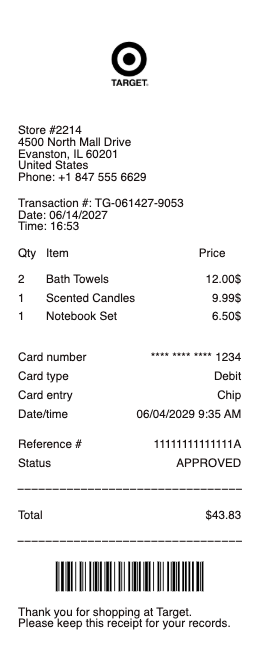
Every Target receipt — printed at the register or stored in the Target app — carries the same core fields, and knowing them makes returns and expense reports far easier:
Store & register details — the store number, address, lane/register number, and cashier ID that identify where the purchase happened.
DPCI item codes — Target's own nine-digit Department-Class-Item number (formatted 3-2-4, e.g. 059-06-0000) prints beside each product. It's how Target and Guest Services identify the exact item during a return.
Item prices & Target Circle savings — the shelf price plus any Target Circle deals, promotions, or RedCard 5% discount applied line by line.
Subtotal, sales tax & total — the taxable subtotal, state and local sales tax, and the amount charged.
Payment (tender) type — the card type and last four digits, RedCard, gift card, or cash used to pay, the detail Target relies on to look up a receipt-free return.
Receipt barcode & number — the barcode and long receipt ID near the bottom that Guest Services scans to pull up the transaction.
Target's return policy when you have the receipt
With a receipt, most items bought at Target can be returned or exchanged within 90 days. Two exceptions work in your favor: purchases made on a Target RedCard get an extra 30 days (120 total), and Target owned brands — like Good & Gather, Cat & Jack, Threshold, and Up & Up — carry a full one-year return window. Electronics and entertainment items have shorter windows (often 30 days). Bring the original receipt or the digital receipt in the Target app, the card you paid with, and a photo ID, and the refund goes back to your original payment method. A gift receipt proves the item was purchased without revealing the price, and those returns come back as a Target merchandise return card the recipient can spend in store or online.
Returning to Target without a receipt
You can often return an item to Target without a receipt, but it's more limited. First, Target may be able to look up your purchase — if you paid with a credit or debit card, a RedCard, or through a Target account, Guest Services can usually find the transaction and treat it like a receipted return. If no record exists, an unreceipted return requires a photo ID, is logged against that ID, and Target caps these at roughly $100 in merchandise returns per year, refunded as a merchandise return card rather than cash. Opened or non-Target items may be refused. The best habit is simple: register your RedCard or scan Target Circle at checkout so every purchase is saved automatically and no paper receipt is ever needed.
How to find, add, or request a copy of a Target receipt
In the Target app: open More → Purchases to see receipts for any trip where you scanned Target Circle or paid with a saved RedCard, plus every Target.com order. Tap a purchase to view or share the itemized receipt as a PDF. Missed a trip? You can add it by scanning the barcode or entering the receipt number, which records the purchase and credits any Target Circle earnings you missed. Need an official itemized copy for an expense report, insurance claim, or warranty? Contact Target Guest Services (or the store) with the date, store, and card used and request an itemized receipt copy — they can reprint it from the transaction record. For online orders, the full invoice is always under Target.com → Orders.
Related retail receipts: see also our Walmart receipt guide and our Best Buy receipt guide.
Returns tip: taking something back without proof of purchase? Our Target return policy without a receipt guide explains the ID requirement, refund method, and limits.
Using a Target receipt for expenses — and making a clean copy
Beyond returns, a Target receipt is proof of purchase for warranties, price-match adjustments, business expense reports, and reimbursement. Those uses need a legible, itemized copy — faded thermal paper and cramped photos are often rejected. Our Target receipt template and generator lets you reproduce a clean, itemized copy of a purchase you actually made — with the store line, DPCI-style item rows, Target Circle savings, tax, tender, and total laid out clearly — so you can file expenses or keep readable records when the paper original has faded or been lost.
Use it for legitimate record-keeping only. Recreating a receipt for a purchase you didn't make, or to obtain a refund or return you're not entitled to, is fraud. This tool is for reproducing and organizing your own genuine transactions.
Frequently asked questions
Everything you need to know about the product and billing.
How do I look up a Target receipt I lost?
Open the Target app and go to More → Purchases. Any trip where you scanned Target Circle or paid with a saved RedCard, plus every Target.com order, is stored there and can be shared as a PDF. If it's missing, Target Guest Services can look up the transaction using the card you paid with, the date, and the store.
Can I return something to Target without a receipt?
Often yes. Target can usually find the purchase if you paid by card, RedCard, or through your Target account and treat it as a receipted return. With no record, you'll need a photo ID, the return is tracked against it, and Target limits unreceipted merchandise returns to roughly $100 per year, refunded as a merchandise return card.
What is the DPCI number on a Target receipt?
DPCI (Department-Class-Item) is Target's internal nine-digit product code, written in a 3-2-4 format such as 059-06-0000. It uniquely identifies each item and is what Target uses to match a product to your transaction during a return.
How long do I have to return an item to Target?
Most items can be returned within 90 days. RedCard purchases get an extra 30 days, and Target owned brands (Good & Gather, Cat & Jack, Up & Up, Threshold and others) have a one-year window. Electronics and some entertainment items have shorter 30-day windows.
How do I add a missed receipt to the Target app?
In the app, go to your Purchases/Target Circle and choose to add a trip, then scan the barcode or enter the receipt number from your paper receipt. This records the purchase and credits any Target Circle earnings you missed at checkout.
What's the difference between a Target gift receipt and a regular receipt?
A gift receipt proves the item was purchased and allows a return or exchange without revealing the price paid. Regular-receipt returns go back to the original payment method, while gift-receipt returns are issued as a Target merchandise return card.