A The RealReal receipt documents a luxury consignment purchase or a consignor payout. It is commonly used as proof of purchase, provenance for authenticated resale items, and income records for sellers.
The RealReal Receipt
Add custom logo
Edit line items
Choose payment method
Add/remove elements
Customize business information
Choose font
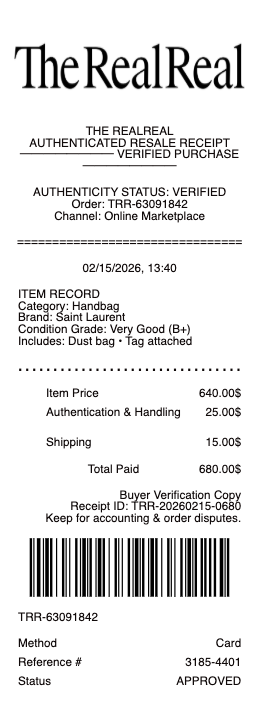
Two Different The RealReal Receipts
The RealReal is a two-sided luxury consignment marketplace, which means "a The RealReal receipt" can mean one of two entirely different documents.
If you bought, you have an order confirmation: the item name and designer, the item or listing ID, the condition grade, the price paid, any promotion applied, shipping, sales tax, the total, and the order number. If you consigned, you have a payout statement: the item sold, its final sale price, the commission rate applied, any fees deducted, and your net payout. They serve different purposes — the first proves ownership and provenance, the second is income — and mixing them up is the single most common confusion here.
The Buyer's Side: Authentication Is the Point
What a buyer is really paying for at The RealReal is the authentication, so that's what the paperwork is for. Every item is inspected before listing by an in-house team of 90+ expert authenticators, supported by artificial intelligence that examines everything from the dye and fabric to the stitching technique.
Your order confirmation, with its item ID and listing details, is the thread back to that authenticated listing. Hold onto it. When a luxury piece is resold, insured, or valued years later, the record showing it came through an authenticated marketplace — with the item ID that identifies the exact listing — is a meaningful part of its provenance, in a category where provenance is much of the value.
The Consignor's Side: Commission Tiers and Payouts
Consignor statements are dominated by one number: the commission split, which is tiered by the item's value — the more an item sells for, the larger the share the consignor keeps. Rates run from roughly 20% up to 70% depending on item value (for example, around 55% on clothing selling in the $200–$299 range, rising toward 70% for items above $5,000), and certain high-demand categories such as fine watches can reach as high as 90%.
Payouts arrive the month after the item sells, and you choose the method: direct deposit, cheque, or site credit — which carries an extra 5% if you're planning to shop rather than cash out. Your statement is the record of all of it, and it is what you'll want when reporting consignment income.
Why People Need a The RealReal Receipt
Buyers reach for it when reselling a piece later, when insuring a high-value bag or watch, or when a return or condition dispute needs the original order details. Consignors need their statements for income records at tax time and for reconciling what actually sold against what they sent in.
And in luxury resale generally, the paper trail is unusually valuable: a documented purchase from an authenticated marketplace supports the item's story in a way that a bare photograph never can. That's why the order confirmation is worth saving well beyond the return window — its value is highest years after the purchase, not days.
Create a Luxury Consignment Receipt — Free, No Login
Our receipt generator builds a clean luxury resale record with the fields that matter: seller or marketplace name, order or item ID, designer and item description, condition grade, price, shipping, tax, total, and payment method. Add a logo, choose your currency, and export to PDF, PNG, or JPG instantly.
Use it to document a purchase or consignment sale that genuinely happened — reproducing an order confirmation you can no longer retrieve, or keeping a tidy record of an authenticated piece for your own insurance and provenance files. It is built for documenting real transactions, not for inventing authenticity or provenance that does not exist.
Frequently asked questions
Everything you need to know about the product and billing.
What is a The RealReal receipt?
It is one of two documents: a buyer's order confirmation (item, item ID, condition, price, shipping, tax, total, order number) or a consignor's payout statement (item sold, sale price, commission rate, fees, net payout).
Why should I keep my The RealReal order confirmation?
Because it is part of a luxury item's provenance. It links back to the authenticated listing by item ID, which supports resale value, insurance claims, and valuations years later.
How does The RealReal authenticate items?
Every item is inspected before listing by an in-house team of more than 90 expert authenticators, supported by AI that analyses details from dye and fabric to stitching technique.
What commission does The RealReal take?
Commission is tiered by item value — consignors keep roughly 20% to 70% depending on the sale price (around 55% on clothing at $200–$299, rising toward 70% above $5,000), and some categories such as fine watches can reach up to 90%.
When do consignors get paid?
Payouts are issued the month after the item sells. You can take direct deposit, a cheque, or site credit — and site credit includes an extra 5%.
Can a receipt prove an item is authentic?
A receipt documents a purchase; it does not itself authenticate an item. What it does is evidence that the piece was bought through a marketplace that authenticates its inventory, which is a meaningful part of provenance but not a substitute for an authentication certificate.