A theatre ticket receipt records a specific seat at a specific performance. This guide explains why theatre tickets are rarely refundable but often exchangeable, and what the receipt needs to show.
Theatre Ticket Receipt
Add custom logo
Edit line items
Choose payment method
Add/remove elements
Customize business information
Choose font
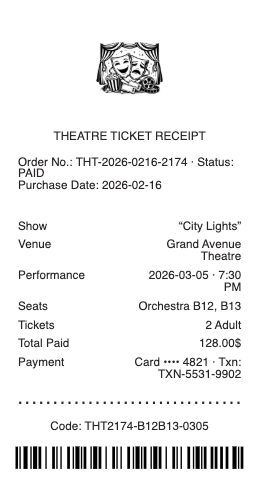
Theatre sells a seat at a moment — which is why refunds are rare
A theatre ticket is unusually perishable. It is not a right to see a show; it is a right to occupy one specific seat at one specific performance, and the instant that performance begins, the thing you bought has expired.
That is the commercial logic behind the near-universal rule printed on every theatre receipt: no refunds. An unsold seat cannot be recovered, and a seat released back an hour before curtain will not be resold. So the theatre holds the line.
But the same industry that refuses refunds is frequently generous about something else — and it is the thing most patrons never ask for.
Exchange is the flexibility that actually exists
Many theatres, and most subscription and membership schemes, allow you to exchange a ticket for another performance of the same production — often for a modest fee, and usually subject to a deadline (commonly up to 24 or 48 hours before the performance).
This is materially different from a refund and it is the option worth knowing about:
It typically requires the original ticket or the booking reference — which is exactly what the receipt provides.
It is usually only available before the performance. A no-show has no remedy at all; a call the day before very often does.
Members and subscribers frequently get exchanges free, which is a real part of what a membership is buying.
The practical lesson: if you cannot attend, act before the performance, not after. The difference between a phone call on Tuesday and a phone call on Thursday is the difference between a new date and nothing.
Cancellations, cast changes, and what actually entitles you
The performance is cancelled — a refund or an exchange is standard.
A named performer is off. Understudies are a normal part of theatre, and a cast change is generally not grounds for a refund — unless the production explicitly guaranteed a specific performer's appearance, which is rare and, where offered, is stated in the terms.
The performance is stopped part-way — policies vary, and often turn on how much of the show was completed.
If seeing a particular actor is the entire reason for your booking, that is a question to ask before paying, not a claim to make afterwards.
What the receipt should show
The production, date, and performance time — matinee and evening are different performances.
The exact seats — row and number, not just a section.
The face value and each fee separately (booking fee, restoration levy, transaction fee).
The booking reference, which is what an exchange or a lost-ticket enquiry runs on.
Any restricted view or age guidance attached to the seats.
The exchange and refund terms as they applied at booking.
Keeping the record
Keep the confirmation until the curtain comes down — and afterwards if you are expensing it. Box offices retain booking history and can reissue or reprint from a reference, which is the first thing to try when a ticket has gone astray.
Beware unofficial resale sites for theatre in particular: seats bought outside official channels are frequently sold at a substantial markup and sometimes without a valid seat behind them at all. Buying from the venue or its authorised agent is what makes the receipt worth something.
If a record is lost while the booking genuinely happened, your card statement establishes the date, amount, and venue, and a clear reconstructed record documents that real payment for your files, matching the charge exactly. It is not a ticket and will not seat you — the box office's own record is what does that, and they can almost always retrieve it.
Frequently asked questions
Everything you need to know about the product and billing.
Why are theatre tickets non-refundable?
Because a ticket is a right to one specific seat at one specific performance, and once that performance begins the thing you bought has expired. A seat released shortly before curtain generally cannot be resold, so theatres hold the no-refund line.
Can I change my theatre ticket to another date?
Often yes — many theatres allow an exchange to another performance of the same production, typically for a small fee and before a deadline (commonly 24 to 48 hours ahead). Members and subscribers frequently get exchanges free. It requires your booking reference.
What if the lead actor is not performing?
Understudies are a normal part of theatre and a cast change is generally not grounds for a refund, unless the production explicitly guaranteed a particular performer — which is rare. If seeing a specific actor is the point, ask before booking.
What if I simply cannot attend?
Act before the performance. An exchange is very often available beforehand; a no-show has no remedy at all. The difference between calling two days early and calling afterwards is the difference between a new date and nothing.
What should a theatre ticket receipt show?
The production, the exact date and performance time (matinee and evening differ), the precise seats by row and number, the face value with each fee named, the booking reference, and the exchange and refund terms.
Is it safe to buy theatre tickets from a resale site?
Be careful. Unofficial resellers frequently charge a substantial markup and occasionally have no valid seat behind the listing. Buying from the venue or its authorised agent is what makes the receipt meaningful.