A training fee receipt documents payment for personal training, coaching, or instructional sessions. It is commonly used for client records, trainer bookkeeping, and reimbursement or HSA claims that require proof of service.
Training Fee Receipt
Add custom logo
Edit line items
Choose payment method
Add/remove elements
Customize business information
Choose font
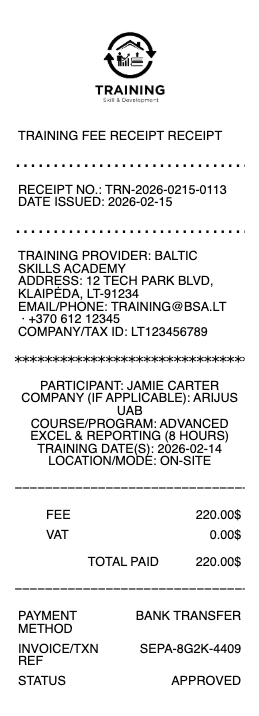
What's on a Personal Training Receipt
A training fee receipt records a service, not a product, so it has to answer a specific question: who trained whom, when, and for how much. A complete personal training receipt shows the trainer or studio name with a business address, the client's name, the date or dates of service, the type of session (one-on-one, small group, virtual, assessment), the number of sessions covered, the rate per session, the total paid, and the payment method.
That level of detail is not bureaucratic fussiness. Reimbursement administrators and the IRS both look for the same four fields on any service receipt: date of service, type of service, dollar amount, and the provider's name and address. A receipt missing any one of them is the receipt that gets sent back.
Session Packages, Single Sessions, and Prepaid Blocks
Most personal training isn't sold one session at a time — it's sold in packages, and that's where receipts get muddled. A ten-session package paid upfront in January but used through April creates a gap between the payment date and the service dates, and a receipt that only shows the payment date leaves that gap unexplained.
The cleaner approach is to state both: the purchase date and the sessions the package covers, ideally with the sessions listed or the number remaining noted. If sessions expire, the receipt should say so. For trainers, this doubles as the client's own record of what they've bought and used, which quietly prevents most billing disputes before they start.
HSA and FSA: Why the Letter of Medical Necessity Decides Everything
Personal training is not automatically an eligible HSA or FSA expense — general fitness never is. It becomes eligible only when it is prescribed to treat a specific diagnosed medical condition, and only when it is backed by a Letter of Medical Necessity (LMN) from a physician.
The LMN must state the diagnosis, explain why personal training is necessary to treat that condition, and say how long the treatment should continue. Conditions that commonly qualify include obesity, hypertension, diabetes, cardiovascular disease, arthritis, chronic back pain, and diagnosed anxiety or depression. Keep one copy with your medical records, send one to your plan administrator, and keep one for your files — alongside the training receipts themselves, which supply the date, service, amount, and provider details the administrator will match against the letter.
For Trainers: Receipts, Income Records, and Self-Employment
Most personal trainers are independent contractors rather than gym employees, which makes receipts the backbone of their bookkeeping. Every issued receipt is a line of self-employment income, and the set of them is what supports the income you report — the same documents that justify deducting certifications, equipment, liability insurance, and gym rental or floor fees against that income.
Issuing consistent, numbered receipts also protects the client relationship. When someone needs a receipt months later for an HSA claim, an employer wellness reimbursement, or a dispute over a package balance, being able to reissue an exact record of a session that genuinely happened is the difference between a two-minute answer and an argument.
Create a Training Fee Receipt — Free, No Login
Our training receipt generator builds a clean, itemized record with every field a client or plan administrator looks for: trainer or studio name and address, client name, date of service, session type, sessions covered, rate, total, and payment method. Add a logo, choose your currency and format, and export to PDF, PNG, or JPG instantly.
Use it to document sessions you genuinely delivered or paid for — reissuing a lost receipt, recording a cash-paid session, or producing the itemized proof an HSA administrator needs. It's built for accurate record-keeping of real transactions, not for inventing services that never happened.
Frequently asked questions
Everything you need to know about the product and billing.
What is a training fee receipt?
A training fee receipt documents payment for personal training, coaching, or instructional sessions. It shows the trainer or studio name and address, the client, the date and type of service, the sessions covered, the rate, and the total paid.
What should a personal training receipt include?
At minimum: the provider's name and address, the client's name, the date of service, the type of session, the amount paid, and the payment method. Reimbursement administrators consistently look for date of service, type of service, dollar amount, and provider name and address.
Can I use my HSA or FSA for personal training?
Only with a Letter of Medical Necessity. General fitness is not eligible; personal training becomes eligible when a physician documents that it treats a specific diagnosed condition, such as obesity, hypertension, diabetes, or chronic back pain.
What does a Letter of Medical Necessity need to say?
It must state your diagnosis, explain why personal training is necessary to treat that condition, and specify how long the treatment will last. Keep copies with your medical records, your plan administrator, and your own files.
How do I document a package of training sessions?
Show both the purchase date and the sessions the package covers, and note how many remain. A receipt that shows only the payment date leaves the service dates unexplained, which is a common cause of reimbursement questions.
Do personal trainers need to issue receipts?
Most trainers are independent contractors, so receipts are their primary income record and support the expenses they deduct. Clients also frequently need them later for HSA claims, wellness reimbursements, or package balance questions.