A travel insurance receipt proves the premium was paid and the policy is active. This guide explains the Schengen visa requirement for €30,000 of cover, what a certificate must state, and what documents a claim actually needs.
Travel Insurance Receipt
Add custom logo
Edit line items
Choose payment method
Add/remove elements
Customize business information
Choose font
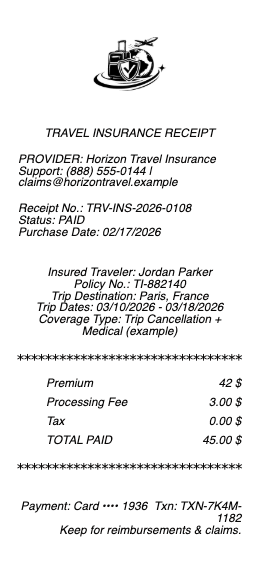
The receipt proves you paid — the certificate proves you're covered
Travel insurance produces two documents that are easy to confuse and are not interchangeable:
The receipt or invoice shows the premium was paid — the transaction.
The certificate or policy schedule shows what you are actually covered for — the entitlement.
An embassy, a hospital, or a claims handler wants the second one. The receipt matters as evidence the policy was purchased and active on the travel dates, and as a deductible business expense for a work trip, but it is the certificate that carries the policy number and the coverage limits — and those are what get you a visa or a hospital admission.
The Schengen requirement: €30,000, and it is a legal minimum
For a Schengen visa, travel medical insurance is not advisory. Under the Schengen Visa Code (EU Regulation (EC) No 810/2009), an applicant must hold cover with a minimum sum insured of €30,000, and the policy must:
Be valid throughout the territory of the Schengen member states, not merely in the country you are visiting.
Cover the entire period of the intended stay or transit, with no gaps at either end.
Include emergency medical treatment, hospitalisation, medical repatriation, and repatriation in the event of death — that last clause is explicitly required and is the one budget policies most often omit.
Your insurance certificate is what the consulate examines, and it should state the policy number, the coverage dates, the €30,000-plus medical limit, Schengen-wide validity, and repatriation cover. A certificate missing any of these is the most common reason an otherwise sound visa application is rejected on insurance grounds.
What a claim actually requires
Insurers do not pay on a description of events. A travel medical claim is built from documents, and they must be gathered while you are still there — reconstructing them from another country weeks later ranges from difficult to impossible:
Original itemised medical bills and receipts, not summaries.
The medical report or diagnosis, ideally in a language the insurer accepts.
Proof of payment for anything you paid out of pocket.
A police report for theft or loss — usually required within a short window, often 24 hours.
Your policy number and the certificate.
Photograph every document before you leave the country. The single most common reason a legitimate claim fails is not exclusion — it is missing paperwork.
Reimbursement, direct billing, and the deductible
How a policy pays changes what you must be able to fund yourself. A direct-billing policy settles with the hospital; a reimbursement-only policy requires you to pay and claim back, which for a serious admission can mean fronting a very large sum on a card.
This is also why Schengen-compliant policies typically carry no deductible and no co-pay, and are not reimbursement-only — the requirement exists so that a visitor cannot be turned away from treatment for inability to pay. When comparing policies on price, the excess and the payment mechanism matter more than the headline premium.
Keeping the paperwork where you can reach it
Carry the certificate and the emergency assistance number with you — not in a suitcase, and not solely in an email you would need working data to open. Keep a copy accessible offline on your phone and, ideally, with someone at home.
Insurers keep records and can reissue a policy document, so a missing certificate is usually recoverable from your account or the broker who sold it. If a payment record for a premium that was genuinely paid is lost, your card statement establishes the date, amount, and insurer, and a clear reconstructed record documents that real payment for your files — matching the underlying charge exactly. It does not evidence coverage, and it never substitutes for the certificate, which only the insurer can issue.
Frequently asked questions
Everything you need to know about the product and billing.
What insurance does a Schengen visa require?
Travel medical insurance with a minimum sum insured of €30,000, valid across all Schengen member states, covering the entire stay, and including emergency treatment, hospitalisation, medical repatriation, and repatriation in the event of death.
What must a Schengen insurance certificate show?
The policy number, the coverage dates, a medical limit of at least €30,000, validity throughout the Schengen area, and repatriation cover. A missing repatriation clause is the most common reason a certificate is rejected.
Is a receipt the same as an insurance certificate?
No. The receipt proves the premium was paid; the certificate proves what you are covered for and carries the policy number and limits. Embassies and hospitals want the certificate.
What documents does a travel insurance claim need?
Original itemised medical bills and receipts, the medical report or diagnosis, proof of any out-of-pocket payment, a police report for theft or loss (often required within 24 hours), and your policy number. Gather them before you leave the country.
What is the difference between direct billing and reimbursement?
A direct-billing policy settles with the hospital; a reimbursement-only policy requires you to pay first and claim back — which can mean fronting a very large sum. Schengen-compliant policies typically avoid reimbursement-only structures.
Why do Schengen policies have no deductible?
So that a visitor cannot be refused treatment for inability to pay. Schengen-compliant cover typically carries no deductible and no co-pay, which is part of what makes it compliant.