A videography receipt documents milestone payments for a production — and the usage rights that decide what the footage may legally do. This guide explains deposit-shoot-delivery billing, licensing, and raw footage terms.
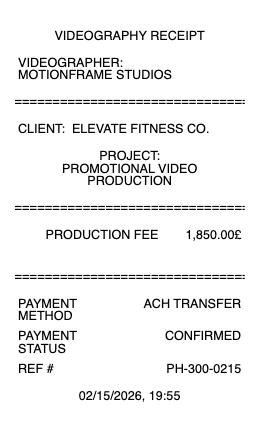
Videography Receipt
Add custom logo
Edit line items
Choose payment method
Add/remove elements
Customize business information
Choose font
Video is bought in milestones
Professional video work — weddings, commercial content, events, brand films — bills on a milestone structure because the work has phases with real costs in each:
Booking deposit — secures the date; commonly non-refundable, because the videographer turns away other work for it.
Pre-production or shoot payment — due around the shoot itself.
Delivery balance — the remainder against the finished edit.
Each milestone produces its own receipt, and the set maps money onto phases. The delivery-balance timing carries the leverage on both sides: clients should know that final files customarily transfer on final payment — editors do not release masters against unpaid balances — and videographers should invoice the balance before delivery for exactly that reason.
Usage rights: what the money actually bought
The least understood line in a video engagement is not the price — it is the licence. Paying for a video does not automatically buy the copyright: by default the creator owns what they shot, and the client receives usage rights defined in the agreement. The dimensions that matter:
Where — social, web, broadcast, paid advertising (ad usage is routinely priced separately).
How long — perpetual or term-limited.
Exclusivity, and whether the creator may portfolio the work.
A receipt for a "brand film" that is silent on usage is a receipt for an argument. The invoice should state the licence, because the price only means something relative to it — the same film costs differently with social-only rights than with broadcast rights, and both parties need the paper to say which was sold.
Raw footage, music, and the pass-through lines
Three recurring extras deserve their own lines on the invoice:
Raw footage — not included by default. Editors sell finished work; the unedited material is typically retained, and buying it (or archival guarantees) is a separately priced item.
Music licensing — commercial use requires licensed tracks, and the licence cost passes through. The receipt should name the licence, because an unlicensed soundtrack becomes the client's takedown problem.
Revisions — packages include a stated number of revision rounds; further rounds bill hourly. The invoice should show which rounds were included and which were billed.
What the videography paper set contains
The agreement — scope, deliverables, timeline, and the licence.
Milestone receipts — deposit, shoot, balance, each referencing the project.
Change and revision records — added scope, extra rounds.
Pass-through licences — music, stock, talent releases where applicable.
The delivery record — what files, what specs, delivered where and when.
The strongest final invoices carry a licence summary right on the document — term, territory, and media in a sentence — so that when the usage period ends, the renewal conversation starts from paper instead of from two people's memories of a call. A deliverables list with formats and durations belongs there for the same reason: what was delivered, in what form, is a receipt-level fact.
Keeping production records
Clients: keep the set for as long as the video is in use — the licence terms are live obligations, and a rights question years later (a rebroadcast, a re-edit) reopens the file. Creators: the mirror-image file is the income record and the portfolio-rights evidence.
If a record is missing while the payment genuinely happened, the counterparty can reissue the invoice, your bank statement establishes the payments, and a clear reconstructed record documents those real payments for your files, matching them exactly — while the licence, which lives in the agreement rather than the receipt, is the document to actually retrieve, because it is the one that says what all that money entitled you to do.
One retention fact surprises clients: production houses do not keep raw footage indefinitely — storage is a real cost, and unagreed archives get purged on the studio's schedule. If long-term archival matters, it should exist as its own agreed line in the paperwork, because an assumption is not a backup.
Frequently asked questions
Everything you need to know about the product and billing.
How are video productions billed?
In milestones: a commonly non-refundable booking deposit, a shoot payment, and the balance at delivery — with final files customarily transferring on final payment. Each milestone gets its own receipt against the project.
Do I own the video I paid for?
By default the creator owns the copyright; you receive the usage rights defined in the agreement — where it may run, for how long, and whether exclusively. The invoice should state the licence, because the price only means something relative to it. The cleanest engagements put a licence summary — term, territory, media — on the final invoice itself, so the answer survives on paper.
Is raw footage included?
Typically not — editors sell finished work and retain the unedited material. Buying raw footage or archival guarantees is a separately priced line. Nor is it archived forever by default — studios purge unagreed storage on their own schedule, so long-term archival needs its own agreed line.
Who handles music licensing?
The production licenses commercial tracks and passes the cost through, named on the invoice. An unlicensed soundtrack becomes the client's takedown problem, which is why the licence deserves its own line.
What about revisions?
Packages include a stated number of revision rounds; more rounds bill hourly. The invoice should show which were included and which were extra — the classic end-of-project dispute otherwise.
How long should video paperwork be kept?
As long as the video is in use. Usage rights are live obligations, and rights questions — rebroadcast, re-editing, extended campaigns — reopen the file years later.