A Visa transaction receipt records a card payment on the Visa network. This guide explains the authorization code and other identifiers, Visa's dispute categories and 120-day filing window, and what the receipt proves in a chargeback.
Visa Transaction Receipt
Add custom logo
Edit line items
Choose payment method
Add/remove elements
Customize business information
Choose font
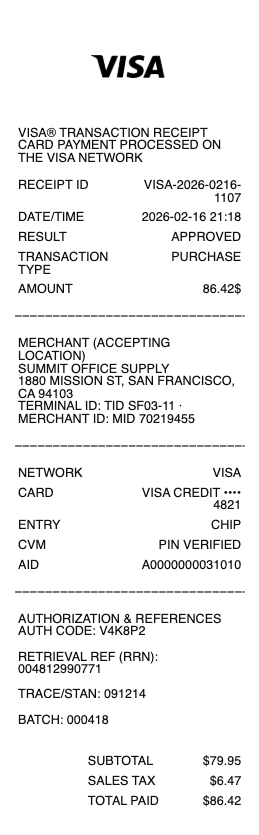
What the identifiers on a Visa receipt are for
A card receipt looks like a list of numbers, and each one exists to answer a different question later:
Authorization code — proof the issuing bank approved the transaction at the time. Its absence is a red flag on any disputed sale.
Last four digits of the card — the only card digits that should ever appear. A receipt printing the full number is a security failure, not a convenience.
Merchant name and ID — who took the money, in the form the card network knows them by (which is why a statement descriptor can look unfamiliar).
Date, time, and amount, plus the entry method — chip, contactless, swipe, or keyed.
Transaction or reference number — the thread that ties the receipt to the record held by the acquirer.
Together, these make a transaction traceable. Without them, a dispute becomes one party's word against another's.
Chip, contactless, and who is liable when fraud happens
The entry method is not a technicality — it decides who absorbs a fraud loss. A chip transaction produces cryptographic evidence that the physical card was present; a keyed or magnetic-stripe transaction does not.
This is why the liability shift matters to merchants: accepting a swipe when a chip was available moves the risk of counterfeit fraud onto the merchant. For cardholders, the practical consequence is simpler — Visa's zero-liability policy means you are generally not responsible for unauthorised charges you report, and the receipt is how a legitimate charge is distinguished from one you never made.
Visa's dispute categories and the 120-day clock
Visa sorts every chargeback into four reason-code families, and knowing which one applies tells you what evidence is needed:
10.x — Fraud. The cardholder says they did not authorise the transaction. Most so-called friendly fraud arrives as 10.4, Other Fraud — Card-Absent Environment.
11.x — Authorization. Something was wrong with the approval itself.
12.x — Processing errors. Duplicate charges, wrong amounts, incorrect currency.
13.x — Consumer disputes. Goods not received, not as described, cancelled recurring billing.
The timing: cardholders generally have 120 days from the transaction date to file a dispute, extending in certain fraud scenarios. Merchants get 30 days to respond at each phase of a Visa dispute. Missing your window is the most avoidable way to lose a case that the evidence would have won.
Why the receipt is the merchant's best defence
In a dispute, the merchant must produce evidence that the transaction was legitimate — and the receipt is the spine of that file. A signed receipt, a chip-read authorization, a delivery confirmation matching the cardholder's address: these are what representment is built from.
The most common way a defensible sale is lost is simply that the paperwork was not kept, or was kept in a form nobody can read months later. Card receipts are printed on thermal paper that fades; a faded receipt is, evidentially, a blank one. Merchants who digitise at the point of sale keep cases they would otherwise concede.
Keeping your own copy
For cardholders, the receipt is what turns "I don't recognise this charge" into a resolved question — it identifies the merchant behind an opaque statement descriptor, and it evidences what you actually bought when a refund is disputed.
Ask for the emailed or texted copy where it is offered, and photograph paper ones you may need beyond a few weeks. If an original is lost while the payment genuinely happened, a clear reconstructed record of your own transaction, built from your statement's date, amount, and merchant, documents that real payment for your files — matching the underlying charge exactly, and never standing in for the acquirer's or issuer's own records in a formal dispute.
Frequently asked questions
Everything you need to know about the product and billing.
What is the authorization code on a Visa receipt?
Proof that the issuing bank approved the transaction at the time it was made. It is one of the first things examined in a disputed sale, and its absence is a significant red flag.
Why does my receipt show only the last four digits?
Because printing the full card number is a security failure. Masking all but the last four digits is the standard, and a receipt showing more should be reported.
How long do I have to dispute a Visa transaction?
Cardholders generally have 120 days from the transaction date, with longer windows in certain fraud scenarios. Merchants get 30 days to respond at each phase of the dispute.
What is Visa reason code 10.4?
'Other Fraud — Card-Absent Environment', within Visa's 10.x fraud family. It is the code under which most friendly-fraud disputes are filed.
Why does the entry method matter on a receipt?
A chip transaction produces cryptographic evidence the card was present; a keyed or swiped one does not. That difference determines who bears the loss when counterfeit fraud occurs.
Am I liable for fraudulent charges on my Visa card?
Under Visa's zero-liability policy, cardholders are generally not held responsible for unauthorised charges they report. Your receipts are how legitimate charges are distinguished from ones you never made.