A vision care receipt documents payment for eyeglasses, contact lenses, or an eye exam. It is commonly used for FSA and HSA claims, vision insurance reimbursement, and prescription records.
Vision Care Receipt
Add custom logo
Edit line items
Choose payment method
Add/remove elements
Customize business information
Choose font
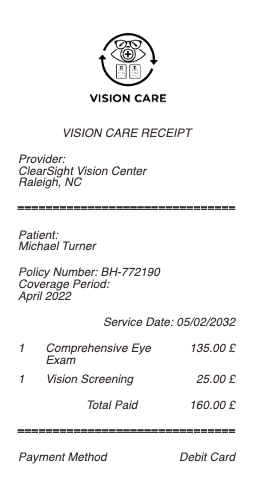
What's on an Eyeglass and Vision Care Receipt
A vision care receipt is one of the few everyday receipts whose itemization matters more than its total. A complete one shows the optical practice or retailer name and address, the patient's name, the date of service, and then — crucially — a line-by-line breakdown: the frames, the lenses, each lens enhancement (anti-reflective coating, scratch resistance, UV protection, photochromic, progressive), the eye exam, and any refraction fee, each with its own price.
A receipt that says "Eyewear — $420" and nothing else is technically a receipt and practically useless. The breakdown is what turns it into a reimbursable document.
Why Itemization Decides Your FSA/HSA Claim
Prescription eyeglasses are fully FSA- and HSA-eligible — the complete cost of frames, lenses, and lens enhancements such as anti-reflective coatings, scratch resistance, and UV protection all qualify when the glasses are prescribed to correct vision.
But eligibility isn't the hard part; documentation is. Vague or bundled receipts are one of the biggest reasons vision reimbursements get delayed or denied. A plan administrator has to see which portion of your spend was the prescription eyewear, and a single bundled total doesn't let them. Save the itemized receipt and a copy of your prescription — plan administrators may ask for both. If the store handed you a summary slip, ask for the itemized version; optical retailers can print one with the added detail on request.
What "Refraction" Means on Your Receipt
The line that confuses people most is the refraction fee. Refraction is the part of the eye exam that determines your actual prescription — the "better one, or two?" test. It is billed separately from the medical eye examination, and it is frequently not covered by medical insurance, because it is considered a vision service rather than a medical one, which is why it can appear as an unexpected out-of-pocket line on an otherwise-covered visit.
Seeing it broken out isn't an error. It's actually useful: because it's a distinct, identifiable vision-care charge, it's typically a clean candidate for FSA or HSA reimbursement, but only if it appears as its own line on the receipt rather than being folded silently into an exam total.
Vision Insurance Reimbursement (VSP, EyeMed, and Out-of-Network Claims)
If you used an in-network provider, your vision plan usually settles directly and the receipt is just for your records. The receipt becomes the whole story when you go out of network — then you pay in full, submit a claim, and the plan reimburses you against your allowance.
Those out-of-network claims are precisely where itemization is non-negotiable. Plans reimburse different allowances for frames, lenses, and exams, so they need to see each amount separately to apply the right one. Submit the itemized receipt with the claim form, keep a copy of the prescription, and keep the originals until the reimbursement actually lands.
Create a Vision Care Receipt — Free, No Login
Our vision care receipt generator produces a properly itemized optical receipt: practice or retailer name and address, patient name, date of service, and separate lines for frames, lenses, coatings and enhancements, exam, and refraction — each with its own price, so nothing arrives at your plan administrator as an unexplained lump sum.
Use it to document eyewear or eye care you genuinely purchased — recreating a lost optical receipt for an FSA claim, or producing the itemized version of a bundled slip you were handed. It is built for accurate record-keeping of real purchases, not for inventing expenses.
Frequently asked questions
Everything you need to know about the product and billing.
What should an eyeglass receipt include?
The optical practice or retailer name and address, the patient's name, the date of service, and an itemized breakdown: frames, lenses, each lens enhancement (anti-reflective, scratch-resistant, UV, progressive), the eye exam, and any refraction fee — each priced separately.
Are eyeglasses FSA or HSA eligible?
Yes. Prescription eyeglasses are fully eligible, including the complete cost of frames, lenses, and lens enhancements such as anti-reflective coatings, scratch resistance, and UV protection.
Why was my vision reimbursement denied?
Vague or bundled receipts are one of the most common causes. If the receipt shows only a single total instead of separating frames, lenses, and add-ons, the administrator cannot verify what was prescription eyewear. Ask the retailer for the itemized version.
What does refraction mean on an eyeglass receipt?
Refraction is the portion of the exam that determines your actual prescription. It is billed separately from the medical eye exam and is often not covered by medical insurance, so it appears as its own out-of-pocket line — which also makes it a clean candidate for FSA or HSA reimbursement.
Do I need my prescription as well as the receipt?
Often, yes. Plan administrators may ask for both the itemized receipt and a copy of the prescription, so keep them together until the claim is paid.
How do I claim an out-of-network vision expense?
You pay in full, then submit an itemized receipt with your plan's claim form. Because plans apply different allowances to frames, lenses, and exams, they need to see each amount separately — which is why the itemized receipt is essential.