A warehouse rent receipt covers industrial space charged per square foot, often with separate loading, utility, and insurance terms. This guide explains how industrial rent is quoted and what the receipt must document.
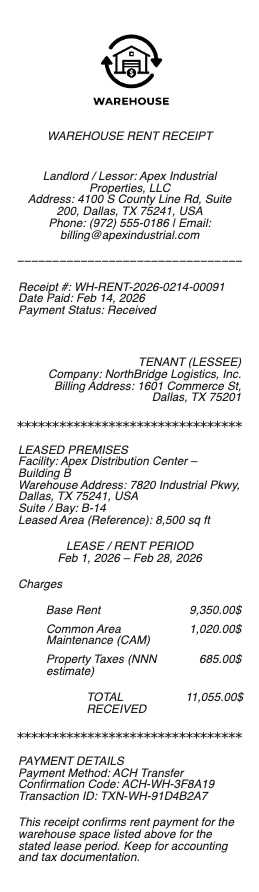
Warehouse Rent Receipt
Add custom logo
Edit line items
Choose payment method
Add/remove elements
Customize business information
Choose font
Industrial rent is quoted per square foot — and per year
Warehouse and industrial leasing has its own conventions, and the first one trips up anyone arriving from residential. Rent is quoted per square foot, and in most US markets per square foot per year, not per month.
So "$9 per square foot" on a 10,000 sq ft unit means $90,000 per year — $7,500 a month — before any pass-through costs. Industrial space is also commonly leased on a triple net basis, meaning taxes, insurance, and maintenance are charged on top of that base figure.
The receipt, therefore, is not a single rent line. It is a base rent calculated from an area, plus additional charges, and it should let you verify both halves.
The square footage itself is negotiable — and disputed
Because rent is a function of area, the area is a financial term rather than a fact. Two numbers matter and are frequently confused:
Usable square feet — the space you actually occupy.
Rentable square feet — usable space plus a share of common areas, which is what you are usually billed on.
The gap between them (the load factor) can be significant, and it is the difference between the space you can use and the space you pay for. A lease that does not define which measure it uses, or that states an area you have never verified, is a lease with an open financial question in it. Measure the space.
What the receipt must document
The unit and the square footage billed — the number the rent derives from.
The rate, and the period it covers, with the annual-versus-monthly basis explicit.
Base rent and each pass-through separately: taxes, insurance, CAM.
Utilities, where separately metered — industrial power costs are substantial and often billed apart from rent.
Any storage, loading dock, or yard charges that sit outside base rent.
Warehouse space is not the same as self-storage
These are frequently conflated and are legally quite different. A self-storage unit is a licence to store goods, usually month-to-month, with the operator retaining broad rights over the facility and — importantly — a statutory lien on your goods for unpaid rent, enforceable by sale in many jurisdictions.
A warehouse lease is a lease of real property. It carries a term, exclusive possession, and the landlord-tenant protections that follow from that.
The distinction becomes acute when payment falls behind: a storage operator's route to selling your goods is comparatively fast, and it is one of the few places where a missing rent receipt can cost you your inventory. Keep the receipts, and keep them in date order.
Insurance, goods, and who bears the risk
Industrial leases invariably require the tenant to insure — both liability and, critically, the tenant's own goods. The landlord insures the building, not what you put in it. Businesses that assume otherwise discover the gap only after a fire or a flood.
Keep the rent receipts with the lease, the insurance certificate, and the inventory records: together they establish what was stored, where, under what terms, and who was covering it — which is precisely the file an insurer will ask for.
If a receipt is lost while the payment genuinely occurred, the landlord or agent can reissue from their ledger, and your bank record establishes date, amount, and payee. A clear reconstructed record documents that real payment for your files, matching it exactly — and where a lien or a possession dispute is in play, the landlord's ledger and your bank records are the documents that will actually decide it.
Frequently asked questions
Everything you need to know about the product and billing.
How is warehouse rent calculated?
Per square foot, and in most US markets per square foot per year. A $9 per square foot rate on 10,000 sq ft is $90,000 annually — $7,500 a month — before triple net pass-throughs for taxes, insurance, and maintenance.
What is the difference between usable and rentable square feet?
Usable is the space you occupy; rentable adds a share of common areas and is usually what you are billed on. The gap — the load factor — is the difference between space you can use and space you pay for.
Is a warehouse lease the same as self-storage?
No. Self-storage is typically a month-to-month licence to store goods, and operators commonly hold a statutory lien enforceable by sale for unpaid rent. A warehouse lease is a lease of real property with a term and exclusive possession.
Who insures the goods in a leased warehouse?
The tenant. The landlord insures the building, not its contents. Industrial leases almost always require the tenant to carry both liability cover and insurance on their own goods.
What should a warehouse rent receipt show?
The unit and the square footage billed, the rate and whether it is annual or monthly, base rent and each pass-through named separately, separately metered utilities, and any dock, yard, or storage charges outside base rent.
Why does the square footage matter so much?
Because rent is calculated from it, the area is a financial term rather than a fact. A lease stating an area you have not verified leaves an open financial question — measure the space.