A watch store receipt from an authorized dealer comes with the document that matters most: the warranty card stamped at purchase. This guide explains AD purchases, allocation lists, and the paperwork that grey market watches lack.
Watch Store Receipt
Add custom logo
Edit line items
Choose payment method
Add/remove elements
Customize business information
Choose font
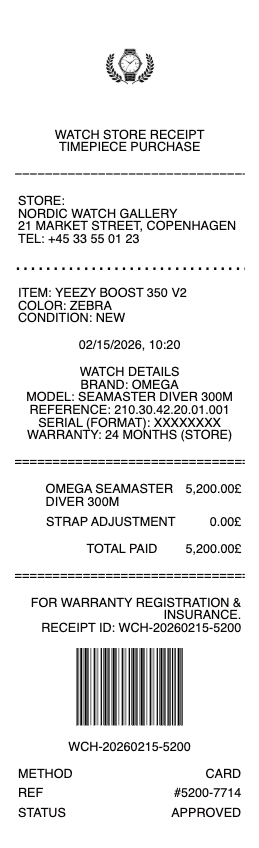
The stamp on the card is what you are buying
At an authorized dealer — a watch store officially appointed by the brand — the purchase includes the act that activates the manufacturer's warranty: the dealer stamps and dates the warranty card (or activates its digital equivalent) at the point of sale.
That stamp is the entire difference between an AD purchase and a grey market one. The watch may be identical; the stamped card is what the brand's service network recognises, and its absence is why otherwise-new watches from unofficial channels carry dealer warranties instead of factory ones. The receipt and the stamped card together are the proof of an authorised, warranty-active purchase — and they should never be separated from each other or the watch.
Waitlists, allocation, and purchase history
For sought-after models, authorized dealers do not sell from the case — they allocate: scarce pieces go to clients the dealer chooses, and the choosing runs on relationship and purchase history. The practical mechanics:
Waitlists are real but unranked — allocation is discretionary, not queue-ordered.
History counts — previous purchases at the dealer, documented by their records and your receipts, are the currency.
Bundling exists — informal expectations of buying available stock to earn allocation of scarce stock, controversial but common.
Your receipts at a dealer are, in effect, your position in that system — one more reason the paper trail at an AD is worth keeping meticulously.
What the AD receipt should show
The dealer's identity as an authorised retailer of the brand.
The watch precisely — brand, model, reference number, and the serial number.
The price and any trade-in credited (part-exchange is common at watch stores, and the trade-in's paperwork matters for both sides of the deal).
The warranty activation — the stamped card or digital warranty reference, dated to match.
Box and accessories included.
Serial-on-receipt matters: it ties this specific watch to this purchase, which is what insurance scheduling, theft reports, service history, and eventual resale all key from.
Trade-ins and part-exchange at the counter
Watch stores routinely take trade-ins against purchases, and the receipt structure doubles: the store buys your watch (its own transaction, with the store as buyer — expect them to record your ID and the watch's serial) and sells you the new one with the trade-in as credit. Two documents, two serial numbers, one visit.
Keep both sides. The trade-in record is your proof of disposal (relevant if the old watch ever resurfaces in a dispute) and the basis of the credit on the purchase receipt; the purchase receipt with trade-in shown is the honest record of what the new watch actually cost you — which is the figure insurance and any future sale calculations start from.
Keeping the watch file
The complete AD file: receipt, stamped warranty card, box and papers, serial photographs — kept together, permanently. It is simultaneously the warranty claim file, the insurance schedule evidence, the service-history anchor, and the resale premium (full-set AD-sourced watches sit at the top of the secondary market).
Dealers retain sales records and brands keep warranty registrations, which are the recovery routes for missing documents. If a receipt is lost while the purchase genuinely happened, your card statement establishes the date, amount, and dealer, and a clear reconstructed record documents that real payment for your files, matching the charge exactly — while the warranty card and the dealer's own record remain what the brand's service network and the resale market actually recognise.
Frequently asked questions
Everything you need to know about the product and billing.
What makes an authorized dealer purchase different?
The warranty card stamped and dated at the point of sale — the act that activates the factory warranty. The watch may be identical elsewhere; the stamped card is what the brand's service network recognises.
How do watch waitlists actually work?
Allocation is discretionary: scarce models go to clients the dealer chooses, weighted by documented purchase history rather than queue position. Your receipts at a dealer are effectively your standing in that system.
What should an AD receipt show?
The dealer's authorised status, the exact watch — brand, model, reference, serial — the price with any trade-in credited, the warranty activation reference, and included box and accessories. Serial-on-receipt ties the specific watch to the purchase.
How does a trade-in at a watch store work?
As two transactions: the store buys your watch (recording your ID and its serial), and sells you the new one with the trade-in as credit. Keep both documents — one proves disposal, the other the true net cost.
Why keep the watch file permanently?
Receipt, stamped card, box and papers, and serial photos together serve warranty claims, insurance scheduling, service history, and resale — full-set AD-sourced watches command the top of the secondary market.
What if I lose the receipt but have the stamped card?
The dealer's sales record and the brand's warranty registration are the recovery routes, and your card statement evidences the payment. The stamped card remains the warranty document; the reconstructed payment record supports, but does not replace, it.