A Wells Fargo payment receipt documents an ACH transfer, wire, deposit, or ATM transaction. This guide explains the difference between ACH and wire receipts, which reference numbers matter, and how to retrieve a copy from online banking.
Wells Fargo ACH Payment Receipt
Add custom logo
Edit line items
Choose payment method
Add/remove elements
Customize business information
Choose font
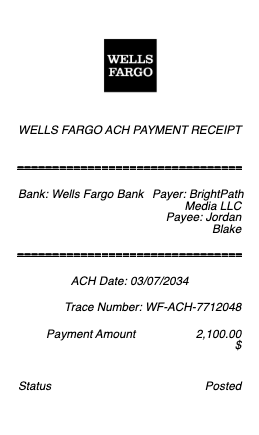
Four different Wells Fargo receipts, four different documents
"Wells Fargo receipt" covers several documents that behave nothing alike, and asking for the wrong one wastes a lot of time at the branch:
ACH payment receipt — an electronic transfer through the automated clearing house: direct deposits, bill payments, and most transfers between banks. Cheap, batched, and not instant.
Wire transfer receipt — a same-day, individually processed transfer. Faster, more expensive, and effectively irreversible once sent.
Deposit receipt — proof you put money in, at a branch or an ATM.
ATM receipt — the slip from a withdrawal, deposit, or balance enquiry.
The distinction that costs people money is ACH versus wire. An ACH payment can often be disputed or returned; a completed wire generally cannot be recalled at will. If a payment must be reversible, that choice is made before you send, not after.
The reference numbers that actually matter
Every electronic payment carries an identifier, and knowing which one you need is the difference between tracing a payment and being told there is nothing to look at:
ACH trace number — a 15-digit identifier assigned to an ACH entry. This is what the receiving bank needs to locate a transfer that has apparently vanished.
Wire reference / IMAD-OMAD — the identifiers attached to a wire as it passes through the Fedwire system. A wire investigation starts here.
Confirmation number — what online banking shows you at the moment you submit a payment. Useful with your own bank; meaningless to the recipient's.
When a payment does not arrive, the first question anyone competent will ask is for the trace or wire reference. A screenshot of "payment sent" is not a substitute.
Reading a Wells Fargo ATM or deposit receipt
ATM slips are short but carry more than people notice. Beyond the amount and balance, look for the terminal or ATM ID and the date and time stamp — those are the fields that let the bank pull the transaction and, in a disputed deposit, the ATM's imaging of what was actually inserted.
For a deposit, the receipt typically shows the amount credited and, importantly, when the funds become available — which is not always the same day. A deposit receipt is proof you deposited; it is not proof the money has cleared, and confusing the two is how accounts get overdrawn.
Getting a copy from online banking
Most Wells Fargo records are self-service, and the routes are worth knowing before you queue at a branch:
Account activity shows recent transactions with their details and confirmation numbers.
Statements — the permanent record, downloadable as PDFs, and generally what an accountant or a court will accept.
Wire transfer history keeps the details of sent and received wires, including references.
Bill pay history shows scheduled and completed payments with their confirmation numbers.
For anything a third party must verify — a landlord, a court, a mortgage underwriter — the statement is the stronger document, because it comes from the bank rather than from your screen.
When you need a record and the receipt is gone
Electronic payments are the easiest records to recover, because the bank holds them whether or not you kept anything. Statements go back years, and account activity carries the transaction detail — so the first move is always to look, not to reconstruct.
Where you need a clean, presentable record of your own payment for your files — an expense claim, a reimbursement, a personal ledger — reconstructing it from the statement detail documents a real transaction you made. It must match the bank's record exactly: same date, same amount, same counterparty. For anything a bank or a court will examine, the bank's own statement remains the authoritative document, and it can always be reissued.
Related records: the ACH payment receipt for ACH payments from any bank, the bank transfer receipt for general transfers, and the Bank of America wire transfer receipt when the money went by wire instead.
Frequently asked questions
Everything you need to know about the product and billing.
What is the difference between an ACH payment and a wire transfer?
ACH transfers are batched, inexpensive, and not instant — and can often be returned or disputed. Wires are processed individually the same day, cost more, and are effectively irreversible once completed. Choose before you send, not after.
What is an ACH trace number?
A 15-digit identifier assigned to an ACH entry. It is what the receiving bank needs to locate a transfer that has not arrived — a screenshot showing 'payment sent' is not a substitute.
How do I get a copy of a Wells Fargo payment receipt?
Through online banking: account activity shows transaction detail and confirmation numbers, statements provide the permanent downloadable record, and wire and bill-pay histories keep their own references.
Does a deposit receipt mean the money is available?
No. A deposit receipt proves you made the deposit; funds availability can be later. The receipt usually indicates when the money becomes available, and confusing the two is a common cause of overdrafts.
Can a wire transfer be reversed?
Generally not at will once completed — that is the trade-off for its speed. This is why the ACH-versus-wire decision matters before sending, particularly for a payment you may need to claw back.
What is on an ATM receipt?
The amount, the resulting balance, and — importantly — the terminal or ATM ID and a date-and-time stamp. Those last fields are what allow the bank to pull the transaction and any ATM imaging in a disputed deposit.