A Wise international transfer receipt shows the mid-market rate and the fee separately. This guide explains why that transparency matters, how it differs from a bank's hidden margin, and what the receipt proves.
Wise International Transfer Receipt
Add custom logo
Edit line items
Choose payment method
Add/remove elements
Customize business information
Choose font
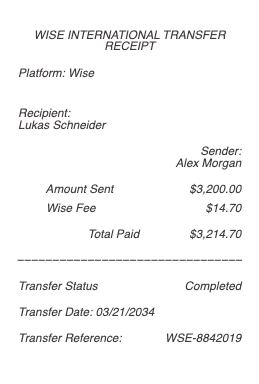
The fee you can see versus the fee you cannot
The defining feature of a Wise transfer receipt is what it makes visible. It states the mid-market exchange rate — the real, unmarked-up rate you would see on a currency chart — and shows the fee as an explicit, separate charge.
That sounds unremarkable until you compare it with the alternative. A traditional bank transfer frequently advertises a low fee, or none, and takes its margin inside the exchange rate instead — converting at a rate a few percent away from mid-market. The cost is real and often larger, but it never appears as a fee, so it feels free.
This is the whole substance of the comparison: one model prices the conversion, the other hides it in the rate. The receipt is where you can tell which one you paid.
How to check what a transfer actually cost you
The arithmetic is simple and worth doing once, on any provider:
Note the mid-market rate on the day (any currency chart shows it).
Find the rate actually applied on your receipt.
The gap between them, expressed as a percentage, is the hidden margin.
Add any explicit fee.
Total cost is the margin plus the fee — and a transfer with "no fee" and a 3% margin costs more than one with a 0.5% fee at the mid-market rate. A receipt that does not disclose the rate applied is a receipt that prevents you from doing this calculation, which is not an accident.
What the receipt should show
The amount sent, in the source currency.
The amount received, in the target currency.
The exchange rate applied, and whether it is the mid-market rate.
The fee, stated separately.
The transfer reference — the identifier for tracing.
Sender and recipient details, and the date.
The amount received matters as much as the amount sent: for an international payment, what the beneficiary actually got is the fact that settles an invoice, and a receipt showing only the send amount leaves that question open.
What the receipt proves — and what it does not
An international transfer receipt is strong evidence of a payment: it names the sender, the recipient, the amount, the date, and carries a reference that allows the payment to be traced through the system.
What it does not do is evidence what the payment was for. Like any transfer, it proves money moved between two parties — not that it settled a particular invoice, or covered a particular month's rent, or represented a gift rather than a loan. That meaning has to be attached by the reference field, and by keeping the receipt with the invoice it relates to.
Keeping transfer records
Payment platforms keep a complete, downloadable transaction history — so a lost receipt for an electronic transfer is very rarely lost at all. Download the PDF rather than screenshotting the confirmation screen: the document version generally carries the rate, the fee, and the reference, which a screenshot of a success message does not.
For business use, keep the transfer receipt with the invoice it settles and the accounting entry it supports. The transfer proves payment; the invoice proves purpose; together they are a complete record.
If a record is missing for a transfer that genuinely happened, your bank statement establishes the amount, date, and counterparty, and a clear reconstructed record documents that real payment for your files, matching the statement exactly. For a trace or an investigation, the provider's own reference is what is required — and they can reissue it.
Frequently asked questions
Everything you need to know about the product and billing.
What is the mid-market rate?
The real exchange rate between two currencies, without any markup — the rate you see on a currency chart. Providers that convert at mid-market and charge a separate, visible fee are pricing the conversion openly.
How do banks hide transfer costs?
By taking their margin inside the exchange rate rather than as a fee. A transfer advertised as free can carry a rate several percent away from mid-market, which costs more than a small explicit fee at the real rate.
How do I work out what a transfer really cost?
Compare the mid-market rate on the day with the rate actually applied on your receipt — the gap is the hidden margin. Add any explicit fee. Margin plus fee is the true cost.
What should an international transfer receipt show?
The amount sent, the amount received, the exchange rate applied, the fee stated separately, the transfer reference, and the sender and recipient details with the date.
Does a transfer receipt prove what the payment was for?
No. It proves money moved between two parties on a date. The purpose has to be attached by the payment reference and by keeping the receipt with the invoice it settles.
Why download the PDF rather than screenshot the confirmation?
Because the document version generally carries the exchange rate, the fee, and the reference number. A screenshot of a success message usually carries none of them.