A work meal receipt covers food a company provides to its own staff. This guide explains the 2026 change that makes employer-provided meals nondeductible, how that differs from a client meal, and what records to keep.
Work Meal Receipt
Add custom logo
Edit line items
Choose payment method
Add/remove elements
Customize business information
Choose font
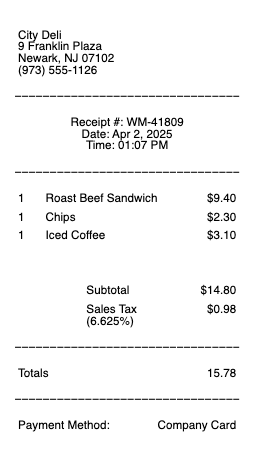
Feeding your own staff is not the same as taking a client to lunch
Businesses routinely buy food for their own people — the pizza for the team working late, the sandwiches at an all-day meeting, the coffee and pastries at the Monday standup, the staff cafeteria. All of it is a genuine business cost.
None of it is a business meal in the tax sense. A business meal involves a client, a customer, or a business contact. Food for your own employees falls under a different rule entirely — and in 2026 that rule changes materially against employers.
The 2026 change: employer-provided meals become nondeductible
Under the Tax Cuts and Jobs Act, meals a company provides for the convenience of the employer — the classic example being food brought in so staff keep working through a deadline — were reduced to 50% deductible, with a further change deferred to a later year.
That deferred change takes effect in 2026. From this year, those employer-provided meals become nondeductible. The category is broad, and it catches:
Company cafeteria expenses and subsidised on-site dining.
Meals provided for the convenience of the employer — food supplied so staff remain on site and keep working.
Occasional meals that qualified as a de minimis fringe benefit.
This is a real cost increase for employers who feed their teams, and it arrives quietly — the food still gets bought, the receipts still pile up, and the deduction simply is not there any more.
What still gets a deduction
The contrast is what makes this navigable. A qualifying business meal — with a client, customer, or business contact, where you or an employee is present and the cost is not lavish — remains 50% deductible.
So the same team, the same week:
Pizza bought so the team can finish a release → employer-provided meal → nondeductible from 2026.
Dinner with a client to discuss that release → business meal → 50% deductible.
The receipts look nearly identical. The tax treatment is opposite. Which is exactly why work meal receipts must be coded separately from client meal receipts at the point of capture — because nobody will reliably reconstruct the difference at year end from a shoebox.
What a work meal receipt should record
The date and the vendor.
Itemised food and drink, with any alcohol separately identified.
The business reason — a working late session, an all-day training, a team meeting — written on the receipt.
Who it fed: employees only, or employees plus outside guests. A meal that includes a genuine client changes the analysis.
The head count, which supports that the spend was reasonable for the group.
Employee meals as taxable income
There is a second question hiding behind the deduction one: is the meal taxable to the employee who ate it? Occasional, minor, and impractical-to-account-for benefits have historically been treated as de minimis and excluded from an employee's income, while regular, substantial provision of food is a different matter and can become a taxable benefit.
Keeping clear records of what was provided, to whom, how often, and why is what allows that line to be drawn defensibly. The receipt alone does not do it — the context written on the receipt does.
If a record is lost while the expense genuinely occurred, a clear reconstructed record from the company card statement documents that real payment for the files, matching the charge exactly. It does not recreate the business context, which is why noting the reason at the time is worth more than any reconstruction afterwards.
Frequently asked questions
Everything you need to know about the product and billing.
Are meals a company buys for its employees deductible?
From 2026, generally no. The TCJA's deferred change takes effect this year, making employer-provided meals — company cafeteria food, meals provided for the convenience of the employer, and occasional de minimis meals — nondeductible.
What is a 'convenience of the employer' meal?
Food a company provides so that staff remain on site and keep working — the classic case being meals brought in during a deadline push. It is a genuine business cost, but from 2026 it is not a deductible one.
What is the difference between a work meal and a business meal?
A business meal involves a client, customer, or business contact, and remains 50% deductible where you are present and the cost is not lavish. A work meal feeds your own employees, and from 2026 it is nondeductible. The receipts look nearly identical; the treatment is opposite.
How should work meal receipts be recorded?
Separately from client meal receipts, at the point of capture — with the date, vendor, itemised food, the business reason, who it fed (employees only, or with outside guests), and the head count. Nobody reliably reconstructs the distinction at year end.
Is a free meal taxable income to the employee?
It depends. Occasional, minor benefits impractical to account for have historically been treated as de minimis and excluded, while regular, substantial provision of food can become a taxable benefit. Clear records of what, to whom, how often, and why are what allow the line to be drawn.
Does having a client present change things?
Yes. A meal that genuinely includes a client, customer, or business contact is analysed as a business meal rather than an employer-provided one, which is why the receipt should record who was fed.