A workshop receipt covers hands-on instruction — often with a materials fee, small-group limits, and minimum-enrollment cancellation terms. This guide explains what workshop pricing contains and which terms to read first.
Workshop Receipt
Add custom logo
Edit line items
Choose payment method
Add/remove elements
Customize business information
Choose font
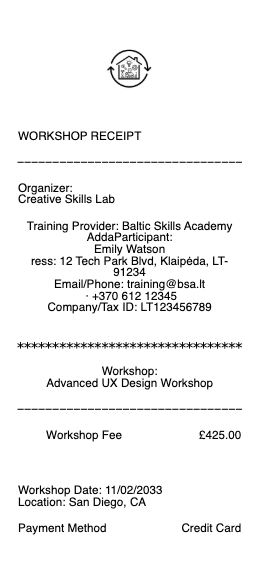
Workshop pricing has a second line: materials
What separates a workshop from a lecture is that you make something — and the making has a cost. Workshop pricing therefore commonly splits into tuition (the instruction) and a materials or lab fee (the consumables: wood, clay, ingredients, kits, safety equipment).
The split matters in three small ways that add up: the materials fee is often payable even if you cancel late (the kit was bought for you); it is sometimes collected in cash on the day (get it receipted); and where the finished piece goes home with you, the fee is effectively a purchase attached to a class. The receipt should show both components — a single blended figure hides what the refundable portion is.
Minimum enrollment: the cancellation that comes from the organiser
Small-group workshops carry a term most attendees never read: minimum enrollment. Below a stated head count, the workshop cancels — by the organiser, not by you — usually with a full refund or a transfer to a later date.
Read that clause alongside the attendee-cancellation ladder (full refund far out, partial closer in, none late), because they are different mechanisms with different outcomes. A workshop the organiser cancels owes you everything; a workshop you abandon owes you whatever the ladder says. The receipt plus the published terms at booking is the record of which ladder applied — terms change season to season, and the version that binds is the one you bought under.
Skill levels, prerequisites, and safety inductions
Hands-on instruction stratifies by level, and the receipt should name the course precisely — "Woodturning II" is a different product from an open studio session:
Prerequisites — advanced workshops legitimately turn away attendees without the prerequisite; the receipt naming the level is your booking evidence.
Safety inductions — machine-shop and kiln environments often require a one-time induction, sometimes separately priced and separately receipted, valid for future sessions.
Equipment use — some receipts double as evidence of paid studio access or firing credits that outlast the workshop day.
Where equipment is involved, the joining instructions carry a tool list — what the studio provides versus what you bring — and it quietly allocates cost and liability: gear on the studio's side is covered by the fee, gear on yours is your own expense and your own insurance question if it breaks in class. Keeping the list with the receipt settles later arguments about what the price included.
Business, hobby, and the deduction line
Whether a workshop is deductible depends on what it maintains: hands-on training that develops skills for your existing trade (a chef's technique masterclass, a welder's certification refresher) sits comfortably as professional development, receipt-supported. A pottery evening for pleasure does not become deductible because your hands got better at something.
The grey zone — the designer taking a letterpress workshop, the developer at a hardware-hacking weekend — is argued from business relevance, and the receipt plus the course description is the file. For craftspeople who sell their work, workshop fees and the materials component are ordinary business costs, and the two-line receipt maps neatly onto training versus supplies in the books.
Keeping workshop records
Keep the receipt, the booking confirmation with its terms, and any induction or completion evidence until refund windows close and claims settle — longer where the induction grants ongoing studio access.
Organisers keep booking records and can reissue receipts, which is the recovery route. If a record is missing while the booking genuinely happened, your card statement establishes the date, amount, and organiser, and a clear reconstructed record documents that real payment for your files, matching the charge exactly — with the tuition-versus-materials split taken from the organiser's records rather than estimated.
Multi-session workshops deserve one extra line of tracking: courses sold as a series bill once but deliver across weeks, and a make-up policy for missed sessions — where one exists — is part of the booking terms, not the receipt. The value of session four lives in the terms document; the receipt only proves you paid for the whole run.
Frequently asked questions
Everything you need to know about the product and billing.
Why does a workshop charge a separate materials fee?
Because hands-on instruction consumes materials — kits, clay, ingredients, safety gear — bought per attendee. The fee is often non-refundable on late cancellation, sometimes collected in cash on the day, and should appear as its own line on the receipt.
What is a minimum-enrollment cancellation?
If bookings fall below a stated head count, the organiser cancels the workshop — with a full refund or transfer. It is a different mechanism from your own cancellation, which follows the refund ladder in the terms you booked under.
Can I get a refund if I cancel a workshop booking?
Per the ladder in the terms at booking: typically full far out, partial closer in, none late — with the materials fee often unrefundable once the kit is bought. The organiser's own cancellation owes you everything.
Are workshops tax deductible?
When they develop skills for your existing trade, they sit as professional development. Hobby workshops are not deductible for pleasure — and the grey zone is argued from business relevance, with the receipt and course description as the file.
What should a workshop receipt show?
The precise course name and level, the date, tuition and materials fees as separate lines, any induction or studio-access component, and the attendee's name. For equipment-based workshops, the provided-vs-bring tool list belongs with it — that list is what allocates the cost and liability the fee covered.
Why keep the booking terms with the receipt?
Because cancellation ladders change season to season, and the version that binds is the one you bought under. The receipt plus that day's terms is the record of your actual deal. Series bookings especially — the make-up policy for missed sessions lives in the terms, while the receipt only proves payment for the full run.