A generic store receipt — plain paper, no logo, minimal branding — is still a valid document if it carries the right fields. This guide explains what makes an unbranded receipt work for returns, warranties, and expenses.
Generic Store Receipt
Add custom logo
Edit line items
Choose payment method
Add/remove elements
Customize business information
Choose font
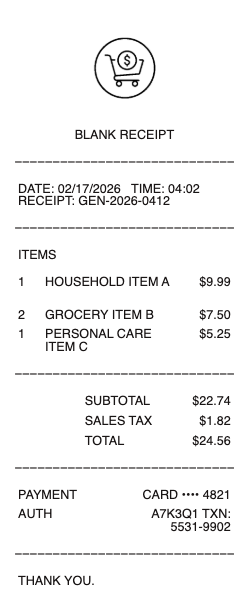
A receipt's validity comes from its fields, not its logo
Plenty of legitimate businesses issue generic receipts: plain thermal stock with no logo, a market stall's handwritten slip, a small shop's unbranded till print. The instinct that these are somehow lesser documents is wrong — no law requires a receipt to be pretty. What law, retailers, insurers, and employers require is information:
Who sold — the business name and address, printed, stamped, or written.
When — the date.
What — the items or service, identifiably.
How much — the amount, with tax shown where charged.
A generic receipt carrying those four things outperforms a beautifully branded slip that says "Miscellaneous — $40".
Where unbranded receipts come from
Generic receipts are not a warning sign; they are an economics sign. They come from businesses too small for custom-printed stock: market traders, pop-up sellers, independent shops using off-the-shelf till rolls, service providers with receipt books from the stationery aisle. The till roll is generic because ordering branded paper costs money — the same reason the shop's prices are lower.
The one habit that matters at these businesses: make sure the seller is identifiable. If the print has no business name, ask for the shop's stamp or a written name on the slip. An anonymous receipt fails at exactly the moment you need it — a return, a warranty claim, an expense audit — because nobody can tell where the money went.
Do stores accept their own generic receipts for returns?
Yes — a store recognises its receipts by content, not decoration: the till prints a transaction number, date, register, and item codes that match its own system. That machine-readable spine is why even a logo-less slip supports a return: the store can look the transaction up.
The corollary: the fields that matter for a return are the transaction identifiers, so a generic receipt torn at the top (losing the shop name) but intact at the barcode may still work at that store — while being useless as proof to anyone else. For third parties (your employer, an insurer), the seller identification is the part that cannot be missing.
Generic receipts in expense claims and audits
Expense systems and tax audits accept unbranded receipts routinely — small-business economies would collapse otherwise — but they apply the same information test, and generic slips fail it more often because nobody enforced the fields at the till:
No seller name → unverifiable → commonly rejected.
No item detail → unclassifiable → queried.
Faded thermal print → generic stock is often the cheapest paper, which fades fastest — photograph these receipts the same day.
The discipline costs seconds at purchase and saves the claim: check the four fields before pocketing the slip, and ask for the missing ones on the spot.
Reconstructing when the generic slip is gone
Unbranded receipts are the least recoverable documents in retail: no loyalty account, often no card-lookup capability, sometimes a cash purchase at a business with minimal records. Prevention (the same-day photograph) genuinely is the strategy.
Where a record is missing and the purchase was by card, your statement establishes the date, amount, and merchant, and a clear reconstructed record documents that real payment for your files, matching the charge exactly. Where it was cash at an unbranded till, there may be nothing to reconstruct from — which is the honest reason to capture the four fields at the counter, while the transaction still exists on both sides.
Frequently asked questions
Everything you need to know about the product and billing.
Is a receipt without a logo valid?
Yes. Validity comes from information, not branding: the seller's name and address, the date, identifiable items, and the amount with tax. A generic slip with those four fields beats a branded one that says 'Miscellaneous'.
Why do some shops print unbranded receipts?
Economics — custom-printed till stock costs money that small traders, market stalls, and independents reasonably skip. It signals a small business, not a suspicious one.
Will a store accept its own generic receipt for a return?
Yes — stores recognise receipts by the transaction number, date, register, and item codes that match their system, not by the logo. The machine-readable spine is what supports the return.
Do expense systems accept unbranded receipts?
Routinely — subject to the same information test. The common failures are missing seller names and faded thermal print, both preventable at the counter: ask for the stamp, photograph the slip same-day.
What should I do if the receipt has no business name?
Ask for the shop's stamp or a handwritten name on the slip before leaving. An anonymous receipt fails at returns, warranties, and audits alike, because nobody can tell where the money went.
Can a lost generic receipt be recovered?
Rarely — no loyalty account, often no lookup. A card payment leaves a statement line to reconstruct a payment record from; a cash purchase at an unbranded till may leave nothing, which is why the same-day photograph is the strategy.