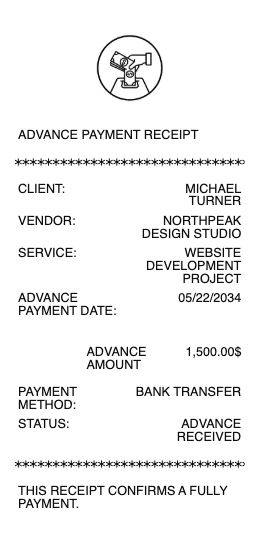
An advance payment receipt records money paid before the goods or services are delivered — a prepayment to start work, secure an order, or fund materials. Its defining question isn’t how much of a total was paid, but what happens between payment and delivery: what the money is toward, when delivery is due, and what gets refunded if it never happens. This page explains what an advance payment receipt should capture and why the terms on it matter.
Advance Payment Receipt
Add custom logo
Edit line items
Choose payment method
Add/remove elements
Customize business information
Choose font
What’s on an Advance Payment Receipt
The payer and the business, and the payment date
The amount paid in advance
What it’s toward — the specific goods, order, or work
The expected delivery or start date
The refund terms if delivery doesn’t happen or is cancelled
Whether it’s the full price or a first part, with any balance and when it’s due
A reference to the order, quote, or contract
Defined by Timing — Advance vs Partial vs Deposit
The three terms overlap, so it pays to be precise. An advance payment is defined by timing: it’s paid before delivery, whether it covers the full price or only part. A partial payment is defined by amount: a fraction of a known total, tracked by its remaining balance — it can happen before, during, or after delivery. A deposit sits in the overlap: a first part-payment made in advance to secure an order or date, often with its own refundability terms. Why businesses ask for advances is straightforward — a customer with money down is committed, and the funds cover materials and setup for custom work (a made-to-order sofa, a catering job, a fabrication run). The receipt’s job follows from the timing: since nothing has been delivered yet, it must pin down what the money is for and when delivery is due — the two things a plain “received $X” slip leaves dangerously vague.
For the Business: Unearned Revenue, Not Income Yet
On the business’s books, an advance payment has a special status: it’s unearned revenue — money received for something not yet delivered — and under accrual accounting it sits as a liability until the goods ship or the work is done, only then becoming earned revenue. (On cash-basis books, and often for tax, it’s generally counted when received — timing that differs by accounting method and is worth an accountant’s confirmation.) That’s not trivia; it’s why clean advance-payment receipts matter to a business: each one documents an obligation still owed to a customer, and the file of open advances is effectively a list of promises outstanding. When delivery completes, the final invoice or receipt shows the advance credited against the total, closing the loop. A business that can’t match its advances to deliveries has both an accounting problem and a customer-trust problem — the receipts are the record that keeps both straight.
For the Customer: Protection Before Delivery
Paying in advance means bearing risk between payment and delivery, and the receipt is the customer’s main protection. Before handing over an advance, get the essentials in writing on the receipt: exactly what is being bought, the delivery or completion date, and the refund terms if it’s late, cancelled, or never arrives. If the business fails to deliver, that receipt is the evidence for a demand, a small-claims case, or — if you paid by card — a chargeback for goods not received (card networks allow disputes for non-delivery, and the receipt showing what was promised and when anchors the claim). Reasonable caution applies too: large advances to unknown businesses are a known scam pattern, so match the advance to the trust — an established shop’s custom-order prepayment is normal; a stranger demanding full payment up front for future delivery deserves scrutiny. The receipt can’t remove the risk, but it converts a verbal promise into an enforceable record.
Related payment receipts: see also our Partial Payment receipt guide and our Proof Of Payment receipt guide.
Create an Advance Payment Receipt
Our generator produces a clean advance payment receipt — payer and business, amount, what it’s toward, expected delivery, refund terms, and any balance — as a PDF a business can issue at prepayment or a customer can keep as proof of what was promised.
Use it responsibly: recreate only real prepayments that actually happened, with true amounts and terms. Fabricating an advance payment receipt to claim money was paid (or received) when it wasn’t, invent an obligation, or support a false refund or chargeback claim is fraud — bank records and the business’s books show every genuine advance, and both are checkable. This tool is for legitimate record-keeping only.
Frequently asked questions
Everything you need to know about the product and billing.
What does an advance payment receipt show?
The payer and business, the payment date, the amount paid in advance, exactly what it’s toward (the goods, order, or work), the expected delivery or start date, the refund terms if delivery doesn’t happen, whether it’s the full price or a first part with a balance, and a reference to the order or contract.
What’s the difference between an advance payment and a partial payment?
An advance is defined by timing — paid before delivery, whether full or part of the price. A partial payment is defined by amount — a fraction of a known total tracked by its remaining balance, whenever it’s paid. A deposit sits in the overlap: a first part-payment made in advance to secure an order.
Why do businesses ask for advance payments?
A customer with money down is committed, and the funds cover materials and setup for custom or made-to-order work — a custom sofa, a catering job, a fabrication run. The receipt then pins down what the money is for and when delivery is due.
What is unearned revenue?
The accounting status of an advance on the business’s books: money received for something not yet delivered, held as a liability under accrual accounting until the goods ship or the work is done. Each advance receipt documents an obligation still owed to a customer.
What should I get in writing before paying in advance?
Exactly what you’re buying, the delivery or completion date, and the refund terms if it’s late or cancelled — all on the receipt. If the business fails to deliver, that record anchors a demand, a small-claims case, or a card chargeback for goods not received.
What happens to the advance when the order is delivered?
The final invoice or receipt shows the advance credited against the total, closing the loop — you pay only the remaining balance, and the paperwork ties the prepayment to the completed delivery. Keep both documents together as the full record of the purchase.