A partial payment receipt records paying part of a total owed — and its defining feature is a line no ordinary receipt has: the remaining balance. Whether it’s a layaway installment, a contractor draw, or half a wedding vendor’s fee, each partial payment needs its own receipt showing what was paid and what’s still due. This page explains what a partial payment receipt shows, why the balance line is the point, and where these receipts do their work.
Partial Payment Receipt
Add custom logo
Edit line items
Choose payment method
Add/remove elements
Customize business information
Choose font
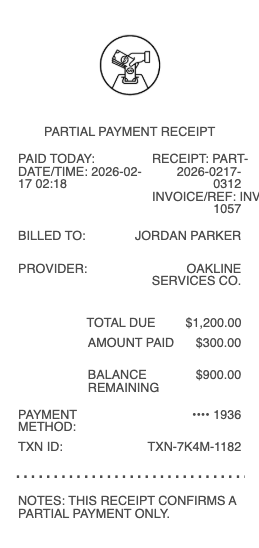
What’s on a Partial Payment Receipt
The payer and payee, and the payment date
The original total owed for the goods or service
The amount paid this payment
The remaining balance after this payment — the defining line
The payment’s place in the schedule — e.g. “payment 2 of 4,” or deposit / installment / final
The balance due date or next installment date
A reference tying it to the invoice, contract, or order
The Balance Line Is the Point
An ordinary receipt says a transaction is finished; a partial payment receipt says it isn’t — and that’s exactly its job. Each one must show three numbers together: the original total, the amount paid now, and the remaining balance, so both sides always agree on where things stand. A sequence of partial payments works like a running ledger: a deposit (the first partial payment, often securing the order or date), installments along the way, and a final payment that brings the balance to zero — and only that last receipt should say “paid in full.” Writing “paid in full” on anything earlier is asking for a dispute, because those words can be read as settling the whole debt. Numbering the payments (“3 of 5”) and dating the next due amount turns a pile of receipts into an unambiguous history — which is precisely what resolves a later disagreement about who still owes what.
Where Partial Payments Happen
Partial-payment receipts show up wherever big amounts get split. Layaway is the classic retail case: the store holds the item while you pay it off in installments, each with a receipt against the balance. Contractors and trades bill in draws tied to project stages, and each draw’s receipt tracks the contract total. Wedding and event vendors take a booking deposit and a pre-event balance. Tuition and medical payment plans split a large bill into scheduled parts. And in B2B, customers routinely part-pay invoices — a receipt for the partial amount, with the invoice number and remaining balance, keeps the accounts-receivable record straight. One caution worth knowing: accepting a check marked “payment in full” for less than a disputed balance can, in some circumstances, be treated as settling the entire debt — so businesses receipt partial payments explicitly as partial, with the balance stated, rather than leaving the words ambiguous.
Partial vs Advance vs Deposit — and Keeping Records
Three overlapping terms are worth separating. A partial payment is defined by amount: it’s a fraction of a known total, tracked by the remaining balance. An advance payment is defined by timing: money paid before goods or services are delivered (it may be the full amount or a part). A deposit is usually both — a first partial payment made in advance to secure something, sometimes non-refundable by agreement. The receipt should say which it is, because the terms differ: a deposit’s refundability, an installment’s schedule, a final payment’s “paid in full.” For records, keep every receipt in the sequence until the balance hits zero and you hold the final one — for the payer, that chain proves how much has been paid toward the total; for the business, it’s the ledger behind the customer’s account. The last receipt, marked paid in full, is the one that closes the file.
Related payment receipts: see also our Advance Payment receipt guide and our Loan Payment receipt guide.
Create a Partial Payment Receipt
Our generator produces a clean partial payment receipt — payer and payee, original total, amount paid, remaining balance, and the payment’s place in the schedule — as a PDF you can issue a customer or keep as proof of what you’ve paid toward a total.
Use it responsibly: recreate only real payments that actually happened, with true amounts and balances. Fabricating a partial payment receipt to misstate a balance, fake progress on a debt, or claim a payment that wasn’t made is fraud — the payee’s ledger and bank records are the authoritative source and can be verified. This tool is for legitimate record-keeping only.
Frequently asked questions
Everything you need to know about the product and billing.
What does a partial payment receipt show?
The payer and payee, the payment date, the original total owed, the amount paid this payment, the remaining balance (the defining line), the payment’s place in the schedule — deposit, installment number, or final — the balance due date, and a reference to the invoice or contract.
Why does a partial payment receipt show the remaining balance?
Because its job is to say the transaction isn’t finished. Showing the original total, the amount just paid, and the remaining balance together keeps both sides agreed on where things stand — a sequence of these receipts works like a running ledger until the balance reaches zero.
When should a receipt say "paid in full"?
Only on the final payment that brings the balance to zero. Writing it on an earlier partial payment invites a dispute, since those words can be read as settling the whole debt — receipts before the last one should say “partial payment” with the balance stated.
What’s the difference between a partial payment, an advance, and a deposit?
A partial payment is a fraction of a known total, tracked by the remaining balance. An advance payment is money paid before delivery, whatever the amount. A deposit is usually both — a first partial payment made in advance to secure something, sometimes non-refundable by agreement.
Where are partial payment receipts commonly used?
Layaway plans, contractor draws tied to project stages, wedding and event vendor deposits and balances, tuition and medical payment plans, and part-paid B2B invoices — anywhere a large total is split, each payment gets its own receipt against the balance.
Why number partial payments on the receipt?
Marking each as “payment 3 of 5” with the next due date turns the receipts into an unambiguous history of the whole schedule. If there’s ever a disagreement about who owes what, the numbered chain of receipts is what resolves it.