An airport transfer receipt documents a pre-booked ride between an airport and a hotel or address — arranged online in advance at a fixed, agreed price, not hailed on arrival. That upfront booking is the whole difference from a rank taxi, and it shapes the receipt: a confirmation voucher, a set fare with no meter, and often a driver holding a name board. This page covers what it shows and why business travelers prefer it.
Airport Transfer Receipt
Add custom logo
Edit line items
Choose payment method
Add/remove elements
Customize business information
Choose font
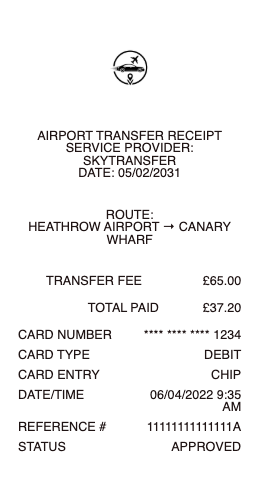
What’s on an Airport Transfer Receipt
Transfer company and the booking reference/voucher number
Route — airport to the named hotel or address, with the date and pickup time
Flight number, since transfers track the flight for arrival timing
Vehicle type — private sedan, minivan, or shared shuttle seat
The agreed fixed price — no meter, quoted and paid per the booking
Passenger count and any extras — child seats, meet-and-greet, extra luggage
Total, payment method, and whether prepaid or paid to the driver
Pre-Booked and Fixed-Price: How a Transfer Differs From a Taxi
The defining feature is that everything is settled before you land. You book online in advance, agree a fixed price for the exact route, and receive a confirmation voucher — so there is no meter, no surge, and no negotiation at the curb. Many services include flight tracking: the driver monitors your arrival and waits if the flight is delayed, without extra charge, and a meet-and-greet option puts a driver with a name board in the arrivals hall. Private transfers are typically priced per vehicle, not per person, so a group or family splits one fare — often cheaper than several taxis. The receipt reflects all of this: a named route, a set price, and a booking reference rather than a metered total.
Shared Shuttle vs. Private Transfer
Two models sit under “airport transfer,” and the receipt shows which you bought. A shared shuttle is priced per seat and stops for other passengers — cheapest, slower, and billed per person. A private transfer is a dedicated vehicle direct to your destination, priced per vehicle regardless of passenger count. Business travelers usually book private for the fixed price and the door-to-door certainty; the receipt’s vehicle type and per-vehicle-vs-per-person pricing is what distinguishes them on an expense claim. Either way, because the fare was agreed at booking, the receipt total should match the voucher exactly — a useful check that no surprise charge was added.
Business Travel, Expenses, and Getting a Copy
Airport transfers are a business-travel staple precisely because they are predictable and documented: a fixed price and an emailed receipt are exactly what an expense policy wants, with none of the metered-taxi variability that invites scrutiny. The itemized transfer receipt shows the route, the vehicle, and the set fare — submit that rather than a card-statement line. For a copy, the booking platform or transfer company keeps the reservation in your account and can resend the receipt or a VAT invoice, useful for international trips where tax reclaim applies. Keep the confirmation voucher and the final receipt together; for prepaid transfers they are often the same document, which is part of the appeal.
Related transport receipts: see also our airport parking receipt guide and our airport taxi receipt guide.
Create an Airport Transfer-Style Receipt
Our generator rebuilds a transfer receipt — company and booking reference, route and pickup time, vehicle type, the fixed fare, and total — as a clean PDF for an expense or records file when the original is gone.
Use it responsibly: recreate only transfers you actually booked, at their real agreed fares. Fabricating transfer receipts for reimbursement is expense fraud — the booking platform holds the genuine reservation and receipt, which is the correct document for any claim.
Frequently asked questions
Everything you need to know about the product and billing.
What is the difference between an airport transfer and an airport taxi?
A transfer is pre-booked online at a fixed, agreed price with a confirmation voucher, often with flight tracking and a name-board meet-and-greet. A taxi is hailed at the rank on arrival and metered. The transfer receipt shows a booking reference and set fare, not a metered total.
Is an airport transfer priced per person or per vehicle?
Private transfers are priced per vehicle, so a group or family splits one fare. Shared shuttles are priced per seat. The receipt’s vehicle type shows which you booked.
Does an airport transfer track my flight?
Many do — the driver monitors your arrival and waits if the flight is delayed, usually at no extra charge, which is a key reason business travelers pre-book rather than queue for a taxi.
Should the transfer receipt match the quoted price?
Yes — because the fare is agreed at booking, the receipt total should equal the voucher exactly, with no meter or surge. A mismatch is worth querying, since the price was fixed in advance.
How do I get a receipt for an airport transfer?
The booking platform or transfer company keeps the reservation in your account and can resend the receipt or a VAT invoice. For prepaid transfers the confirmation voucher and receipt are often the same document.
Why do business travelers prefer airport transfers?
Predictability — a fixed price and an emailed receipt are exactly what expense policies want, without the metered-taxi variability that invites scrutiny. The itemized receipt shows route, vehicle, and set fare.