An airport taxi receipt is the slip from a metered cab taken at the official rank on arrival — and it reads differently from an ordinary town taxi because airports layer on their own charges: a pickup surcharge, sometimes a flat-rate zone, and tolls on top of the meter. This page covers what it shows, the airport-specific fees, and why business travelers watch this receipt closely.
Airport Taxi Receipt
Add custom logo
Edit line items
Choose payment method
Add/remove elements
Customize business information
Choose font
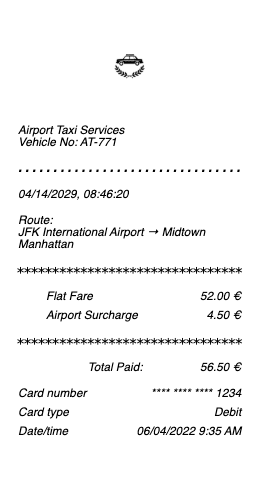
What’s on an Airport Taxi Receipt
Taxi company or the licensed operator, and often a medallion/vehicle number
Date, time, and pickup (the airport) and drop-off
Metered fare, or a flat rate where the airport sets one for a zone
Airport pickup surcharge/access fee — a common add-on for taxis leaving an airport
Tolls passed through to the passenger
Tip and the total, with payment method
Metered Fares, Flat Rates, and the Airport Surcharge
Unlike a pre-booked transfer with one agreed price, an airport taxi is usually metered — the fare climbs with distance and time — with three airport-specific twists. First, many airports charge a taxi pickup surcharge or access fee that appears as its own line. Second, some major airports set a flat rate for common routes (a fixed fare to the city center regardless of the meter), which caps the cost and is worth knowing before you ride. Third, tolls on the route are added to the fare. Reading these off the receipt tells you whether the total is legitimate — an airport taxi total is the meter or flat rate, plus the disclosed surcharge and tolls, plus your tip, and not much else.
Using the Official Rank and Getting a Receipt
Two practical points protect the traveler. Use the official, marked taxi rank and licensed cabs — airports post them, and unlicensed drivers who approach in the terminal are the classic overcharge and safety risk. And ask for the receipt at the end of the ride: metered taxis print or write one on request, showing the fare, surcharge, and tolls, and for a cash ride it is the only record you will get. If a driver is reluctant, the medallion or vehicle number is what a complaint or a lost-property claim references, so note it. Card payments leave a statement line too, but only the itemized receipt separates the surcharge and tolls from the fare.
Expenses, Overcharge Checks, and Records
Airport taxis get scrutiny on expense reports because metered fares vary and surcharges confuse approvers, so the itemized receipt showing fare, airport fee, tolls, and tip is what makes the claim clean — a bare card line invites questions. It is also your evidence if you were overcharged: comparing the receipt against the airport’s published flat rate or expected metered range is how a disputed fare gets resolved, and the operator or airport taxi authority handles complaints against the medallion number. For frequent routes, knowing the flat rate in advance and getting the receipt every time is the discipline that keeps airport ground transport from becoming the messiest line on a trip.
Related rideshare & taxi receipts: see also our taxi receipt guide and our airport transfer receipt guide.
Related rideshare and taxi receipts: see also our taxi receipt guide and our airport transfer receipt guide.
Create an Airport Taxi-Style Receipt
Our generator rebuilds a metered-taxi receipt — operator and vehicle number, airport pickup and drop-off, fare or flat rate, airport surcharge, tolls, tip, and total — as a clean PDF for an expense or records file when the printed slip is gone.
Use it responsibly: recreate only rides you actually took, at their real fares. Fabricating or inflating taxi receipts for reimbursement is expense fraud — an honest reconstructed receipt documents a real ride, and card records or the operator can confirm a genuine fare.
The cab receipt example walks through each part of a metered fare if you need to check a charge line by line.
Frequently asked questions
Everything you need to know about the product and billing.
Why is my airport taxi fare higher than a normal taxi?
Airports layer charges on the meter: a taxi pickup surcharge or access fee, tolls on the route, and sometimes a set flat rate. The itemized receipt separates these from the base fare so you can see what the total is made of.
What is an airport taxi flat rate?
A fixed fare some major airports set for common routes — for example to the city center — regardless of the meter. It caps the cost, and the receipt should show the flat rate rather than a metered total where one applies.
How do I get a receipt from an airport taxi?
Ask the driver at the end of the ride — metered taxis print or write one on request, showing the fare, surcharge, and tolls. For a cash ride it is the only record, so always request it.
How do I avoid being overcharged by an airport taxi?
Use the official marked rank and licensed cabs, know the published flat rate for your route if there is one, and get the itemized receipt. Note the medallion or vehicle number, which any complaint references.
What is the airport surcharge on my taxi receipt?
A pickup or access fee many airports charge for taxis leaving the airport, shown as its own line on top of the fare. It is a legitimate, disclosed charge distinct from the meter and tolls.
How is an airport taxi different from an airport transfer?
A taxi is hailed at the rank on arrival and metered, with airport surcharges and tolls added. A transfer is pre-booked at a fixed price with a voucher. This page covers the metered rank taxi; the transfer receipt is a separate document.