A bakery receipt covers two very different transactions: the quick over-the-counter buy — a loaf, a dozen bagels, a coffee and a pastry — and the custom order, where a wedding cake or a party platter is booked weeks ahead with a deposit. The receipt works differently for each, and the deposit side is where it matters most.
Bakery Receipt
Add custom logo
Edit line items
Choose payment method
Add/remove elements
Customize business information
Choose font
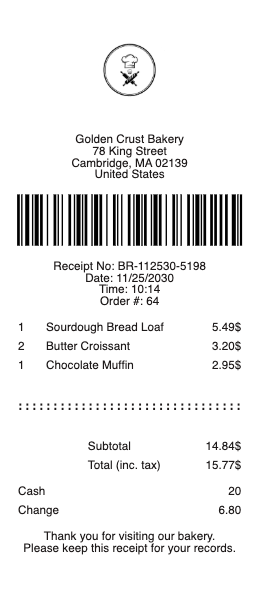
What’s on a Bakery Receipt
Bakery name and location, date, and transaction or order number
Each item — priced per item or per dozen, the way bakeries actually sell (bagels, rolls, cookies)
Custom-order details — cake flavor, size, inscription, pickup date — on special orders
Deposit paid and balance due, for orders booked ahead
Subtotal, tax, and total, with payment method
Pickup or delivery note and time for pre-orders
Custom Orders, Deposits, and Why the Receipt Is a Contract
The custom order is where a bakery receipt does real work. A celebration cake, a catering platter, or a holiday pre-order is typically booked with a deposit — often non-refundable, since the bakery commits ingredients and labor — and the receipt records that deposit, the balance due, the exact specification, and the pickup date. That makes it effectively a contract: it is the proof of what you ordered (flavor, size, inscription, dietary requirements) and what you already paid. Keep it, because disputes over custom orders — wrong date, wrong spelling, missed allergy note — are resolved against exactly what the receipt and order form say. Confirm the details on the receipt at the moment of ordering, not at pickup when it is too late to change.
The order sheet's fine print earns its keep on allergen lines: a custom order noting a nut allergy or gluten-free requirement makes the accommodation part of what was purchased, in writing. If the delivered product diverges from a documented dietary specification, the annotated order is what turns a serious complaint into a documented one.
Per-Dozen Pricing and Reading the Receipt
Bakery receipts read differently from most food slips because of unit pricing: rolls, bagels, cookies, and pastries are frequently sold by the dozen or half-dozen, and the receipt may show a per-dozen line rather than each piece. Mixed assortments can be totaled as a single dozen even when the items differ. That is worth checking when a total looks off — the quantity is usually counted in dozens, not units. For anyone buying in volume — offices, events, resellers — this unit structure is exactly why the itemized receipt matters: it shows the count and the per-unit price that a card statement’s single bakery line never will.
Expenses, Events, and Getting a Copy
Bakery purchases land on expense reports constantly — office breakfasts, client meetings, event catering — and the itemized receipt is the reimbursement document, with the custom-order receipt doubling as proof for a larger event spend. Allergen and dietary specifications noted on a custom order also live on the paperwork, which matters if a substitution is later questioned. For a lost receipt, a bakery that took a custom order keeps the order record and can reprint it; a quick counter purchase may exist only as the printed slip, so photograph it if it is going on an expense. For deposits especially, hold the receipt until the order is fulfilled and the balance is settled.
Related cafe receipts: see also our Cafe receipt guide and our Starbucks receipt guide.
Wedding cakes stretch the paper trail furthest: consultations and tastings sometimes bill separately (often credited against the order), delivery and setup carry their own line, and the balance typically falls due days before the event — a timeline of payments that only reads clearly if each receipt references the same order number from deposit to delivery.
Create a Bakery-Style Receipt
Our generator rebuilds a bakery receipt — shop header, itemized lines with per-item or per-dozen pricing, any custom-order deposit and balance, tax, and total — as a clean PDF for records when the original is gone.
Use it responsibly: recreate only real purchases and orders at their true amounts. Fabricating receipts for reimbursement, refunds, or deposit disputes is fraud — for a genuine custom order, the bakery’s own order record is the authoritative document.
Frequently asked questions
Everything you need to know about the product and billing.
What should a bakery receipt include?
The bakery and date, each item priced per item or per dozen, any custom-order details (flavor, size, inscription, pickup date), the deposit paid and balance due, tax, total, and payment method.
Are bakery deposits refundable?
Custom-order deposits are often non-refundable, because the bakery commits ingredients and labor ahead of time. The receipt records the deposit and terms, so confirm the policy when you order. Wedding orders often stage further — tasting fees credited to the order, delivery billed separately, balance due before the event — one order number across every receipt keeps the trail readable.
Why is my bakery receipt priced by the dozen?
Bakeries commonly sell rolls, bagels, cookies, and pastries by the dozen or half-dozen, so the receipt may show a per-dozen line rather than each piece. Check the quantity in dozens if a total looks off.
Is a custom cake order receipt a contract?
Effectively yes — it records the specification, deposit, balance, and pickup date, and disputes over a wrong date, spelling, or allergy note are resolved against what the receipt and order form say. Confirm the details at ordering. Dietary specifications too — an allergen note written on the order makes the accommodation part of what was bought, which matters if the delivered product diverges.
How do I get a copy of a bakery receipt?
A bakery that took a custom order keeps the order record and can reprint it. A quick counter purchase may exist only as the printed slip, so photograph it if it is going on an expense report.
Can I expense a bakery order?
Yes — the itemized receipt is the reimbursement document for office and event purchases, showing counts and per-unit pricing a card statement omits. Custom-order receipts also prove a larger event spend.